
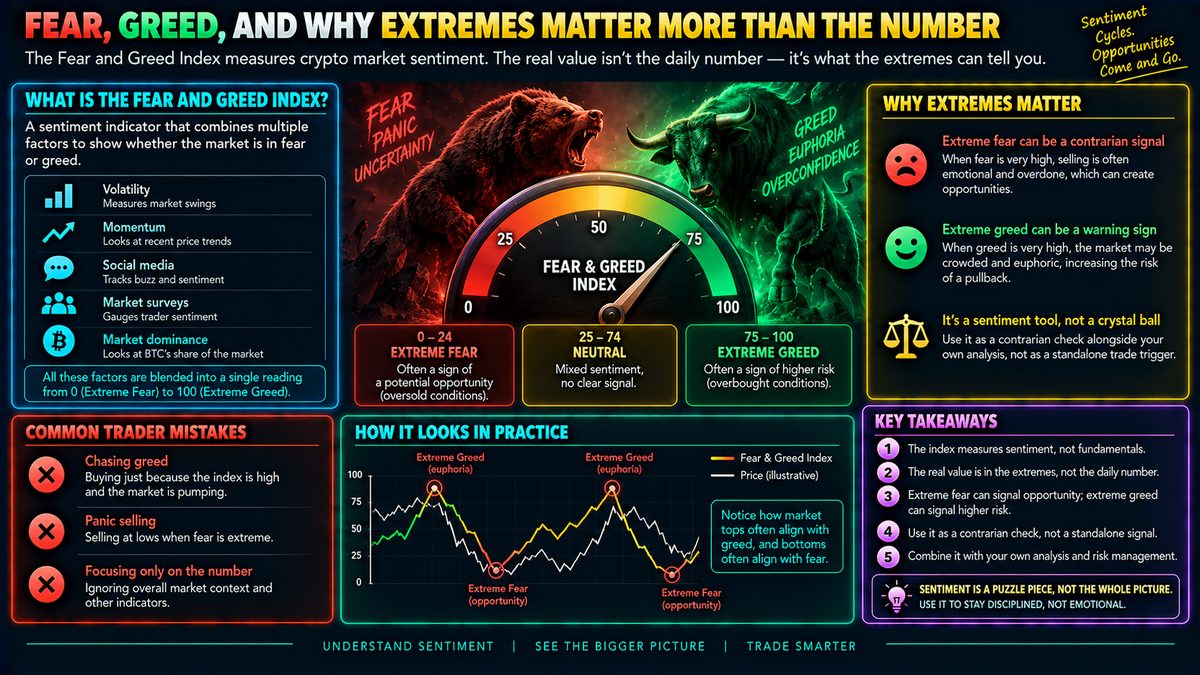
The Fear and Greed Index blends things like volatility, momentum, and social buzz into one sentiment reading. The real value isn't the daily number — it's the extremes. Extreme fear often means selling has gotten emotional and overdone, while extreme greed can signal a crowded, euphoric market. Used as a contrarian check against your own analysis, it helps you avoid buying into hype or panic-selling at lows — not as a standalone trade trigger.
What the Index Actually Measures
A Fear and Greed Index is a composite score, usually shown on a scale like 0 to 100, that tries to capture the overall mood of the market at a given moment. It typically blends several inputs, such as price volatility (how sharply prices are swinging), momentum (whether prices are accelerating up or down relative to recent averages), trading volume, social media chatter, and sometimes survey data or search trends. Each of these gets weighted and combined into a single daily reading, with low numbers labeled "fear" and high numbers labeled "greed."
It is worth understanding that this is a sentiment gauge, not a price forecast. It tells you how people seem to be feeling and behaving right now, not what will happen next. Different versions of these indexes use different formulas and inputs, so the exact number will vary depending on the source, which is another reason to treat it as a rough mood indicator rather than a precise measurement.
Why the Daily Number Is Mostly Noise
On any given day, the index might read 45 instead of 50, or 60 instead of 55, and traders often try to read deep meaning into these small shifts. In practice, this middle range is mostly noise. Markets drift between mild fear and mild greed constantly as part of normal price action, and reacting to every wobble is a good way to trade based on emotion rather than analysis.
The real information tends to show up at the edges of the scale. When a reading sits at an extreme for a sustained period, it suggests that a large share of market participants are feeling the same way at the same time, which is a very different situation from ordinary day-to-day fluctuation.
What Extremes Can Suggest
Extreme fear often coincides with periods where selling has become emotional rather than calculated. People may be exiting positions out of panic instead of a reasoned view on value, which can sometimes push prices below what fundamentals alone would justify. Extreme greed works the other way. It can reflect a crowded market where optimism has become widespread, momentum chasing is common, and euphoria rather than analysis is driving decisions.
Neither extreme guarantees a reversal. Markets can stay fearful or greedy for extended stretches, and a reading of extreme fear does not mean a low is in place, just as extreme greed does not mean a top is imminent. What these readings offer is context: a reminder that current price action may be driven more by crowd emotion than by careful reasoning.
Using It as a Contrarian Check
The most practical use of the index is as a check against your own behavior, not as a standalone signal to act on. If you find yourself wanting to buy aggressively during a reading of extreme greed, that is worth pausing on, since you may be following hype rather than your own analysis. Similarly, if you are considering selling everything during extreme fear, it is worth asking whether that decision is based on changed fundamentals or simply shared panic.
Used this way, the index functions as a mirror. It does not tell you what to do, but it can highlight when the crowd, and possibly you, are leaning heavily in one emotional direction.
Limitations and Fitting It Into a Broader Approach
The index has real limitations. It says nothing about a specific asset's fundamentals, it can be manipulated by short bursts of social activity, and its formula is opaque and varies by provider. It should never be used alone to time entries or exits.
Treat it as one input among several, alongside technical analysis, fundamental research, and a clear risk management plan that includes position sizing and predefined exit points. No sentiment reading, extreme or otherwise, removes the uncertainty inherent in trading, and none of this should be treated as a signal to buy or sell anything.