
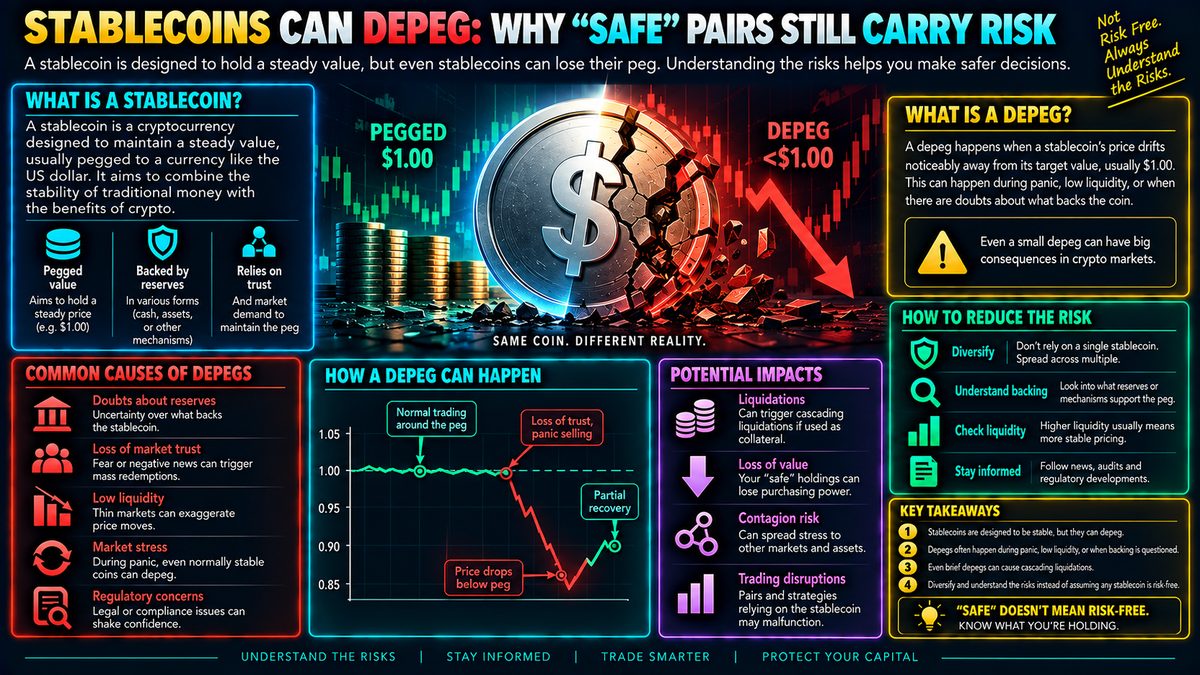
A stablecoin is designed to hold a steady value, usually pegged to a currency like the dollar, but that peg relies on reserves, trust, and market demand staying balanced. A depeg happens when the coin's price drifts noticeably away from its target, often during panic, low liquidity, or doubts about what backs it. Even brief depegs can trigger cascading liquidations if you're using that stablecoin as collateral or a "safe" parking spot. Diversifying which stablecoins you hold and understanding their backing can reduce this hidden risk.
What Backs a Peg
A stablecoin tries to keep its price fixed to something else, most often a national currency like the dollar. It does this in one of a few ways. Some are backed by reserves such as cash or short-term government debt held by the issuer, who promises to redeem coins for the real currency on request. Others are backed by other crypto assets locked up as collateral, often over-collateralized so that a price swing in the collateral does not immediately break the peg. A third type uses an algorithm or a linked token pair to expand and contract supply based on demand, with no hard asset reserve at all.
Each design has a different failure point. Reserve-backed coins can depeg if people doubt the reserves are real, sufficient, or accessible quickly enough. Crypto-collateralized coins can depeg if the collateral itself crashes faster than the system can react. Algorithmic designs can depeg if the mechanism that is supposed to restore balance gets overwhelmed by one-sided selling. Understanding which category a stablecoin falls into is the first step to understanding what could break it.
How a Depeg Actually Happens
A peg is really just a market price that everyone treats as reliable. As long as buyers and sellers trust that one unit of the stablecoin can be redeemed or traded for one unit of the target currency, the price tends to hold close to it. A depeg begins when that trust wavers, whether from a rumor, a delayed redemption, a exchange freezing withdrawals, or simply a wave of panic selling during a broader market crash.
Because stablecoins are often used as the "cash" side of trading pairs, a wobble can spread fast. If holders rush to exit at once, low liquidity, meaning there are not enough buyers to absorb the selling, can push the price down further than the underlying backing would justify. This can create a feedback loop, hypothetically a coin meant to sit at one dollar might trade at ninety-five cents for a period, even if it later recovers, because sentiment moved faster than redemptions could.
Why This Matters Even If You Never Sell
Many traders use stablecoins as collateral for loans, margin positions, or as the quote currency in a trading pair, treating them as a neutral base. If that base coin depegs even briefly, positions valued against it can be affected instantly. A margin position collateralized in a depegging stablecoin may face liquidation, meaning it gets forcibly closed, even if the trader's actual view on the market was fine. A stablecoin is not risk-free just because it looks flat on a chart.
Common Mistakes and Limits
A frequent mistake is assuming all stablecoins carry the same risk simply because they share the word "stable." Their backing, transparency, and redemption processes can differ enormously. Another mistake is concentrating large holdings in a single stablecoin for convenience, which maximizes exposure if that one issuer runs into trouble. It is also easy to underestimate how a depeg in one corner of the market can spill into others through shared liquidity pools or lending platforms.
No stablecoin is guaranteed to hold its peg forever, and past stability does not prove future stability.
Fitting This Into Risk Management
Reasonable steps include spreading holdings across different stablecoin types and issuers, checking what reserves or mechanisms back a coin before relying on it heavily, and treating stablecoin collateral in leveraged positions with the same caution as any other volatile asset. Watching liquidity and redemption conditions during periods of market stress can also help you notice early warning signs rather than being surprised by them.