
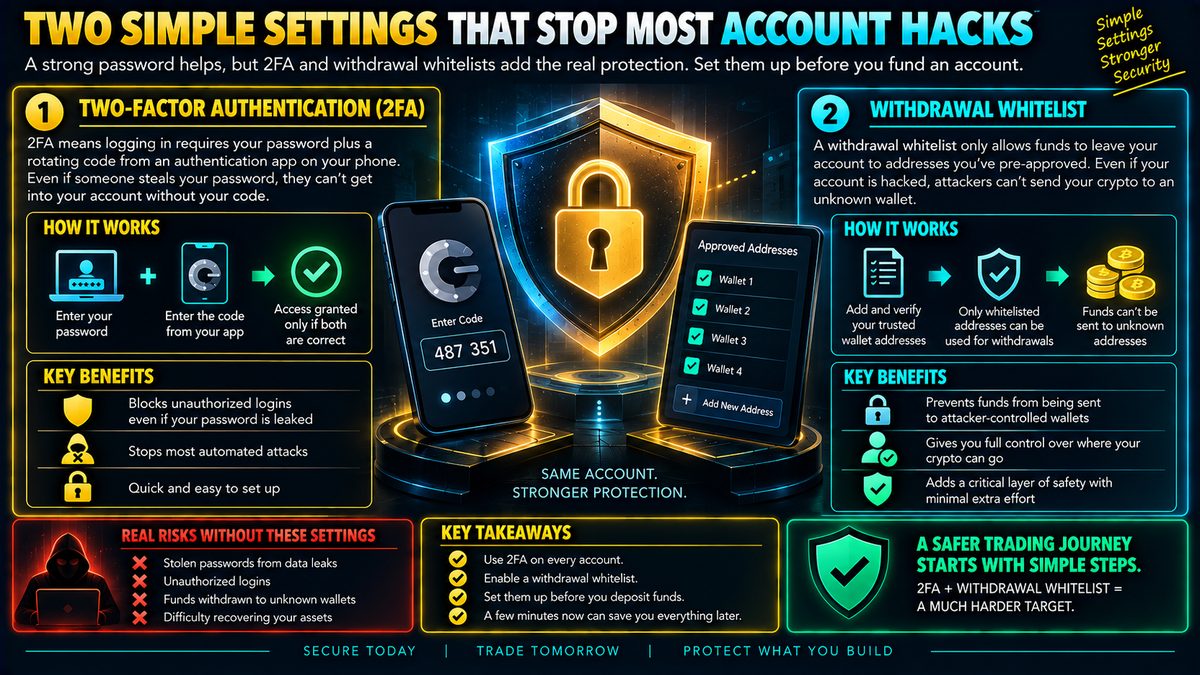
2FA (two-factor authentication) means logging in requires your password plus a rotating code from an app on your phone, so a stolen password alone can't get someone into your account. A withdrawal whitelist takes it further by only allowing funds to leave to addresses you've pre-approved, so even a hacked account can't send your crypto to an unknown wallet. Together they add friction for attackers without adding much friction for you. Set both up before you fund an account, not after something goes wrong.
Why Passwords Alone Are Not Enough
A password is a single piece of information. If it exists, it can be copied, guessed, phished, or leaked from some other website you used the same password on. Once that one secret is exposed, anyone who has it can log in exactly as you would, and there is nothing distinguishing the real you from the attacker. Crypto accounts are attractive targets precisely because a successful login can lead directly to moving funds, so relying on a password by itself leaves a single point of failure that a lot of effort goes into attacking.
How 2FA Changes the Equation
Two-factor authentication adds a second, different kind of proof: something you have, in addition to something you know. Typically this is a rotating numeric code generated by an authenticator app on your phone, refreshed every thirty seconds or so, or a physical security key you plug in or tap. Even if a password leaks, the attacker also needs this second code at the exact moment they try to log in, which they normally cannot get without physical access to your device.
Not all 2FA is equally strong. Codes sent by text message are better than nothing but are vulnerable to a trick called SIM swapping, where an attacker convinces a phone carrier to move your number to their device. An authenticator app or a hardware security key avoids that specific weakness and is generally considered a stronger choice. The friction for you is small, a few seconds at login, but the friction for an attacker is much larger, because they now need two separate things instead of one.
What a Withdrawal Whitelist Adds
A withdrawal whitelist is a setting that restricts outgoing transfers to a list of wallet addresses you have specifically pre-approved, often after a waiting period designed to stop an attacker from adding their own address and immediately draining funds. This matters because 2FA protects the login, but it does not automatically protect what happens after someone is logged in. If an account were ever compromised despite 2FA, a whitelist means the attacker still cannot send coins anywhere except addresses you already approved, which are presumably ones you control.
Think of it like a bank that lets you view your balance with a password, but requires a separate, pre-registered account number before it will wire money anywhere new. The viewing is easy, but moving value out to an unfamiliar destination is deliberately made harder.
Setting Both Up Before You Fund an Account
These protections work best when configured before any meaningful amount of crypto is in an account, not after a scare. Enabling 2FA and a whitelist retroactively still helps going forward, but it does nothing to undo a breach that already happened. Because both settings take only a few minutes to configure, treating them as a first step, before depositing funds, avoids the common mistake of postponing security "until later."
Limitations and the Bigger Picture
Neither setting is a guarantee. If someone gains full control of the device running your authenticator app, or convinces you through a scam to approve a fraudulent transaction yourself, these protections can be bypassed. They also do nothing to protect the security of the wallet addresses on your whitelist itself, which need their own careful handling. 2FA and withdrawal whitelists are best treated as part of a broader habit of caution, alongside unique passwords, skepticism toward unexpected messages asking you to log in or approve something, and only ever storing what you are comfortable losing in any single account.