
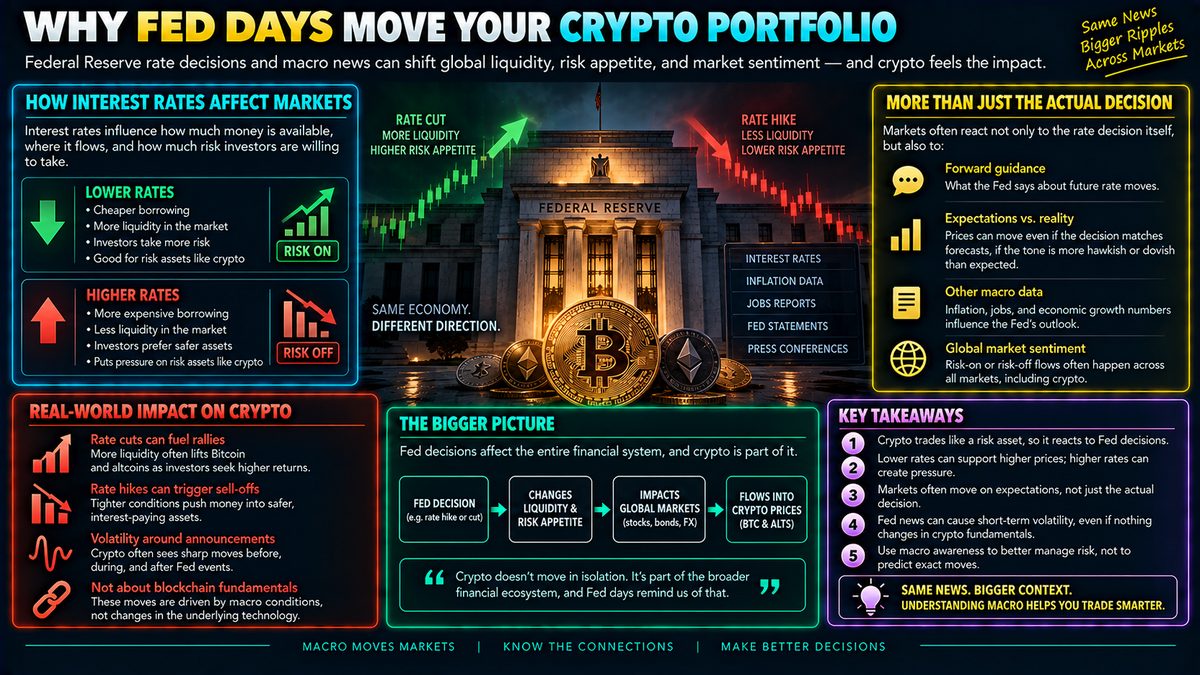
Crypto trades like a risk asset, so when the Fed raises or cuts interest rates, it changes how much money is chasing returns. Lower rates make cheap borrowing easier, pushing investors toward riskier bets like crypto; higher rates pull money back into safer, interest-paying assets. Even the expectation of a rate move can shift prices before anything official happens, since markets price in probabilities in advance. That's why crypto often swings on Fed announcements even though nothing about blockchain fundamentals changed that day.
What the Fed Actually Does
The Federal Reserve, often just called "the Fed," is the central bank of the United States. One of its main jobs is setting a target for short-term interest rates, which influences how expensive it is to borrow money throughout the economy. When the Fed raises rates, loans, mortgages, and credit become more costly. When it cuts rates, borrowing gets cheaper and saving in low-risk places pays less. These decisions are announced at scheduled meetings, commonly referred to as "Fed days" by traders, and they ripple far beyond traditional banking into stocks, bonds, and yes, crypto.
Why Crypto Reacts Like a Risk Asset
Crypto is generally treated by markets as a risk asset, meaning its price tends to move with investor appetite for speculative or growth-oriented bets rather than with safety-seeking behavior. When interest rates are low, safer options like savings accounts or government bonds offer little return, so some investors look elsewhere for yield, and riskier assets including crypto can become more attractive. When rates rise, those safer options start paying more, giving investors an incentive to pull money out of speculative positions and into lower-risk, interest-bearing alternatives. This isn't unique to crypto; it's a pattern seen across many growth-sensitive assets, but crypto's volatility often makes the swings more visible.
Markets Move on Expectations, Not Just Announcements
A key thing beginners often miss is that prices don't wait for the official announcement to move. Financial markets are forward-looking, meaning traders constantly try to guess what the Fed will do based on economic data, public statements, and historical patterns. If most participants expect a rate cut, that expectation may already be reflected in prices well before the actual meeting. This is sometimes described as the news being "priced in." So when the announcement finally comes, the market's reaction often depends less on what the Fed did and more on whether it matched, beat, or fell short of what people were already expecting.
How Traders Commonly Watch This Event
Because of this dynamic, many traders mark Fed meeting dates on their calendars and treat them as periods of potential heightened volatility, meaning prices may swing more sharply than usual in either direction. Some choose to reduce position sizes or avoid opening new trades right before an announcement, simply because outcomes are hard to predict and slippage, which is the difference between an expected trade price and the actual executed price, can increase. Others watch how quickly and how far prices move immediately after the news, using that reaction as one input among many, rather than a standalone signal.
Common Mistakes and Limitations
A common mistake is assuming that a rate decision has a fixed, predictable effect on crypto prices every single time. In reality, the reaction depends on prior expectations, broader economic conditions, and what else is happening in markets simultaneously. Another mistake is treating a single Fed day as a reliable trading signal on its own, without considering risk management, meaning the practice of limiting how much of a portfolio is exposed to any one event or trade. No macroeconomic event, including a Fed decision, guarantees a specific price outcome, and past reactions do not reliably predict future ones.
Fitting This Into a Broader Approach
Understanding Fed days is useful context, not a trading strategy by itself. It works best alongside other tools such as technical analysis, which studies price charts and patterns, and fundamental research into the specific crypto projects someone holds. Combining macroeconomic awareness with sound risk management, like position sizing and having a clear plan before volatility hits, tends to be more sustainable than reacting emotionally to headlines. Ultimately, Fed days are a reminder that crypto doesn't exist in isolation; it's connected to the same broader financial currents that move every other market.