
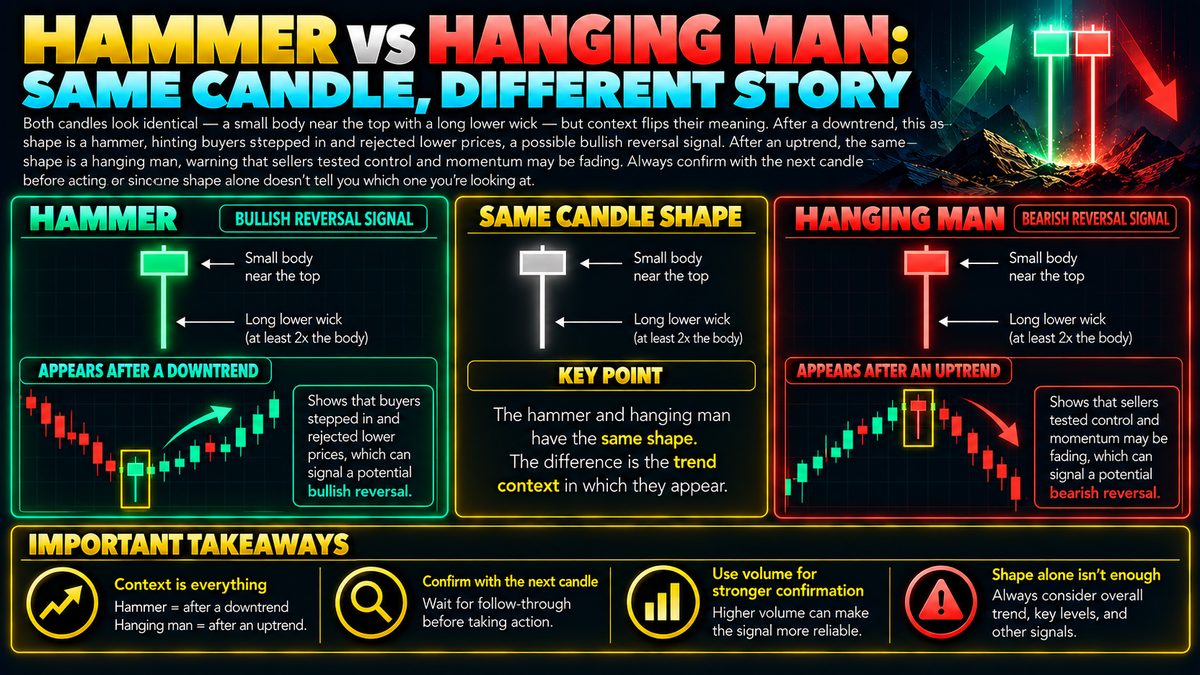
Both candles look identical — a small body near the top with a long lower wick — but context flips their meaning. After a downtrend, this shape is a hammer, hinting buyers stepped in and rejected lower prices, a possible bullish reversal signal. After an uptrend, the same shape is a hanging man, warning that sellers tested control and momentum may be fading. Always confirm with the next candle or volume before acting, since shape alone doesn't tell you which one you're looking at.
What The Candle Shape Actually Shows
A candlestick summarizes four prices for a chosen time period: the open, the close, the high, and the low. The rectangular part, called the body, spans the open and close. The thin lines above and below, called wicks or shadows, show the highest and lowest prices reached during that period.
The shape in question has a small body sitting near the top of the candle's range, with little or no upper wick and a lower wick that is at least twice the length of the body. This tells you that price fell noticeably during the period, then recovered most or all of that drop before the period ended. In other words, sellers pushed price down, but buyers stepped back in before the close.
Why Context Changes The Meaning
The exact same shape can be called a hammer or a hanging man, and the only difference is where it appears. If it forms after a sustained downtrend, it is a hammer, because the long lower wick suggests that selling pressure was tested and rejected near the bottom of a move, hinting that buyers may be regaining control.
If the identical shape forms after a sustained uptrend, it is a hanging man. Here the long lower wick suggests that sellers were able to push price down significantly during the period, even though buyers clamped it back up by the close. That is read as an early warning sign that demand may be weakening, since sellers proved they could take control temporarily, something that had not been happening during the uptrend.
How Traders Commonly Use It
Traders generally treat both shapes as potential reversal signals rather than confirmed ones. A hammer is often watched for a follow up candle that closes higher, which is seen as supporting the idea that buyers are stepping in. A hanging man is often watched for a follow up candle that closes lower, which is seen as supporting the idea that sellers are gaining ground.
Volume is frequently used alongside the shape. Higher than usual volume during the candle or on the following candle is sometimes viewed as adding weight to the signal, since it suggests more participants were involved in the price rejection, though this is interpretive rather than a guaranteed rule.
Common Mistakes And Limitations
A frequent mistake is spotting the shape without first confirming there was an actual preceding trend. If price was moving sideways rather than clearly up or down, the label of hammer or hanging man becomes questionable, since the entire meaning depends on the prior direction of price.
Another mistake is acting on the shape immediately, before the next candle closes. Since the pattern is considered unconfirmed until subsequent price action supports it, treating it as a signal on its own can lead to premature conclusions. It is also worth remembering that these shapes appear often, and many will not be followed by the reversal traders expect. No candlestick pattern works in isolation with any consistency, and past appearances of a shape say nothing certain about what will happen next.
Fitting It Into A Broader Approach
Because a single candle carries limited information, many traders combine this pattern with other tools such as support and resistance levels, trend lines, or momentum indicators, to see whether multiple signals line up rather than relying on shape alone. This does not increase certainty, but it can provide additional context.
Risk management remains separate from pattern recognition entirely. Position sizing, predefined exit points, and awareness that any trade can move against expectations are relevant regardless of which candlestick pattern is observed. Recognizing a hammer or hanging man is only ever one small piece of information within a much larger and uncertain picture.