
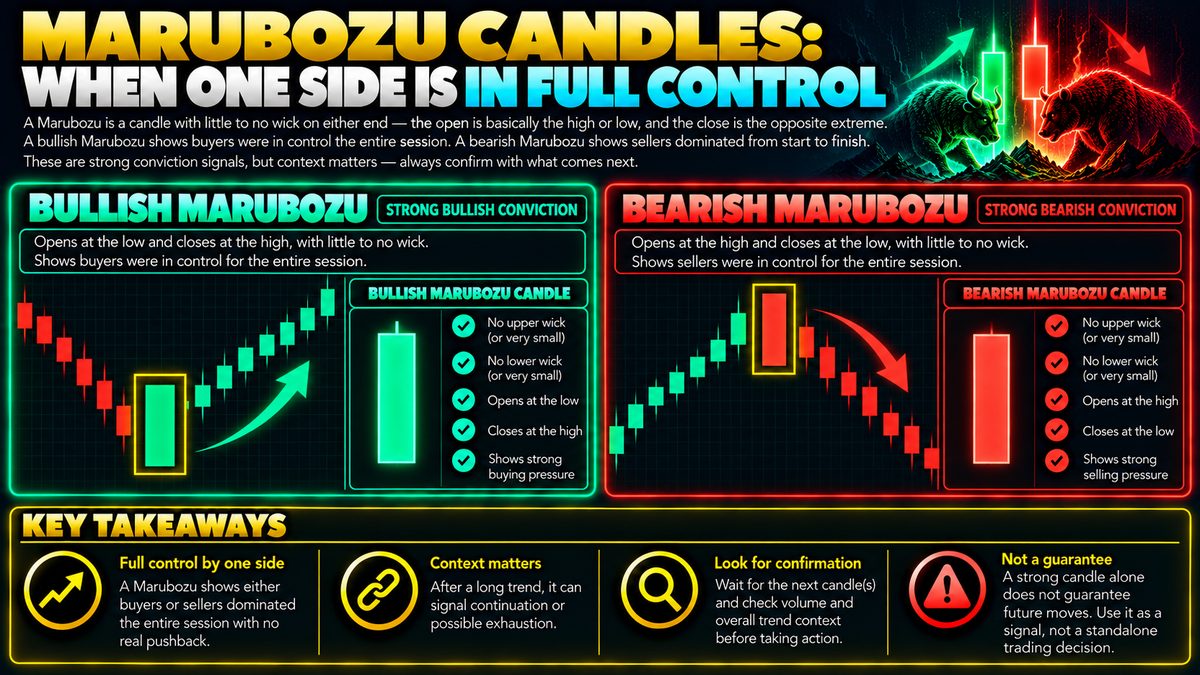
A Marubozu is a candle with little to no wick on either end — the open is basically the high or low, and the close is the opposite extreme. A bullish Marubozu opens at the low and closes at the high, showing buyers were in control the entire session with no real pushback. A bearish Marubozu does the reverse, showing sellers dominated start to finish. Traders read these as strong conviction signals, but context matters — one candle after a long trend can mean continuation or exhaustion, so always confirm with what comes next rather than trading the candle alone.
What a Marubozu Actually Looks Like
A candlestick normally has a body, which shows the range between the opening and closing price, and wicks (also called shadows), which show the highest and lowest prices reached during that time period. A Marubozu is unusual because it has little or no wick at all. The word comes from a Japanese term roughly meaning "bald" or "shaven," which fits the visual: a clean rectangle with almost nothing sticking out of either end.
In a bullish Marubozu, the candle opens at or very near the low of the session and closes at or very near the high, with the body colored to show a rise (commonly green or white, depending on the charting style). In a bearish Marubozu, the opposite happens: the candle opens at or near the high and closes at or near the low, usually shown in red or black. Because there is barely any wick, the candle tells a simple story about that time period, whether it is a one minute chart or a weekly chart.
How It Forms
A Marubozu forms when one side of the market, buyers or sellers, is in control from the opening bell of that candle to the closing bell, with almost no meaningful pushback from the other side. If buyers step in immediately and keep pressing price higher without any real dip, and that pressure holds all the way to the close, the result is a bullish Marubozu. If sellers dominate the same way, pressing price down steadily with no bounce that sticks, a bearish Marubozu appears.
This is different from a candle with long wicks, which shows a tug of war where price moved a lot in one direction and then got pushed back. A Marubozu shows a much more one sided session, at least on the timeframe you are looking at.
How Traders Commonly Interpret It
Traders often treat a Marubozu as a sign of strong conviction. A bullish Marubozu appearing after a period of sideways or falling prices is sometimes read as a signal that buyers have taken firm control, and a bearish Marubozu after a rally is sometimes read the opposite way. Some traders also watch for Marubozu candles that form near key support or resistance levels, areas where price has previously reversed, since a strong one directional candle there can suggest more weight behind a potential move.
Because the pattern is so visually simple, it is popular among beginners, but simplicity is not the same as reliability.
Common Mistakes and Limitations
The biggest mistake is treating a single Marubozu as a standalone trading signal. One candle, no matter how clean looking, does not tell you what happens next. A bullish Marubozu at the end of a long uptrend can just as easily mark exhaustion, where the last buyers are rushing in right before the move stalls, as it can mark the start of a fresh continuation.
Marubozu candles are also more common, and often less meaningful, on very short timeframes or in illiquid markets, where a lack of wicks may reflect thin trading rather than genuine conviction. Relying on candle shape alone, without checking volume, trend context, or what forms in the following sessions, is a common trap.
Fitting It Into a Broader Approach
Most experienced traders treat a Marubozu as one input among several rather than a trigger on its own. Looking at whether the candle appears alongside above average volume, near a meaningful support or resistance zone, or in agreement with a broader trend can add useful context. Waiting for the next candle or two to confirm the direction, rather than acting immediately, is a common way traders try to reduce false signals.
As with any pattern or indicator, a Marubozu offers no guarantee about future price movement. Sound position sizing, predefined risk limits, and a willingness to be wrong are what protect a trader when the pattern does not play out as expected.