
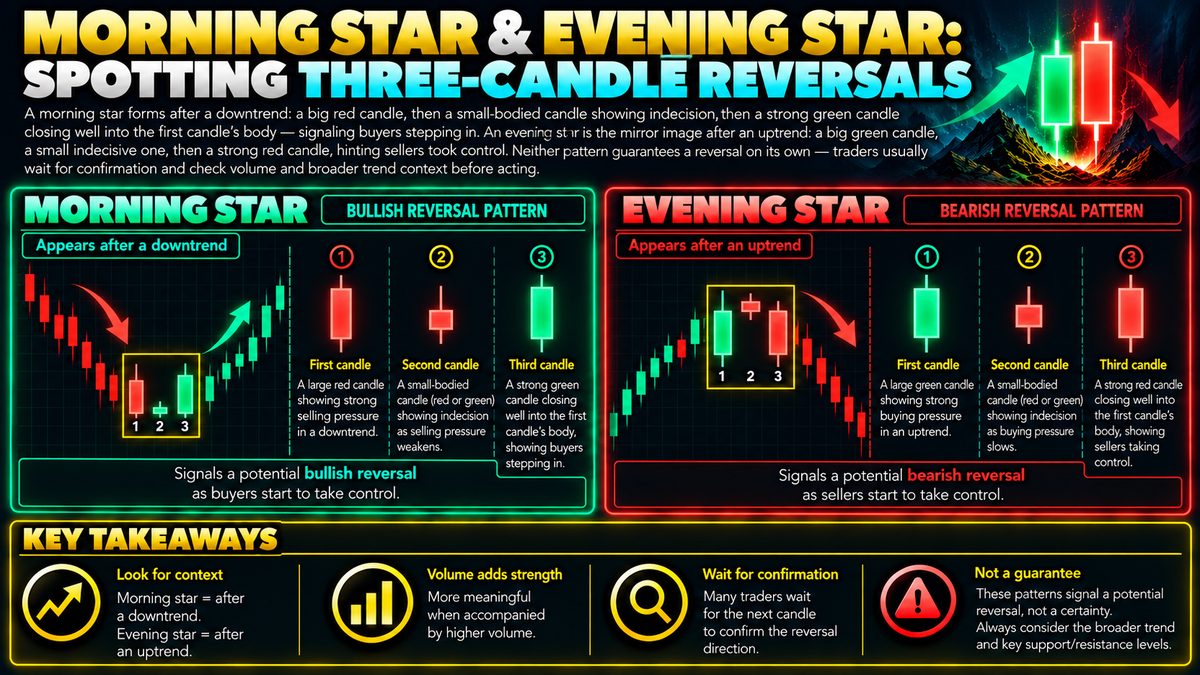
A morning star forms after a downtrend: a big red candle, then a small-bodied candle showing indecision, then a strong green candle closing well into the first candle's body — signaling buyers stepping in. An evening star is the mirror image after an uptrend: a big green candle, a small indecisive one, then a strong red candle, hinting sellers took control. Neither pattern guarantees a reversal on its own — traders usually wait for confirmation and check volume and broader trend context before acting.
What These Patterns Look Like
A morning star is a three-candle formation that appears after a decline in price. The first candle is large and red, showing that sellers were firmly in control. The second candle has a small body, sitting apart from the first, and can be red or green; it reflects a moment of hesitation where neither buyers nor sellers have a clear edge. The third candle is a strong green candle that pushes back into the body of the first candle, suggesting buyers have reasserted themselves.
An evening star is the mirror image, appearing after a rise in price. It starts with a large green candle, followed by a small-bodied candle showing indecision, then a strong red candle that closes well into the first candle's body. This sequence hints that sellers have taken over from buyers.
Why the Pattern Forms
These patterns are read as a story about shifting sentiment over three sessions. In a morning star, the first candle confirms the existing downtrend, the middle candle shows the selling pressure stalling as fewer people are willing to sell at lower prices, and the third candle shows new buying interest overwhelming the remaining sellers. The evening star tells the opposite story: strong buying, then hesitation as buyers run out of conviction, then sellers stepping back in with force.
The small middle candle is the key visual clue. Its tiny body means the session opened and closed near the same level, a sign that the tug-of-war between buyers and sellers was roughly balanced, unlike the decisive candles on either side.
How Traders Commonly Use Them
Traders often look for these patterns near areas that already have some technical significance, such as a prior support or resistance zone, a trendline, or a round psychological level. A morning star appearing in isolation carries less weight than one forming after a sustained downtrend at a level where buyers have shown interest before.
Volume is frequently used as a secondary check. Higher volume on the third candle, the one confirming the reversal, is generally seen as adding credibility, since it suggests broader participation rather than a move driven by a handful of trades. Some traders also wait for a fourth candle to close in the direction of the implied reversal before treating the pattern as confirmed, rather than acting the moment the third candle forms.
Common Mistakes and Limitations
A frequent error is spotting the pattern in hindsight and assuming it was obvious in real time, when in fact the third candle is still forming and its final shape is unknown until the session closes. Another mistake is treating the pattern as a guarantee rather than a probability tilt; price can just as easily continue in the original direction afterward.
These patterns also lose meaning in choppy, low-volume, or sideways markets, where small-bodied candles are common and don't necessarily reflect the same tug-of-war dynamic. Relying on the pattern alone, without considering the broader trend or nearby support and resistance, tends to produce more false signals.
Fitting Into a Broader Approach
Morning and evening stars are best treated as one input among several, not a standalone signal. Traders often combine them with trend indicators, momentum readings, or key price levels to build a fuller picture before drawing conclusions. Risk management remains essential regardless of how convincing a pattern looks, since no chart formation removes the underlying uncertainty of markets. Position sizing and predefined exit points are commonly used to limit the damage if the expected reversal fails to materialize.