
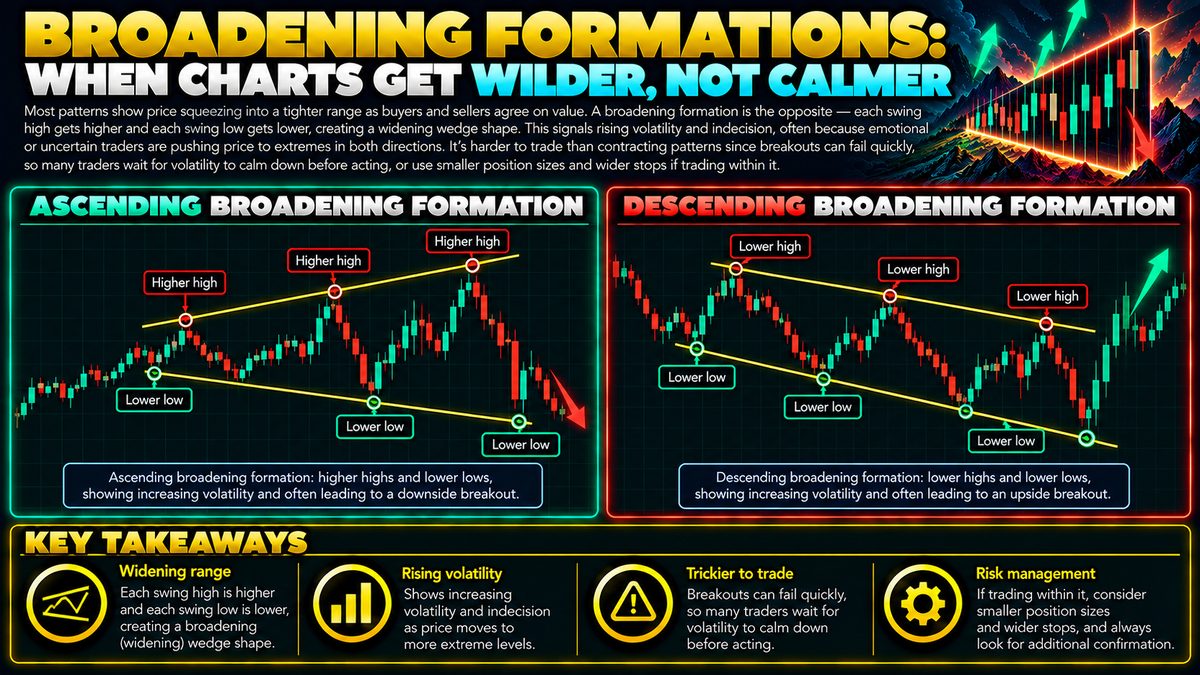
Most patterns show price squeezing into a tighter range as buyers and sellers agree on value. A broadening formation is the opposite — each swing high gets higher and each swing low gets lower, creating a widening wedge shape. This signals rising volatility and indecision, often because emotional or uncertain traders are pushing price to extremes in both directions. It's harder to trade than contracting patterns since breakouts can fail quickly, so many traders wait for volatility to calm down before acting, or use smaller position sizes and wider stops if trading within it.
What A Broadening Formation Actually Looks Like
Picture a chart where price makes a high, pulls back to a low, then pushes to an even higher high, then falls to an even lower low. Connect the highs and connect the lows, and instead of two lines converging into a point like most triangles, you get two lines spreading apart like a megaphone or a funnel turned outward. That widening shape is the broadening formation, sometimes called an expanding wedge or a megaphone pattern.
This is unusual because most chart patterns traders learn about, like symmetrical triangles or flags, show a market compressing. Buyers and sellers are narrowing their disagreement about what an asset is worth, and price coils tighter until it eventually breaks one way. A broadening formation is the mirror image of that idea. Disagreement is growing, not shrinking, and each new swing overshoots the last one in both directions.
How This Shape Tends To Form
Broadening formations usually show up when a market has a mix of participants with very different views and very different reactions. Some traders are chasing price higher out of excitement, others are dumping it lower out of fear, and neither side is willing to back down. Low liquidity, meaning fewer buyers and sellers actively trading at any given moment, can make this worse, since it takes less volume to push price sharply in either direction. News events, uncertainty about a coin's future, or a market where big and small traders are reacting very differently can all contribute to this kind of expanding, unstable price action.
How Traders Read The Pattern
Traders generally treat a broadening formation as a warning sign of rising volatility and indecision rather than a clean signal to enter a trade. Because the highs and lows keep expanding, there is no obvious point of agreement the way there is with a converging pattern, where a breakout out of the tip often gets more attention. Some traders watch for the pattern to start narrowing again, taking that as a sign the emotional extremes are fading and a more tradeable range may be forming.
Others try to trade the edges, buying near the lower boundary and selling near the upper one, but this is considered risky since the boundaries themselves keep moving outward and can be broken abruptly.
Common Mistakes And Limitations
A frequent mistake is treating a broadening formation like a normal support and resistance range, only to get caught when the next swing blows through the old boundary because the pattern is designed to expand, not hold firm. Another mistake is assuming a breakout in either direction will continue, when in reality broadening formations are known for fakeouts, where price breaks out and then reverses hard. No pattern, including this one, guarantees what happens next, and treating it as a reliable signal on its own can lead to poor timing.
Fitting It Into A Broader Trading Approach
Because of this unpredictability, many traders choose to wait on the sidelines until the swings start contracting again, preferring calmer conditions before committing capital. Others who do trade within the pattern often reduce position size, meaning they risk less money per trade, and use wider stop-loss orders to account for the extra noise. Combining this pattern with other tools such as volume analysis or broader trend context, and always applying sound risk management, matters more here than with most other chart formations, given how easily price can swing against expectations.