
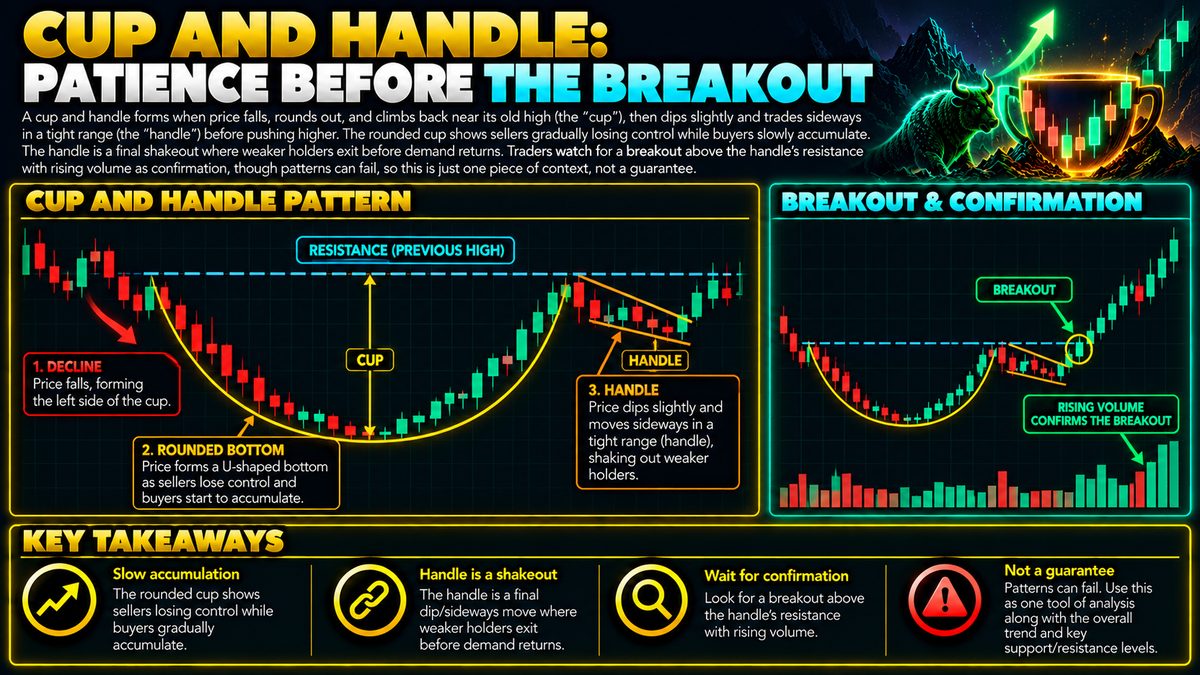
A cup and handle forms when price falls, rounds out, and climbs back near its old high (the "cup"), then dips slightly and trades sideways in a tight range (the "handle") before pushing higher. The rounded cup shows sellers gradually losing control while buyers slowly accumulate. The handle is a final shakeout where weaker holders exit before demand returns. Traders watch for a breakout above the handle's resistance with rising volume as confirmation, though patterns can fail, so this is just one piece of context, not a guarantee.
What the Pattern Looks Like
A cup and handle is a shape that sometimes appears on a price chart over weeks or months. Picture a coin trading at 100 that gradually slides down to 70, then slowly climbs back up to around 100 again. That decline and recovery, when drawn out, looks like a rounded bowl rather than a sharp V. This rounded section is the "cup." After price returns near its old high, it often can't push through right away. Instead it dips slightly, maybe to 90, and trades in a narrow range for a while. That smaller sideways move is the "handle." Only after that consolidation does price sometimes break above the old high, which is what traders call the breakout.
Why It Forms
The rounded bottom of the cup is meant to reflect a gradual shift in sentiment. As price falls, sellers are in control, but as it flattens out near the bottom, selling pressure fades because the people who wanted to exit have mostly already sold. Buyers then start accumulating slowly, which is why the recovery side of the cup is often gentler than a sharp V-shaped bounce. The handle represents a final round of hesitation. Once price nears its old high, some traders who bought lower take profits, and others who are unsure whether resistance will hold decide to sell too. This creates a short pause or pullback. If demand is genuinely strong, buyers absorb that selling fairly quickly, price tightens up, and the stage is set for a potential move higher.
How Traders Read It
Traders who watch for this pattern usually pay attention to two things: the shape of the handle and the volume, meaning the amount of trading activity, that accompanies any move above resistance. A tight, shallow handle is often seen as a sign that sellers are running out of steam. A breakout on rising volume is treated as more meaningful than one on quiet trading, since higher participation suggests broader agreement behind the move rather than a random price flicker. Some traders also look at how long the cup took to form, on the idea that a slower, more rounded base reflects a more thorough shift in supply and demand than a quick, choppy one.
Common Mistakes and Limitations
The most common mistake is seeing the pattern everywhere. Because the definition is somewhat loose, a lot of random price wiggles can be forced into looking like a cup and handle after the fact, especially with hindsight. Another mistake is assuming a breakout guarantees continued upward movement. Price can push above the handle's resistance and then reverse, sometimes called a false breakout, leaving traders who entered late with an immediate loss. It's also worth remembering this pattern has no formal proof of reliability; it is a piece of chart-reading tradition, not a law of markets, and crypto markets in particular can be driven by news, liquidity, and sentiment shifts that have nothing to do with chart shapes.
Using It Alongside Other Tools
Because no pattern works in isolation, many traders combine a cup and handle observation with other context, such as overall market trend, volume trends, or broader news affecting the asset. Some also use predefined risk management rules, like deciding in advance how much of their capital they're willing to risk, rather than reacting emotionally if a breakout fails. Treating the pattern as one input among several, rather than a standalone signal, is generally considered more realistic than expecting it to reliably predict what happens next. Ultimately, it's a way to organize observations about price behavior, not a guarantee of future results.