
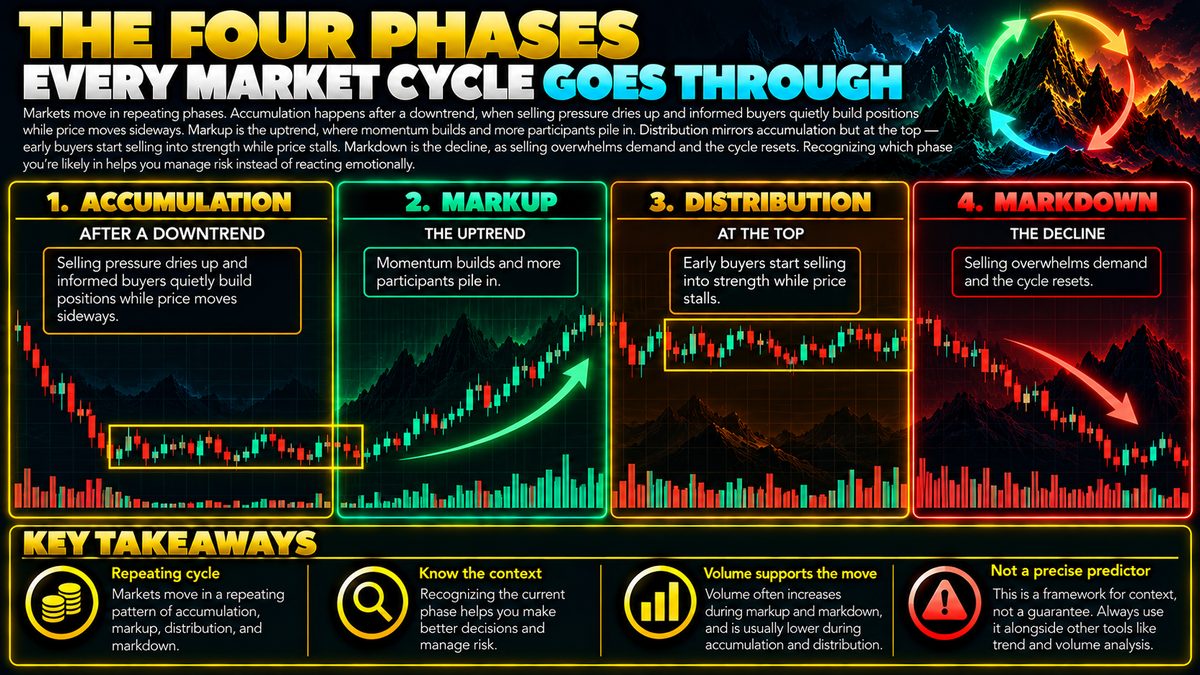
Markets move in repeating phases. Accumulation happens after a downtrend, when selling pressure dries up and informed buyers quietly build positions while price moves sideways. Markup is the uptrend, where momentum builds and more participants pile in. Distribution mirrors accumulation but at the top — early buyers start selling into strength while price stalls. Markdown is the decline, as selling overwhelms demand and the cycle resets. Recognizing which phase you're likely in helps you manage risk instead of reacting emotionally.
Accumulation: The Quiet Base
After a prolonged downtrend, selling pressure eventually starts to dry up. Sellers who wanted out have already sold, and the price stops making new lows. Instead of falling or rising sharply, it tends to move sideways in a range, often for a long stretch of time. This is the accumulation phase.
During accumulation, trading volume (the amount of an asset changing hands) is often lower and choppier, and sentiment among retail traders is usually pessimistic or bored, since nothing exciting seems to be happening. Some traders believe informed or patient buyers use this quiet period to build positions gradually without pushing the price up too fast. This is a theory about market behavior, not a rule, and there is no way to know for certain who is buying or why.
Markup: The Trend Everyone Notices
Markup is the uptrend phase, where price begins making higher highs and higher lows in a more sustained way. As the move develops, it tends to attract attention. More participants notice the price action, media coverage often increases, and momentum can feed on itself as new buyers enter.
This phase is usually the most emotionally seductive, because gains can look easy in hindsight once you are inside it. That is also what makes it risky to chase, since by the time a trend is obvious to everyone, a meaningful part of the move may have already happened. Momentum can also reverse abruptly, and there is no indicator that reliably tells you in advance how long a markup phase will last.
Distribution: The Mirror Image at the Top
Distribution looks similar to accumulation, but it happens after a sustained uptrend rather than a downtrend. Price stalls, makes repeated attempts to push higher, and starts to struggle. Under the surface, some early buyers who entered during accumulation or early markup may begin selling into strength, gradually offloading their positions to newer, often less experienced buyers who arrived during the excitement of markup.
Distribution can be difficult to distinguish from a temporary pause within an ongoing uptrend. Both can look like sideways consolidation. This is one of the main reasons phase identification is more art than science, and traders who assume distribution is happening too early can miss further upside, while those who assume markup is continuing too long can be caught by a reversal.
Markdown: The Decline and Reset
Markdown is the downtrend phase, where selling pressure overwhelms demand and price makes lower highs and lower lows. Sentiment during markdown often shifts from denial to frustration to eventual capitulation, where remaining holders give up and sell. Ironically, this capitulation can be part of what eventually creates the conditions for the next accumulation phase, as selling pressure exhausts itself.
Markdown phases can be sharp and fast or slow and grinding, and there is no fixed duration or depth that applies to every cycle. Assuming a markdown will behave like a previous one is a common source of poorly timed decisions.
Using the Framework Without Overusing It
The four-phase idea is a mental model, not a precise timing tool. In real markets, phases do not have clean labels attached to them in real time, and it is only in hindsight that transitions become obvious. Traders who treat phase identification as certain rather than probabilistic often anchor to a story about where they think price is in the cycle and ignore evidence that contradicts it.
A more balanced approach is to use this framework alongside other tools, such as trend and volume analysis, and to always combine it with basic risk management, including position sizing and predefined risk limits. No pattern, cycle model, or indicator can guarantee what happens next, and treating this framework as a forecasting tool rather than a way to organize thinking is one of the more common mistakes traders make.