
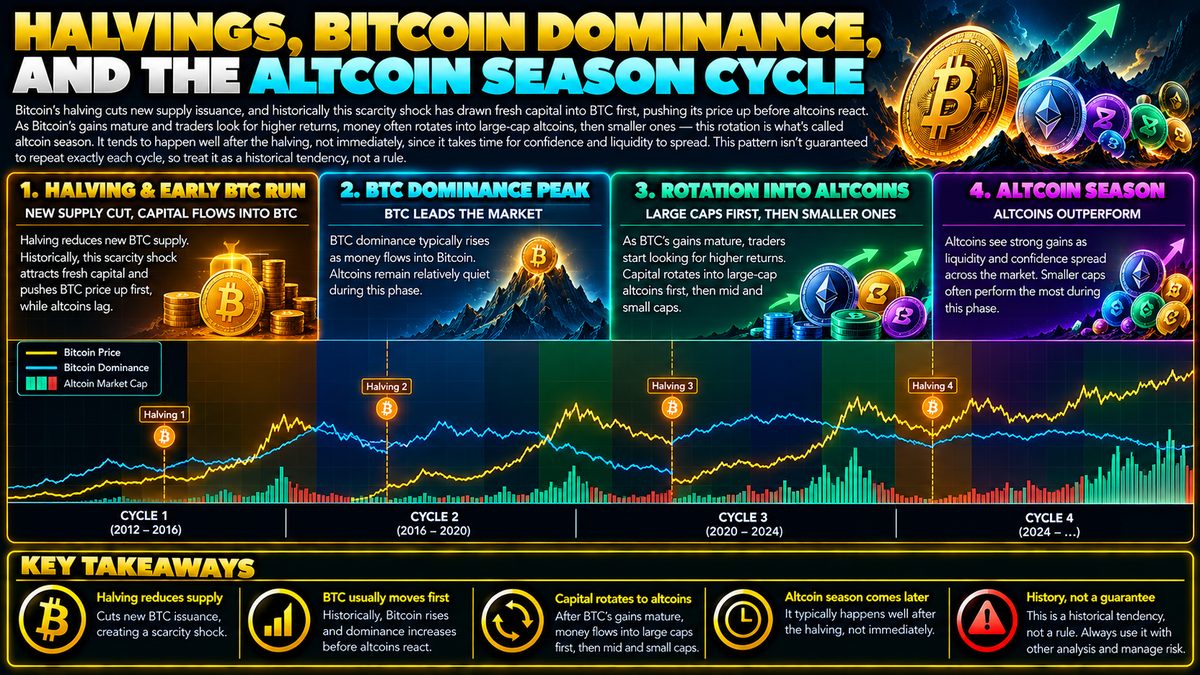
Bitcoin's halving cuts new supply issuance, and historically this scarcity shock has drawn fresh capital into BTC first, pushing its price up before altcoins react. As Bitcoin's gains mature and traders look for higher returns, money often rotates into large-cap altcoins, then smaller ones — this rotation is what's called altcoin season. It tends to happen well after the halving, not immediately, since it takes time for confidence and liquidity to spread. This pattern isn't guaranteed to repeat exactly each cycle, so treat it as a historical tendency, not a rule.
What a Halving Actually Does
Bitcoin's issuance schedule is coded into its software. Roughly every four years, the reward paid to miners for confirming new blocks is cut in half. This event is called a halving. It does not change how many bitcoins already exist, and it does not directly affect demand. What it changes is the rate at which new coins enter circulation. In simple terms, if the same number of buyers want bitcoin but fewer new coins are being created each day, that reduced flow of new supply can matter over time, assuming demand holds steady or grows. That is the scarcity argument behind halvings, and it is a theory about supply mechanics, not a promise about price.
Bitcoin Dominance as a Gauge
Bitcoin dominance is a simple ratio: Bitcoin's total market value divided by the total market value of all cryptocurrencies combined. When dominance rises, it suggests capital is concentrated in Bitcoin relative to everything else. When dominance falls, it suggests money is spreading into other coins, often called altcoins. Traders watch this ratio as a rough proxy for market mood, not as a precise signal. A rising or falling percentage tells you about relative flows, but it says nothing about whether the total market is growing or shrinking in absolute terms.
How the Rotation Story Usually Goes
The commonly described pattern looks like this. After a halving, attention and new money tend to flow into Bitcoin first, since it is the most recognized and liquid asset in the space. As Bitcoin's price movement matures and its upside starts to feel more limited to some traders, appetite for risk often shifts toward large-cap altcoins, which are established coins with substantial market value. If that trend continues, capital can then move further out into smaller, more speculative coins. This broadening of gains across the altcoin market is what people mean by altcoin season. It is described as a rotation because the same pool of capital is thought to move between assets rather than simply expanding everywhere at once.
Why Timing Is Never Precise
One reason this cycle is hard to trade is that the lag between a halving and any altcoin rotation has varied a great deal historically, and there is no fixed countdown clock. Confidence, liquidity, and attention spread through a market gradually and unevenly, influenced by countless factors unrelated to the halving itself, including broader economic conditions, regulation, and shifts in sentiment. Treating the pattern as a guaranteed schedule ignores how much variation has existed between past cycles, and there is no assurance that a future cycle will follow the same shape at all.
Common Mistakes and Limitations
A frequent mistake is assuming altcoin season is a switch that flips on a specific date, leading traders to chase coins after most of a move has already happened. Another is ignoring that dominance and rotation narratives are backward-looking descriptions of past behavior, not forward-looking guarantees. Smaller altcoins also tend to carry much higher volatility and lower liquidity, meaning price swings can be sharper in both directions.
Fitting This Into a Broader Approach
These concepts are best used as context alongside other analysis, not as standalone signals. Combining them with an understanding of overall market conditions, individual project fundamentals, and clear risk management, such as position sizing and predefined risk limits, matters more than trying to time a rotation exactly. No historical pattern, including this one, removes the uncertainty inherent in cryptocurrency markets.