
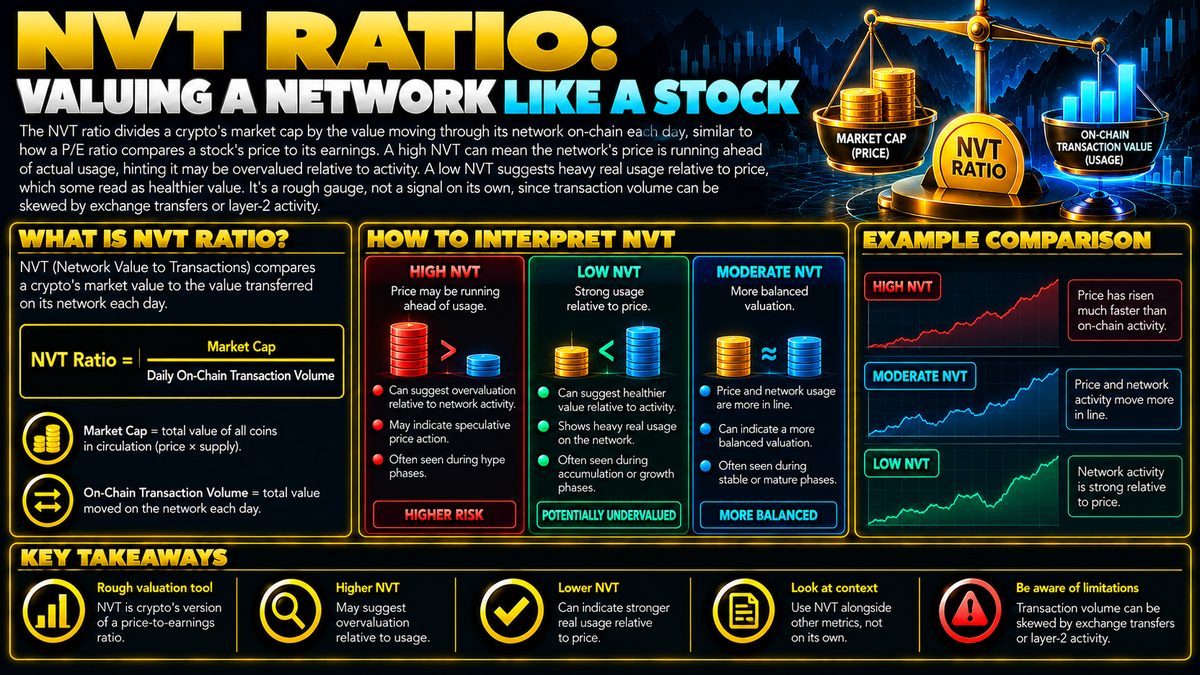
The NVT ratio divides a crypto's market cap by the value moving through its network on-chain each day, similar to how a P/E ratio compares a stock's price to its earnings. A high NVT can mean the network's price is running ahead of actual usage, hinting it may be overvalued relative to activity. A low NVT suggests heavy real usage relative to price, which some read as healthier value. It's a rough gauge, not a signal on its own, since transaction volume can be skewed by exchange transfers or layer-2 activity.
What NVT Actually Measures
The Network Value to Transactions ratio, or NVT, is an attempt to answer a simple question: is a crypto asset's price justified by how much real economic activity is happening on its network? To calculate it, you take the network value, which is just another name for market capitalization, the current price multiplied by the circulating supply, and divide it by the daily value of coins moved on-chain, meaning the total dollar value of transactions recorded on the blockchain itself in a given day.
The idea borrows directly from the price-to-earnings, or P/E, ratio used in stock analysis. A company's P/E compares its share price to the profit it actually generates. NVT does something similar for a blockchain, comparing its market price to the transactional "work" the network is doing. If a stock trades at a high price but earns very little, investors often call it expensive relative to fundamentals. NVT applies that same logic to on-chain usage instead of earnings.
How to Read High and Low Readings
When NVT is high, it means the market cap has grown much larger than the value moving through the network. In theory, this can suggest the price is being driven more by speculation, expectation, or hype than by actual use of the network for payments, settlement, or other on-chain activity. Some traders treat persistently high NVT as a caution flag that valuation has outrun utility.
When NVT is low, the network is moving a lot of value relative to its market cap, which some interpret as a sign of a network that is being genuinely used, and possibly undervalued relative to that usage. This is the same logic as a low P/E stock sometimes being called a "value" opportunity, though in both cases low can also simply mean the market has good reason to be skeptical of that asset's prospects.
Why the Number Gets Noisy
On-chain transaction volume is not a clean proxy for economic usage. A single large holder moving coins between two wallets they control, an exchange shuffling funds internally, or a layer-2 network settling many transactions in one batch on the base chain can all distort the daily transaction figure without reflecting any change in genuine demand. This means NVT can spike or drop for reasons that have nothing to do with sentiment or valuation.
Different chains also have very different transaction patterns by design, so comparing NVT across two unrelated assets is often misleading. A ratio that looks high for one network might be entirely normal for how that particular chain is used.
Using NVT Alongside Other Tools
Because of this noise, most people treat NVT as a slow-moving, trend-based gauge rather than a precise valuation number. Some analysts smooth it out using a moving average of transaction volume over several weeks, which reduces the impact of single-day distortions and makes longer-term shifts easier to see.
NVT works best when paired with other measures, such as active address counts, fee revenue, developer activity, or simple price trend and volume analysis, rather than being read in isolation. A rising NVT alongside falling active users tells a different story than a rising NVT during a period of genuine adoption growth.
Limitations and Risk Management
NVT is a rough, backward-looking gauge, not a predictive signal, and it carries no guarantee about future price direction. It cannot account for off-chain activity, changing network designs, or shifts in how people use a given blockchain over time. Anyone using it should size positions carefully, avoid relying on any single metric, and treat conclusions drawn from NVT as one input among many rather than a standalone basis for decisions.