
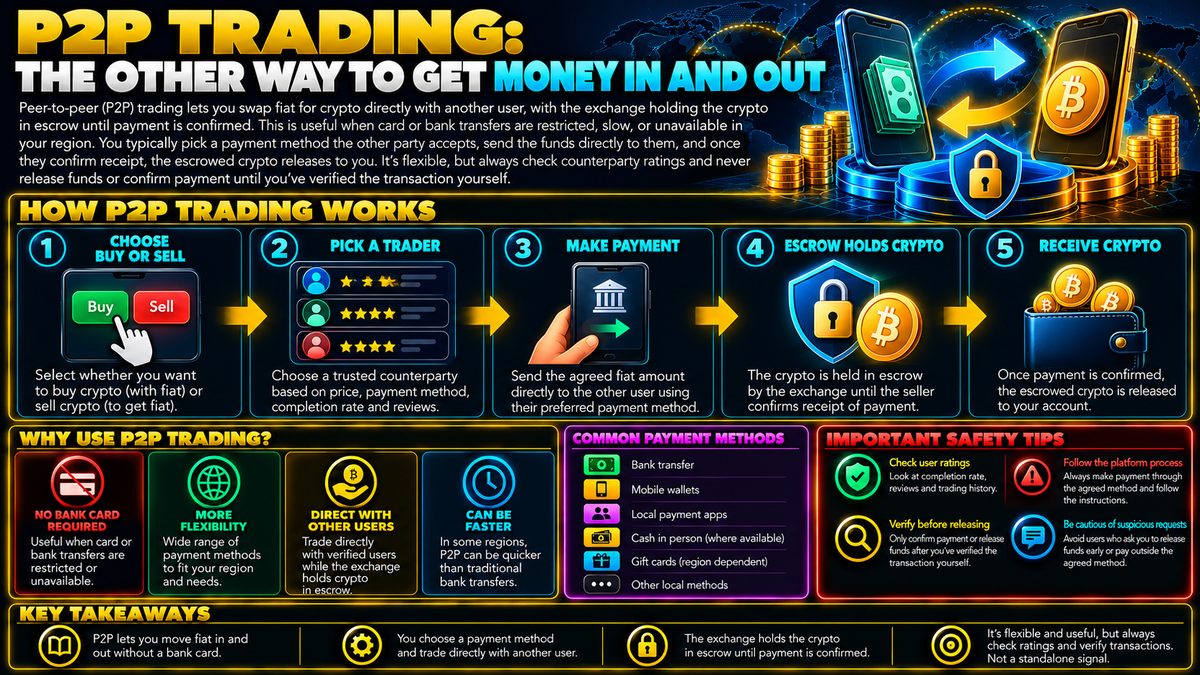
Peer-to-peer (P2P) trading lets you swap fiat for crypto directly with another user, with the exchange holding the crypto in escrow until payment is confirmed. This is useful when card or bank transfers are restricted, slow, or unavailable in your region. You typically pick a payment method the other party accepts, send the funds directly to them, and once they confirm receipt, the escrowed crypto releases to you. It's flexible, but always check counterparty ratings and never release funds or confirm payment until you've verified the transaction yourself.
What P2P Trading Actually Is
Peer-to-peer, or P2P, trading is a way to exchange regular government-issued money (called fiat currency, like dollars or euros) for cryptocurrency directly with another person, rather than buying it straight from an exchange's own order book. Instead of the platform selling you crypto itself, it connects you with another user who wants to do the opposite trade, and the platform acts as a neutral middleman for the crypto side of things.
This matters because in many regions, direct bank transfers or card purchases for crypto can be slow, restricted, or simply unavailable. P2P offers an alternative route in and out of crypto using local payment methods that everyday people already use, such as bank transfers, mobile wallets, or other common transfer apps.
How Escrow Makes It Work
The key mechanic that makes P2P trading reasonably safe is escrow. When a seller lists an offer, the platform locks their crypto in a secure holding account. The buyer then sends fiat payment directly to the seller through an agreed method, outside the platform itself. Once the seller confirms they have received the money, the platform releases the escrowed crypto to the buyer.
This structure means the platform never actually needs to touch your bank account, and the seller cannot simply take your payment and vanish, because they won't receive their crypto until they click confirm. However, escrow protects the crypto side of the trade, not the fiat side, so the fiat payment itself still relies on trust and verification between the two people involved.
The Typical Trade Flow
A P2P trade generally starts with browsing offers and picking one that matches your preferred payment method, amount, and rate. You open a trade, which locks the seller's crypto in escrow, then you send the fiat payment using the exact method and details specified. After sending payment, you mark the trade as paid within the platform.
The seller then checks their own bank or payment app to confirm the money has truly arrived before releasing the crypto. This waiting period is normal and exists precisely so the seller can verify funds rather than trusting a screenshot or a claim. Communication through the platform's chat, rather than external messaging, also creates a record if a dispute needs to be resolved later.
Reading Counterparty Signals
Because you are transacting with another individual rather than an automated system, reputation matters. Most P2P systems show a trader's completion rate, number of past trades, and account age. A long history of completed trades with few cancellations is generally a more reassuring signal than a brand-new account, though it is still not a guarantee of good faith on any single trade.
Response time and clear communication during the trade itself are also useful signals. None of these indicators eliminate risk entirely, and no rating system can fully substitute for your own caution.
Common Mistakes and Limits
The most common and costly mistake is releasing crypto or confirming payment before actually verifying funds have landed in the correct account, not just seeing a notification or screenshot, which can be faked. Another mistake is agreeing to move the conversation or payment outside the platform's official channels, which removes any dispute protection.
It is also worth remembering that P2P trading does not remove counterparty risk entirely, it just structures it. Fees, exchange rates offered by individual sellers, and payment method restrictions can vary trade to trade. As with any part of crypto trading, treat P2P as one tool among several, size trades sensibly, and never treat a smooth past experience as a guarantee that every future trade will go the same way.