
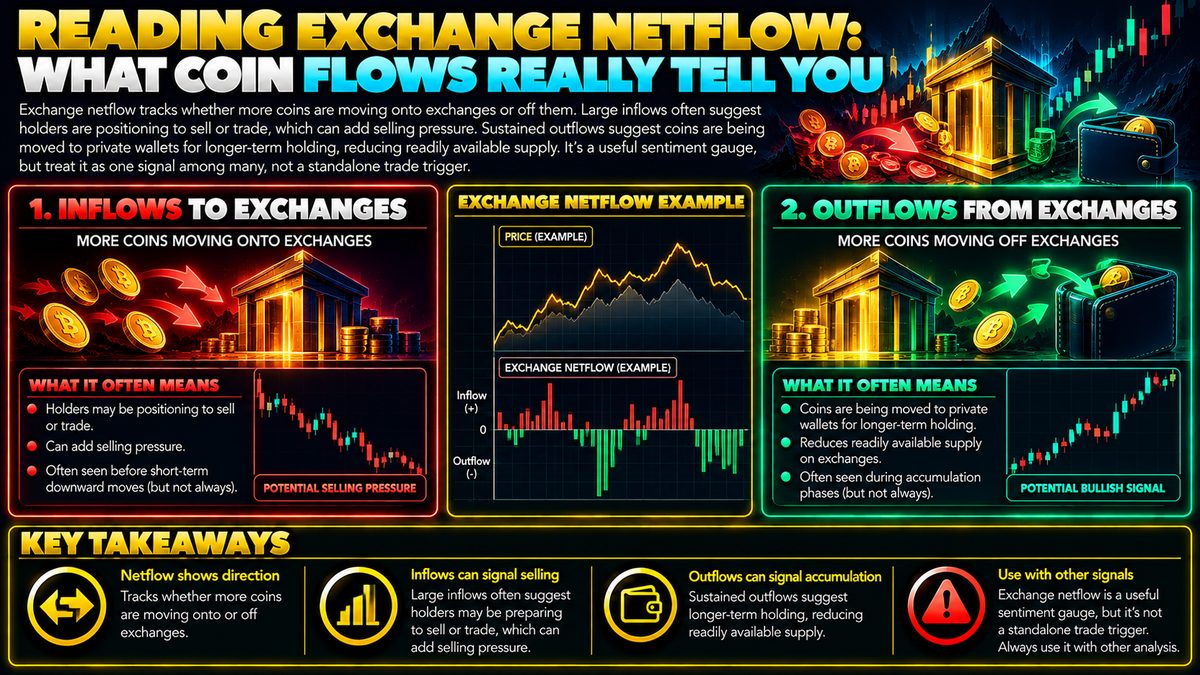
Exchange netflow tracks whether more coins are moving onto exchanges or off them. Large inflows often suggest holders are positioning to sell or trade, which can add selling pressure. Sustained outflows suggest coins are being moved to private wallets for longer-term holding, reducing readily available supply. It's a useful sentiment gauge, but treat it as one signal among many, not a standalone trade trigger.
What Exchange Netflow Actually Measures
Exchange netflow is a way of tracking the movement of coins into and out of exchange wallets. An exchange, for readers new to the term, is a platform where people buy, sell, and trade crypto. When someone deposits coins onto an exchange, that coin is now sitting in a wallet controlled by the exchange rather than the user's own private wallet. Netflow simply adds up all the deposits and subtracts all the withdrawals over a given period, usually a day, to see which direction is winning.
If more coins are flowing in than out, that period shows positive netflow, or an inflow. If more coins are leaving exchanges than arriving, that is negative netflow, or an outflow. On its own this is just a number, but many traders treat the direction and size of that number as a rough proxy for what large holders might be planning to do next.
Why Inflows and Outflows Are Interpreted the Way They Are
The reasoning behind reading netflow comes down to intent. Coins generally need to be on an exchange before they can be sold or actively traded, since private wallets are not directly connected to a trading order book. So when a noticeable amount of coin moves onto exchanges, some traders read that as a sign holders are preparing to sell or trade, which could add supply to the market and put downward pressure on price.
Outflows are read in the opposite way. When coins are pulled off exchanges into private wallets, it often suggests the holder intends to store them for a longer period rather than trade them soon. If this happens consistently over time, it can mean less coin is readily available to sell, which some interpret as a sign of accumulation or reduced selling pressure.
How Traders Commonly Use This Data
In practice, traders rarely look at a single day's netflow number in isolation. Instead they look for sustained trends, a week or more of consistent outflows, for example, rather than one large single transaction. They also often try to separate netflow from overall market sentiment or other indicators to see whether the pieces line up, since one metric agreeing with another builds more confidence than any single data point.
Some also pay attention to unusually large single movements, sometimes called whale transactions, since a single very large deposit or withdrawal can temporarily distort the picture even if it does not represent a genuine shift in broad market behavior.
Common Mistakes and Limitations
A frequent mistake is assuming netflow tells you why coins are moving. A large inflow could mean someone plans to sell, but it could just as easily mean coins are being moved for custody reasons, to provide collateral for a loan, to participate in a program the exchange offers, or simply reshuffled between wallets owned by the same entity. Netflow shows movement, not motive.
Another limitation is that this data reflects only exchanges being tracked, not the entire market, and definitions of what counts as an exchange wallet can vary between data providers, leading to different readings of the same period. Netflow also says nothing about price levels, timing, or how long any pressure might take to show up, if it shows up at all.
Fitting Netflow Into a Broader Approach
Because of these gaps, netflow works best as one input among several, alongside things like trading volume, broader market trends, and a trader's own risk tolerance. No flow of coins guarantees a particular price outcome, and treating any single indicator as a standalone signal to act on tends to increase risk rather than reduce it. Sensible risk management, position sizing, and skepticism toward any one data source remain far more important than chasing a single metric.