
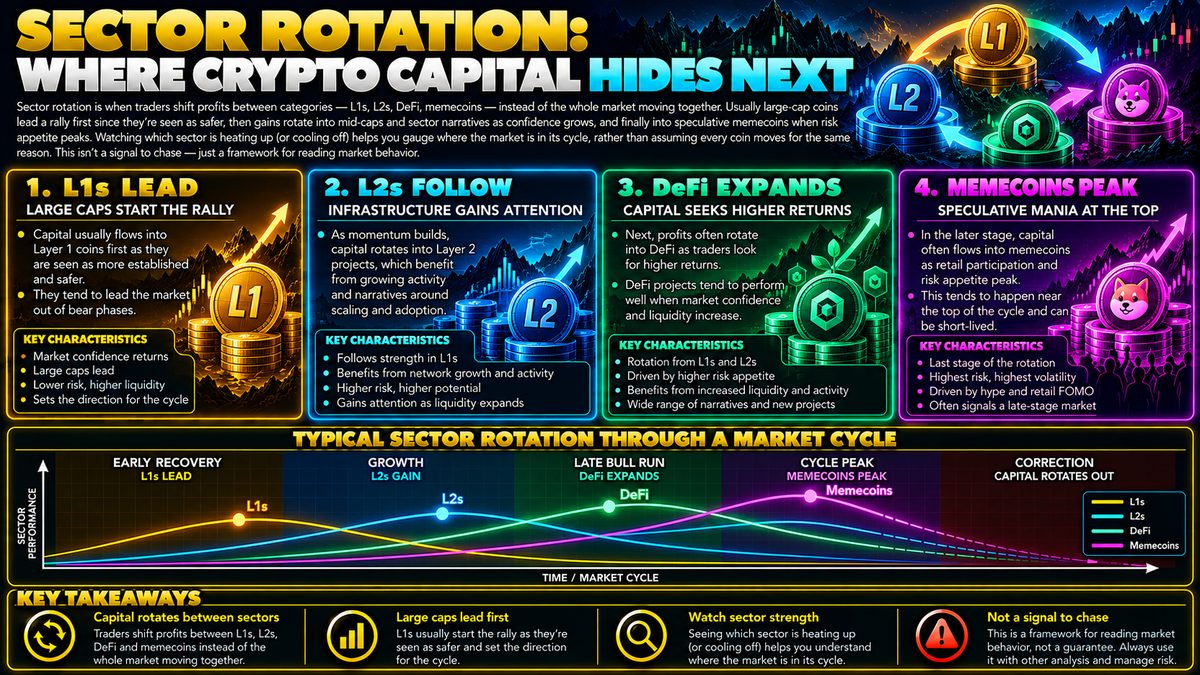
Sector rotation is when traders shift profits between categories — L1s, L2s, DeFi, memecoins — instead of the whole market moving together. Usually large-cap coins lead a rally first since they're seen as safer, then gains rotate into mid-caps and sector narratives as confidence grows, and finally into speculative memecoins when risk appetite peaks. Watching which sector is heating up (or cooling off) helps you gauge where the market is in its cycle, rather than assuming every coin moves for the same reason. This isn't a signal to chase — just a framework for reading market behavior.
What Sector Rotation Actually Means
In crypto, coins are often grouped into categories based on what they do. Layer 1s, or L1s, are base blockchains that other apps run on top of. Layer 2s, or L2s, are networks built to make an L1 faster or cheaper. DeFi refers to decentralized finance projects like lending or trading platforms. Memecoins are tokens with little stated utility whose value is driven mostly by attention and community energy. Sector rotation is the observation that money moving through the market doesn't hit all of these groups at once. Instead, it tends to flow from one category to another as trader confidence and risk appetite change.
Rather than every coin rising or falling together, you might see large, established coins move first, then attention shift to mid-sized projects, then eventually to smaller and more speculative tokens. Recognizing this pattern doesn't tell you what will happen next, but it gives you a vocabulary for describing what already appears to be happening.
How the Rotation Tends to Unfold
A common way traders describe this cycle is that capital starts in large-cap coins, meaning the biggest and most liquid projects by market value. These are seen as relatively safer bets when uncertainty is high, since they usually have longer track records and deeper trading volume. As confidence builds and traders feel more comfortable taking risk, gains often start rotating into mid-cap coins and specific sector narratives, such as a wave of interest in L2s or a particular DeFi niche.
If risk appetite keeps climbing, speculative assets like memecoins can see the sharpest short-term moves, since they carry the least fundamental anchoring and the most sentiment-driven trading. This isn't a fixed rule or a guaranteed sequence, it's simply a pattern that has repeated often enough that traders use it as a mental map of where the broader market cycle might be.
Why Watching Sectors Can Be Useful
Instead of asking why one specific coin is moving, sector rotation encourages you to ask which category is moving and why. If mid-cap L1s are suddenly outperforming while large caps stall, that can suggest a shift in trader confidence rather than something unique to one project. This framing can help you avoid assuming a single narrative explains every price move in the market.
It can also help with expectations. If speculative memecoin activity is picking up sharply, some traders read that as a sign the market is in a later, higher-risk phase of a cycle, where sentiment can reverse quickly.
Common Mistakes and Limitations
The biggest mistake is treating sector rotation as a signal to chase, jumping into whichever category seems hot at the moment. By the time rotation is obvious, much of the move may already have happened, and speculative sectors can reverse just as fast as they rose. Sector boundaries are also blurry. Many projects don't fit neatly into one category, and narratives change over time.
Sector rotation is descriptive, not predictive. It does not guarantee that history will repeat in the same order or timing, and it says nothing about any individual coin's fundamentals or risk.
Fitting It Into a Broader Approach
Sector rotation works best as one lens among several, alongside things like overall market trend, trading volume, and your own risk tolerance. It should never replace basic risk management, such as position sizing or having a clear plan before entering a trade. No framework, including this one, removes the uncertainty inherent in trading volatile assets.