
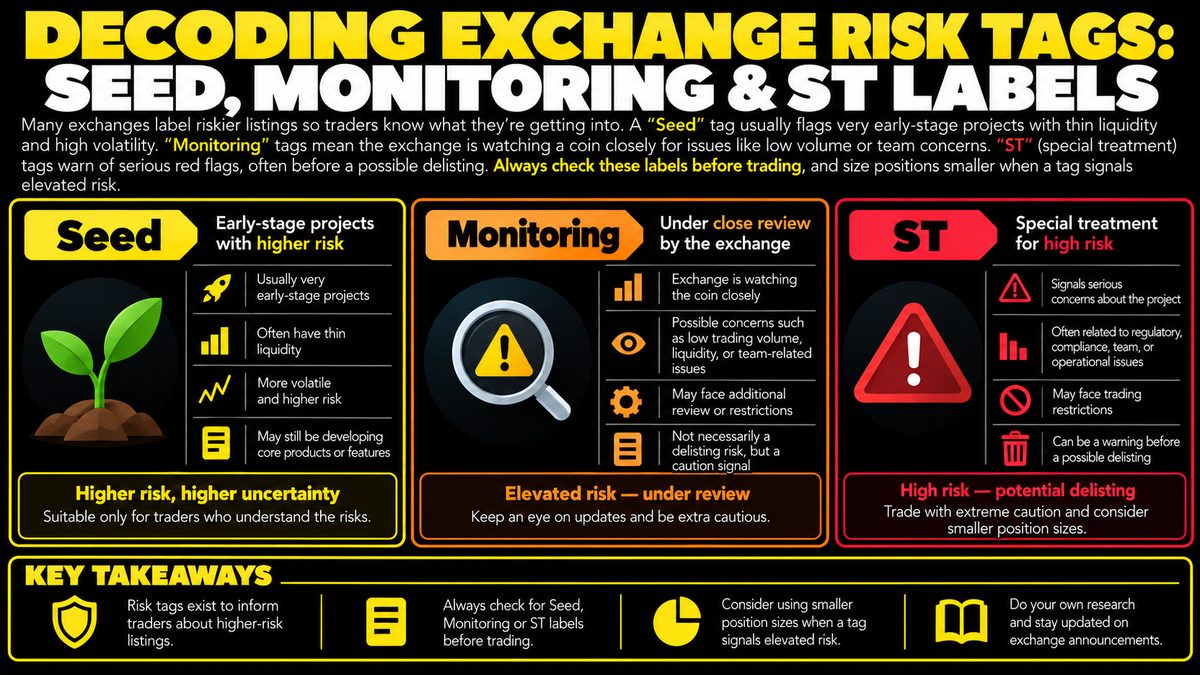
Many exchanges label riskier listings so traders know what they're getting into. A "Seed" tag usually flags very early-stage projects with thin liquidity and high volatility. "Monitoring" tags mean the exchange is watching a coin closely for issues like low volume or team concerns. "ST" (special treatment) tags warn of serious red flags, often before a possible delisting. Always check these labels before trading, and size positions smaller when a tag signals elevated risk.
What Risk Tags Actually Are
When an exchange lists a coin, it often attaches a small label or badge next to the trading pair to signal how risky that listing is considered to be. These labels are not price predictions or trading signals. They are more like warning stickers, similar to how a food label might warn about allergens. The exchange is telling you, in shorthand, that this asset carries characteristics worth extra caution before you commit capital.
Different exchanges use different naming systems, but three types of tags come up often enough to be worth understanding in general terms: Seed, Monitoring, and ST (special treatment). Each reflects a different stage or type of concern, and knowing the difference can help you calibrate how carefully you research a coin and how much risk you take on.
Seed Tags and Early-Stage Projects
A Seed tag typically flags a project that is very new, meaning it has a short trading history, a small number of holders, and thin liquidity. Thin liquidity means there are not many buy and sell orders sitting in the order book, so even modest trades can move the price sharply. Imagine a coin trading at 100 units where a single order worth a small amount of money can push the price to 110 or down to 90 within minutes. That is the kind of volatility a Seed label is warning you about.
Seed does not necessarily mean the project is fraudulent or doomed. Plenty of early-stage assets go on to build real track records over time. But it does mean that price charts can be misleading, spreads between buy and sell prices can be wide, and slippage, the difference between the price you expect and the price you actually get, can be significant. Traders who engage with Seed-tagged assets often treat them as higher-risk, higher-uncertainty bets rather than core holdings.
Monitoring Tags and Ongoing Scrutiny
A Monitoring tag usually means the exchange has noticed something worth watching closely, without necessarily concluding the project has failed. Common triggers include declining trading volume, concerns about the project team's communication or activity, unclear tokenomics, meaning the rules around how the token is created and distributed, or general market conditions that suggest the listing may not remain viable long term.
This tag is essentially a heads-up rather than a verdict. It tells traders that the exchange is actively reviewing the situation and that the outcome could go either way, including removal of the tag if concerns are resolved, or escalation if they are not.
ST Tags and Elevated Delisting Risk
ST, or special treatment, tags are generally reserved for more serious situations. These might include major red flags such as legal or regulatory issues, a team that has gone silent, extremely low liquidity, or other signs that the project may be heading toward removal from the platform entirely. An ST tag is often, though not always, a precursor to delisting.
Trading an ST-tagged asset carries meaningfully higher uncertainty, including the risk that you may struggle to exit a position if liquidity dries up further before any delisting notice period ends.
Using Tags Alongside Your Own Research
These labels are a starting point, not a substitute for your own due diligence. They vary by exchange, are not standardized industry-wide, and reflect each platform's internal criteria rather than an independent audit. A coin might carry no tag at all and still be genuinely risky.
Sound practice includes reading the exchange's own explanation of what a tag means, checking the project's fundamentals independently, and sizing any position smaller when a tag signals elevated risk. Combining tags with broader risk management, such as diversification and predefined limits on how much you are willing to lose, matters more than reacting to a label alone. No tag, indicator, or pattern guarantees an outcome.