
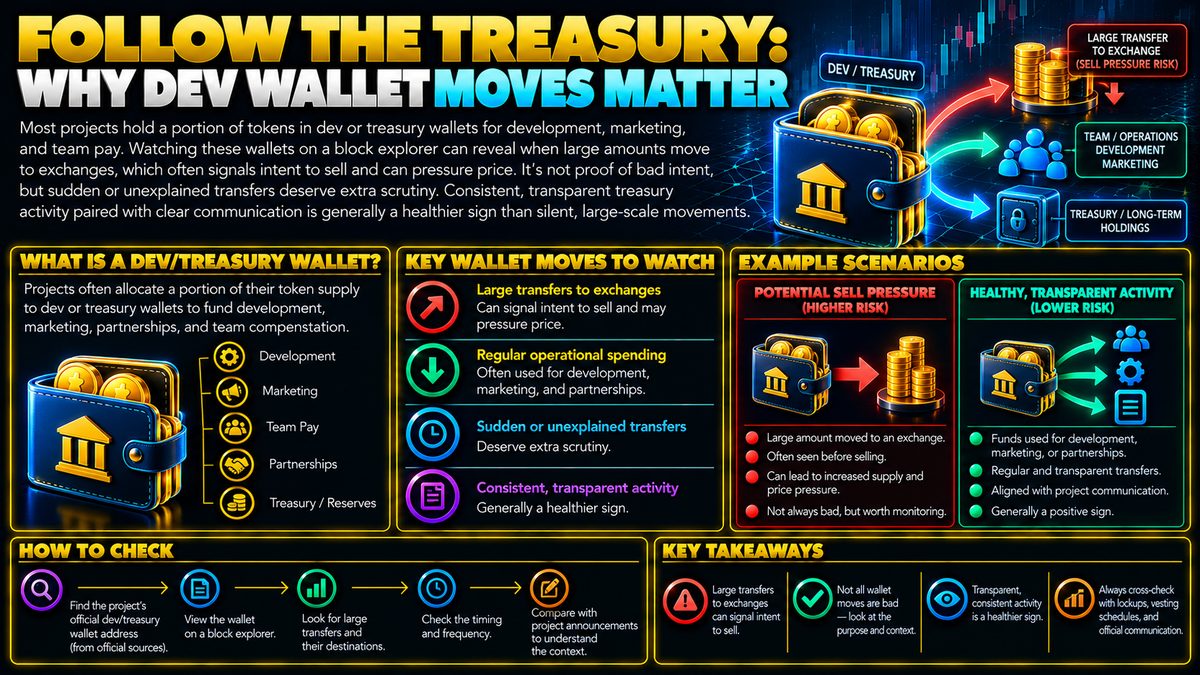
Most projects hold a portion of tokens in dev or treasury wallets for development, marketing, and team pay. Watching these wallets on a block explorer can reveal when large amounts move to exchanges, which often signals intent to sell and can pressure price. It's not proof of bad intent, but sudden or unexplained transfers deserve extra scrutiny. Consistent, transparent treasury activity paired with clear communication is generally a healthier sign than silent, large-scale movements.
What Is a Dev or Treasury Wallet
Almost every crypto project sets aside a portion of its total token supply when it launches. This allocation is usually held in one or more wallets controlled by the founding team, a foundation, or a decentralized organization, and it is meant to fund ongoing development, pay contributors, cover marketing, or reward early supporters over time. These are commonly called dev wallets or treasury wallets.
Because blockchains are public ledgers, anyone can look up these wallet addresses using a block explorer, a website that lets you search transactions, balances, and wallet activity for a given network. This transparency is one of crypto's unique features compared to traditional finance, where a company's internal cash movements are far harder to observe in real time.
How These Wallets Get Used
In a healthy project, treasury funds move in predictable, explainable ways. A team might release a fixed amount monthly to cover payroll, or transfer tokens to a marketing partner as part of an announced campaign. Some projects publish vesting schedules in advance, meaning the public already knows roughly when and how much will unlock and move.
Problems arise when large amounts suddenly move from a dev wallet toward an address associated with an exchange, without any prior announcement or explanation. Moving tokens to an exchange often precedes selling, since exchanges are typically where tokens get converted into other assets or cash. This does not automatically mean something dishonest is happening, but it does raise the odds that available supply on the open market is about to increase, which can put downward pressure on price if buying demand does not keep pace.
How Traders Read Wallet Activity
Traders who follow on-chain activity generally look for a few things: the size of the transfer relative to total supply, whether the destination is a known exchange address, whether the movement matches a previously disclosed schedule, and whether the team offers any public comment afterward. A transfer that lines up with an announced vesting unlock is very different from an unannounced, unusually large transfer with no context.
It also matters whether this is a one-off event or part of a pattern. Consistent, moderate, well-communicated treasury activity over many months tends to be viewed as a healthier sign than long stretches of silence followed by one enormous, unexplained transfer. Patterns of behavior, not single transactions, tend to be more informative.
Limitations and Common Mistakes
Watching wallets is not a crystal ball. A transfer to an exchange does not guarantee a sale will happen, and even if a sale happens, its price impact depends on market depth, overall demand, and timing. Some transfers are for legitimate reasons like providing liquidity, paying a vendor who uses that exchange, or moving funds between the team's own custody solutions.
A common mistake is treating any single large movement as definitive proof of wrongdoing, or conversely, ignoring wallet activity altogether. Another pitfall is misidentifying wallet ownership, since labels on explorers are not always accurate or up to date.
Fitting This Into a Broader Approach
On-chain wallet monitoring works best as one input among several, alongside things like trading volume, project communication, and broader market conditions. It should never be the sole basis for a decision. Because outcomes are uncertain, sound risk management such as position sizing and predefined risk limits remains essential regardless of what a treasury wallet appears to be doing. No indicator, on-chain or otherwise, removes the underlying uncertainty of markets.