
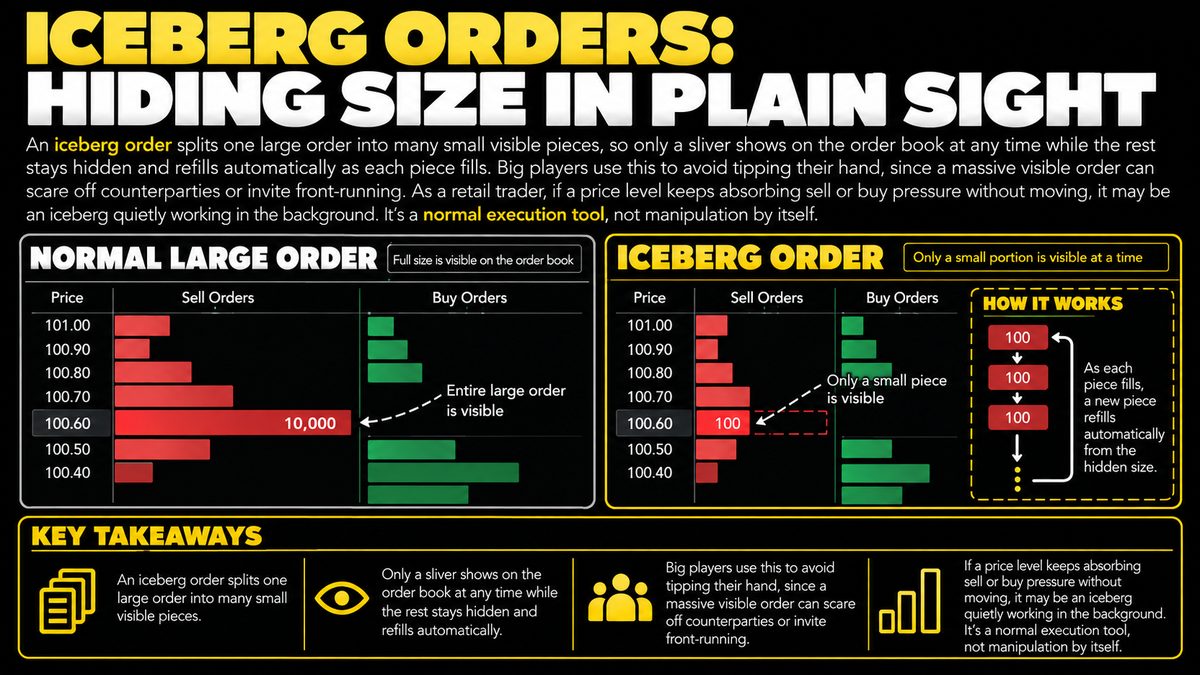
An iceberg order splits one large order into many small visible pieces, so only a sliver shows on the order book at any time while the rest stays hidden and refills automatically as each piece fills. Big players use this to avoid tipping their hand, since a massive visible order can scare off counterparties or invite front-running. As a retail trader, if a price level keeps absorbing sell or buy pressure without moving, it may be an iceberg quietly working in the background. It's a normal execution tool, not manipulation by itself.
What An Iceberg Order Actually Is
An order book is simply the public list of buy and sell orders waiting to be filled at a given price on an exchange. When someone places a normal limit order, the full size of that order is visible to everyone watching the book. An iceberg order is a way to hide most of that size. Instead of showing, say, a large quantity at once, the trader's system displays only a small visible slice, called the tip, while the rest sits hidden in reserve.
As the visible tip gets filled by other traders, the system automatically replaces it with another small slice from the hidden reserve, at the same price. This repeats until the entire hidden order is filled or the trader cancels it. From the outside, it looks like a small order that keeps mysteriously reappearing at the same price, hence the name, evoking an iceberg where only a fraction shows above the waterline.
Why Traders Use This Tool
Large traders, sometimes called whales in crypto slang because of the size of their holdings, often need to buy or sell amounts far bigger than what typical order books can absorb without moving the price. If they placed the full order openly, other market participants might react. Some could rush to buy ahead of the order, a practice often called front-running, pushing the price up before the whale finishes buying. Others might simply get spooked and pull their own orders, making the market thinner and execution worse.
By breaking the order into small visible pieces, the trader reduces this signaling effect. It is generally considered a normal, legitimate execution technique rather than manipulation, similar to how a large investor might quietly accumulate shares over weeks rather than announcing intent publicly. The goal is efficient execution, not deception about market conditions.
How Retail Traders Might Spot One
Icebergs are not directly labeled on public order books, so traders infer their presence from behavior. A classic sign is a price level that keeps absorbing buying or selling pressure without moving, even though a reasonable amount of volume is trading through it. Imagine a coin trading near a round number like 100, and every time sellers push toward it, buy orders seem to endlessly appear at that exact price, refilling almost instantly after being consumed. That repeated refilling at one stubborn price can suggest hidden size sitting there.
Some traders watch trade execution history, sometimes called the tape, alongside the order book. If far more volume trades at a price than the visible order size would suggest, that mismatch hints at hidden liquidity. This kind of observation is more art than science and requires practice reading order flow over time.
Limitations And Common Mistakes
It is easy to mistake ordinary support or resistance, meaning a price area where many separate traders happen to place orders, for a single hidden iceberg. Not every price level that holds is being defended by one large hidden order. Many are simply areas where independent traders converge on similar decisions.
Another mistake is assuming an iceberg guarantees the price cannot break through. Hidden orders can be fully absorbed and exhausted, after which price often moves quickly since the visible resistance was thinner than assumed. There is no way to know the remaining hidden size from outside, so treating an apparent iceberg as an unbreakable wall is risky.
Fitting It Into A Broader Approach
Iceberg awareness works best as one input among several, alongside volume analysis, broader trend context, and clear risk management such as predefined stop levels and position sizing. It should never be the sole basis for a decision, since it is inferred rather than confirmed. No order book pattern, including suspected icebergs, guarantees future price direction, and treating them as certainty rather than a clue can lead to overconfidence.