
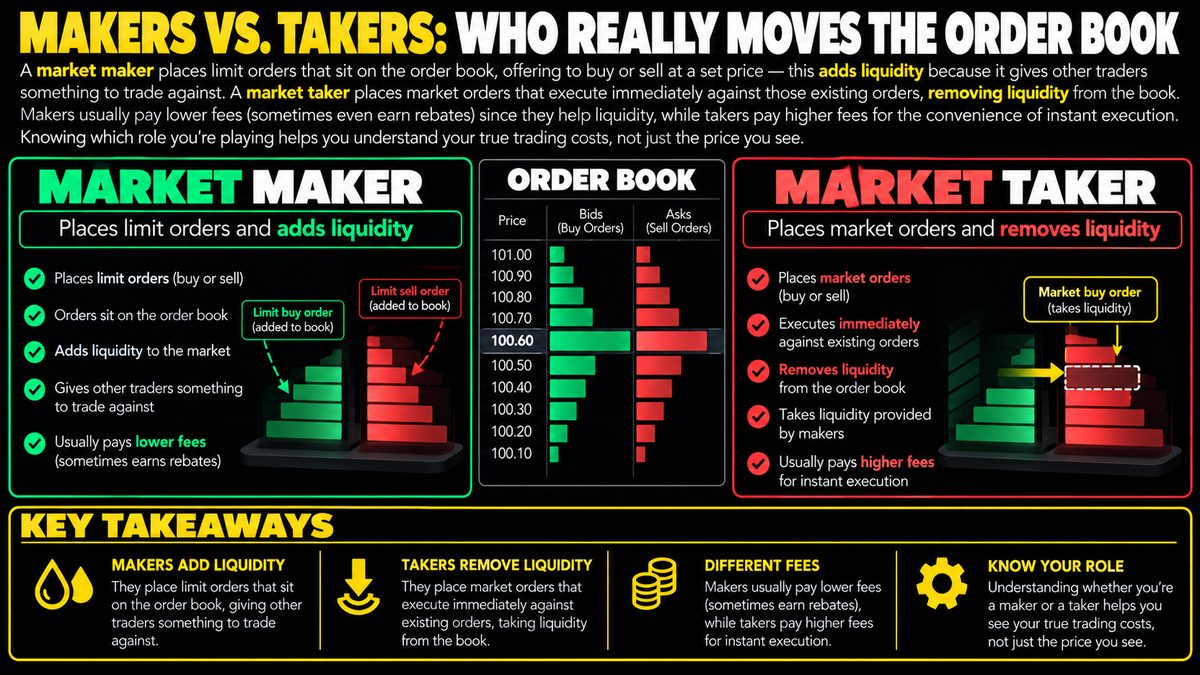
A market maker places limit orders that sit on the order book, offering to buy or sell at a set price — this adds liquidity because it gives other traders something to trade against. A market taker places market orders that execute immediately against those existing orders, removing liquidity from the book. Makers usually pay lower fees (sometimes even earn rebates) since they help liquidity, while takers pay higher fees for the convenience of instant execution. Knowing which role you're playing helps you understand your true trading costs, not just the price you see.
What Makes an Order a Maker or a Taker
Every trade on an exchange's order book involves two types of orders. A limit order is an instruction to buy or sell at a specific price or better, and it does not execute right away unless someone else is willing to trade at that price. Instead, it sits on the order book, a running list of everyone's buy and sell orders, waiting for a match. Because this order gives other traders a price to trade against, the person who placed it is called a maker.
A market order is different. It says "buy or sell right now, at whatever price is currently available." Since it takes liquidity that already exists on the book rather than adding new liquidity, the trader placing it is called a taker. In short, makers wait and provide, takers act and consume.
How the Order Book Actually Works
Imagine a hypothetical coin where some traders have placed limit orders to sell at 101 and others have placed limit orders to buy at 99. That gap between the highest buy and lowest sell is called the spread. Those limit orders are the maker side of the book, sitting quietly until someone matches them.
When a trader wants to buy immediately, they can send a market order that fills against the lowest available sell orders, in this case near 101. That trader is the taker. Their trade removes those sell orders from the book, at least partially, which is why it is described as removing liquidity rather than adding it.
Why Fees Differ Between the Two
Exchanges generally want deep, active order books because that makes trading smoother for everyone. To encourage traders to leave resting limit orders on the book, many exchanges charge makers lower fees than takers, and some even pay small rebates to makers. Takers, who get the convenience of instant execution, typically pay a higher fee for that convenience.
This fee difference can matter more than it first appears. A trader who frequently uses market orders may be paying a meaningfully higher cost per trade than one who uses limit orders, even if both are trading the same size and direction. Over many trades, this difference in fees can add up and affect overall results.
Reading Your Own Trading Costs
Knowing whether you tend to act as a maker or a taker helps you understand your true cost of trading, which goes beyond the price you see on the screen. A market order guarantees speed but not price, since it can fill at a slightly worse level if the book is thin, a situation called slippage. A limit order gives you price control but no guarantee it will fill at all, especially in a fast-moving market.
Some traders deliberately place limit orders slightly inside the current price to try to get filled as a maker while still executing relatively quickly. This is a trade-off between certainty of execution and cost, not a guaranteed way to save money.
Limitations and Risk Considerations
Neither role is inherently better. Makers can end up waiting through unfavorable price moves while their limit order goes unfilled, or filled only after the market has moved against them. Takers pay more in fees and may face slippage, particularly on thinly traded books.
Understanding maker and taker fees is one small piece of a much larger risk management picture. It does not predict where prices will go and should not be treated as a trading strategy on its own. Traders generally combine an awareness of fees with position sizing, stop losses, and a broader read of market conditions rather than relying on order type alone.