
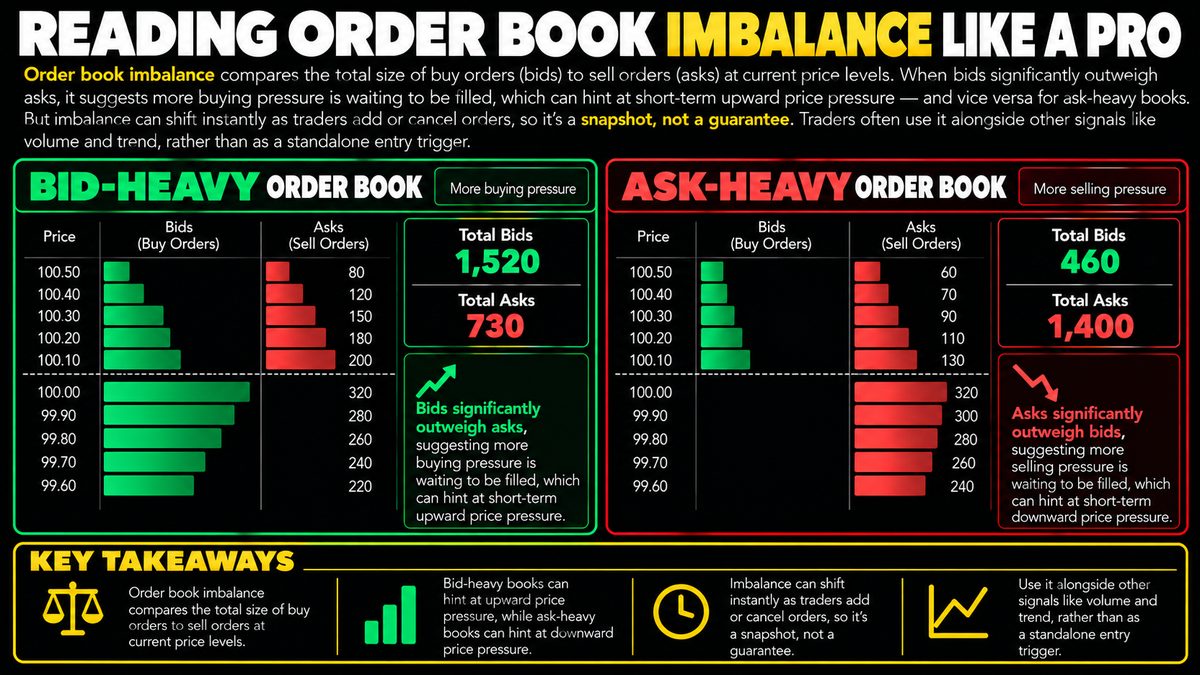
Order book imbalance compares the total size of buy orders (bids) to sell orders (asks) at current price levels. When bids significantly outweigh asks, it suggests more buying pressure is waiting to be filled, which can hint at short-term upward price pressure — and vice versa for ask-heavy books. But imbalance can shift instantly as traders add or cancel orders, so it's a snapshot, not a guarantee. Traders often use it alongside other signals like volume and trend, rather than as a standalone entry trigger.
What The Order Book Actually Shows
Every exchange that lets people trade directly against each other keeps a running list of unfilled orders called an order book. On one side sit bids, which are orders from people willing to buy at a certain price. On the other side sit asks, sometimes called offers, which are orders from people willing to sell at a certain price. The order book stacks these by price level, so you can see how much size is waiting just above and just below the current price.
Order book imbalance simply means comparing the total size on the bid side to the total size on the ask side, usually within some price range close to the current price. If there is, say, three times as much buy size as sell size sitting nearby, the book is considered bid heavy. If the opposite is true, it is ask heavy. This comparison is meant to capture a rough sense of which side currently has more resting interest waiting to trade.
Why Imbalance Can Hint At Short Term Pressure
The logic traders use is fairly intuitive. If there is a wall of buy orders sitting just below the price and comparatively little selling interest above it, then any seller who wants to execute quickly may have to sell into that demand, and price could tick up as those bids get absorbed. The reverse logic applies to a heavy ask side, where sellers dominate and buyers may struggle to push price higher without eating through a lot of offers.
This is why some short term traders watch imbalance as one input suggesting which direction has slightly less resistance in the next few moments, not as a signal that predicts where price will be minutes or hours later.
Why It Is A Snapshot Not A Signal
The order book changes constantly. Traders can add new orders or cancel existing ones in an instant, and on many markets a large share of visible orders are placed with no real intention of being filled. This practice, sometimes called spoofing, involves placing large orders to create a false impression of demand or supply, then pulling them before they are executed. Because of this, an imbalance that looks convincing one second can disappear the next, especially on markets with lower liquidity where a single large trader can move the picture easily.
It is also worth remembering that the visible book only shows resting limit orders, not the intentions of traders who plan to buy or sell at market whenever they choose. A heavily bid book can still be overwhelmed by a sudden wave of market sell orders that were never sitting on the book at all.
Using Imbalance Alongside Other Tools
Because of these limitations, most traders treat order book imbalance as a supporting clue rather than a standalone trigger for entering or exiting a position. It is often combined with recent traded volume, which shows what has actually changed hands rather than what is merely resting on the book, and with broader trend context from price charts. If imbalance lines up with the direction of an existing trend and rising volume, some traders view it as mild confirmation. If it contradicts the trend, they tend to treat it with more caution.
Some also watch how imbalance behaves over a short stretch of time rather than at a single instant, since a persistent lean in one direction can feel more meaningful than a one second reading that might just be noise.
Common Mistakes And Limitations
A frequent mistake is treating a strong imbalance as a guaranteed sign that price must move in that direction, then entering a trade based on that alone. Another is ignoring how thin or manipulated the book can be on lower volume markets, where imbalance readings are far less reliable than on deep, heavily traded ones.
No order book reading, indicator, or pattern can guarantee future price movement. Imbalance is best treated as one small piece of a broader picture, used carefully alongside sound risk management such as position sizing and predefined exit plans, rather than as a shortcut to certainty.