
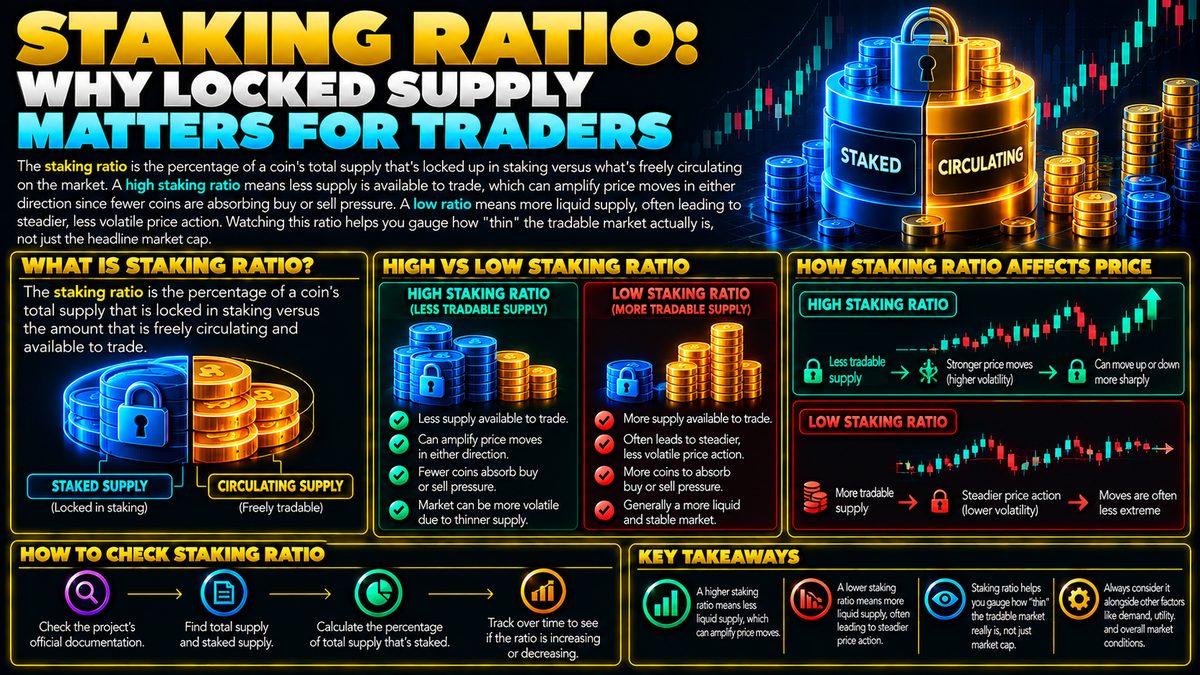
The staking ratio is the percentage of a coin's total supply that's locked up in staking versus what's freely circulating on the market. A high staking ratio means less supply is available to trade, which can amplify price moves in either direction since fewer coins are absorbing buy or sell pressure. A low ratio means more liquid supply, often leading to steadier, less volatile price action. Watching this ratio helps you gauge how "thin" the tradable market actually is, not just the headline market cap.
What The Staking Ratio Actually Measures
Many blockchains let holders lock up their coins to help secure the network or validate transactions, earning rewards in return. This is called staking. The staking ratio is simply the portion of a coin's total supply that is currently locked in this way, expressed as a percentage. If a coin has 100 units in total supply and 60 of those are staked, the staking ratio is 60 percent, leaving only 40 units freely available to trade on the open market.
This number matters because market cap, the headline figure most people look at, is calculated using the entire supply, whether it is staked or not. Two coins can have identical market caps but very different amounts of coins actually available to buy and sell at any given moment. The staking ratio helps you see past that headline figure to the real tradable float.
How A High Or Low Ratio Forms
Staking ratios move for practical reasons. When staking rewards are generous relative to other opportunities, more holders choose to lock coins up, pushing the ratio higher. When lockup periods are short or rewards feel unattractive compared to other uses of capital, holders may unstake and bring coins back into circulation, lowering the ratio. Broader market conditions play a role too, since during uncertain periods some holders prefer to keep coins liquid so they can react quickly, while during calmer periods they may be more comfortable locking coins away for yield.
Unstaking is often not instant. Many networks impose a waiting period, sometimes called an unbonding or unlocking period, before staked coins become tradable again. This delay means the staking ratio does not always shift immediately even when sentiment changes, and it can create a lag between what holders want to do and what the tradable supply actually looks like.
Reading The Ratio As A Trader
A high staking ratio means a smaller slice of the total supply is doing all the buying and selling. In that situation, a given amount of buy or sell pressure has less supply to absorb it, which can lead to sharper, faster price swings in either direction. A low staking ratio generally means more coins are floating around and available to trade, which tends to spread out pressure and can produce steadier, more gradual price action, though this is a tendency rather than a rule.
Traders sometimes watch for changes in the ratio over time rather than the raw number itself. A rising ratio can suggest supply is tightening, while a falling ratio can suggest more coins are about to become available. Neither direction guarantees a particular price outcome, since demand still matters just as much as supply.
Common Mistakes And Limits
A frequent error is treating a high staking ratio as automatically bullish. Locked supply reduces what is tradable, but it says nothing about whether people actually want to buy the coin. Thin supply combined with weak demand can still produce falling prices, just with more volatility along the way. Another mistake is ignoring unbonding periods and assuming staked coins are permanently off the market, when in reality large amounts can become tradable within weeks depending on the network's rules.
Using It Alongside Other Tools
The staking ratio works best as one input among many, not a standalone signal. Pairing it with trading volume, order book depth, and overall market trends gives a fuller picture of liquidity and risk. Because thin markets can move sharply, position sizing and stop losses become especially important when trading coins with high staking ratios. No single metric, including this one, can guarantee how a market will behave.