
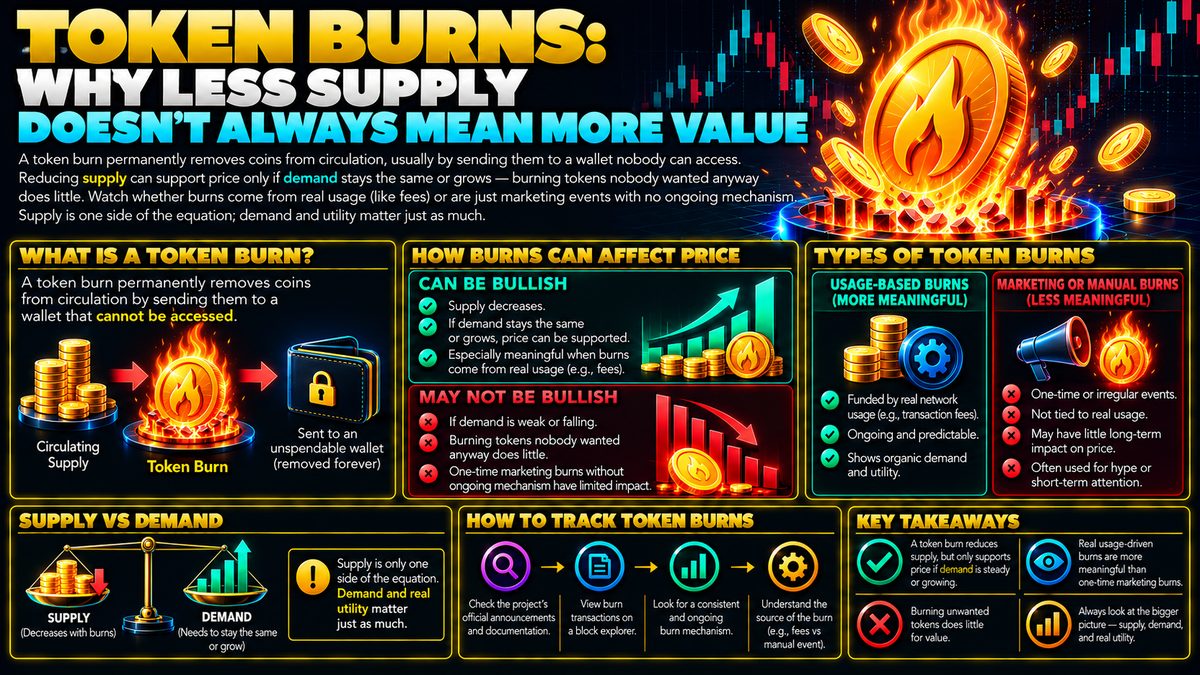
A token burn permanently removes coins from circulation, usually by sending them to a wallet nobody can access. Reducing supply can support price only if demand stays the same or grows — burning tokens nobody wanted anyway does little. Watch whether burns come from real usage (like fees) or are just marketing events with no ongoing mechanism. Supply is one side of the equation; demand and utility matter just as much.
What A Token Burn Actually Is
A token burn is a deliberate action that takes coins out of circulation forever. This is usually done by sending them to a special wallet address that nobody holds the private keys to, meaning no one can ever spend or move those coins again. From a supply standpoint, it is similar to a company destroying unsold inventory rather than trying to sell it. The tokens still exist on the blockchain's history, but they are permanently unusable, so the circulating supply, meaning the number of coins actually available to be bought, sold, or held, goes down.
Projects burn tokens for different reasons. Some do it as a one time event, perhaps to reduce a very large initial supply. Others build burning into their ongoing design, where a small portion of every transaction fee or every use of the network is automatically destroyed. Understanding which type of burn you are looking at matters a lot for judging its significance.
The Basic Supply And Demand Logic
The simple idea behind a burn is that if fewer coins exist, and people still want to buy or hold the same amount, then each remaining coin could represent a larger share of demand. Imagine a coin with 1,000 units outstanding, and 100 are burned, leaving 900. If the same number of people want to hold roughly the same value, the remaining coins each need to absorb more demand, which in theory could support their price. This is the same logic behind stock buybacks in traditional markets.
But this logic depends entirely on the demand side staying steady or growing. Reducing supply does nothing on its own if nobody actually wants the token in the first place. Burning coins that were sitting unused and unwanted is a bit like a store shrinking its unsold inventory of a product nobody was buying anyway. The scarcity is real, but it is scarcity of something with little demand behind it.
Why Burns Alone Rarely Guarantee Anything
A common mistake traders make is treating a burn announcement as automatically bullish, meaning automatically good for price. In reality, a burn is only one input among many. If a project's usage, adoption, or utility is declining, a shrinking supply will not reverse that trend. Price ultimately reflects the balance of buyers and sellers, and burns affect only one side of that equation.
It also helps to distinguish marketing driven burns from structurally embedded ones. A single, publicized burn event can generate short term attention and speculation, but it does not necessarily reflect any lasting mechanism. A burn tied to actual network usage, such as a fee that gets destroyed every time the token is used for something, is arguably more meaningful because it links the reduction in supply to real ongoing activity rather than a one time marketing move.
Questions Worth Asking
Before treating a burn as meaningful, it can help to ask where the burned tokens came from, whether the burn is recurring or a single event, and whether the project shows any other signs of genuine usage or adoption. It is also worth checking how large the burn is relative to total supply, since a small percentage burned from a very large supply may have limited practical effect.
Fitting Burns Into A Broader Approach
Token burns are just one data point, not a strategy on their own. They can be considered alongside other factors like network activity, developer engagement, and broader market conditions. As always, no supply mechanic, burn or otherwise, guarantees future performance, and position sizing and risk management remain important regardless of any single narrative.