
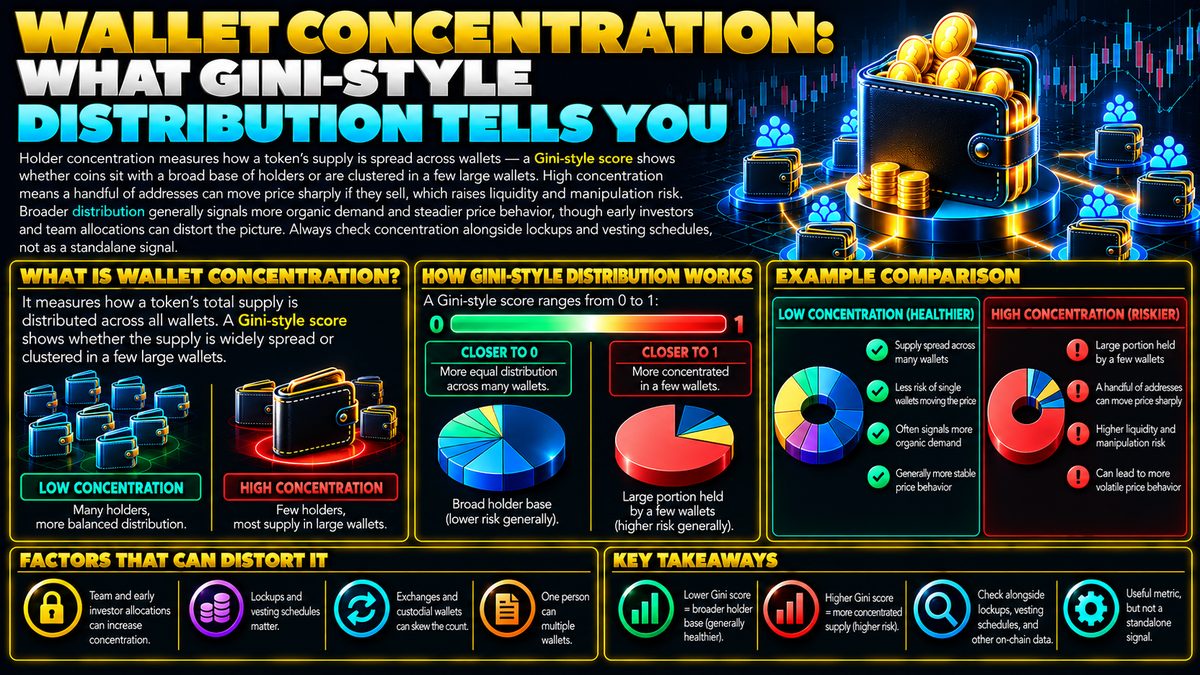
Holder concentration measures how a token's supply is spread across wallets — a Gini-style score shows whether coins sit with a broad base of holders or are clustered in a few large wallets. High concentration means a handful of addresses can move price sharply if they sell, which raises liquidity and manipulation risk. Broader distribution generally signals more organic demand and steadier price behavior, though early investors and team allocations can distort the picture. Always check concentration alongside lockups and vesting schedules, not as a standalone signal.
What Wallet Concentration Actually Measures
Every crypto token exists as a set of balances recorded on a public ledger, and anyone can see how much each wallet address holds. Wallet concentration is simply a way of summarizing that raw data into a single, readable measure: does the supply belong to thousands of small holders, or does a tiny number of wallets control most of the coins.
A Gini-style score borrows from an old economic tool originally used to measure income inequality across a population. Applied to crypto, it produces a number that usually runs from something close to zero, meaning holdings are spread very evenly, up to something close to one, meaning nearly all the supply sits with a handful of addresses. It is a shorthand snapshot, not a full picture of who those wallets actually are or why they hold what they hold.
How Concentration Forms
Concentration is shaped by a token's history. New projects often allocate large chunks of supply to founders, early backers, and treasury or foundation wallets before public trading even begins. Exchanges, custodians, and staking or bridge contracts can also hold large pooled balances that look like single giant wallets even though they represent many underlying users.
Over time, concentration can shift as early holders sell into the open market, as new buyers accumulate small positions, or as large holders split their coins across multiple addresses to appear less dominant. None of this happens instantly, and it can change quickly around unlock events or major news, so a concentration score is really a moving picture rather than a fixed fact.
How Traders Commonly Read It
Traders generally treat high concentration as a caution flag rather than a verdict. If a small number of wallets hold most of the supply, those holders have the power to move the market sharply if they decide to sell, and thin order books can make that impact worse. This is sometimes described loosely as manipulation risk, since a coordinated or even a single large sale can trigger outsized price swings that smaller holders cannot control.
Broader distribution is often read as a sign of more organic, grassroots demand, since it suggests many independent participants chose to hold the asset rather than a few large parties controlling the float. Steadier price behavior sometimes follows from this, simply because no single wallet is large enough to dominate trading on its own, though this is a tendency, not a rule.
Common Mistakes and Limitations
A common mistake is treating a single concentration number as a standalone signal of quality or risk. The score cannot tell you whether a large wallet belongs to a founder under a long lockup, an exchange holding customer funds, or an actual large investor free to sell today. Two tokens with identical scores can have completely different real-world risk depending on who controls those top wallets and what restrictions apply to them.
Another limitation is that concentration data reflects only on-chain balances at a moment in time. It says nothing about intent, and it can be distorted by wallets that are simply technical infrastructure rather than economically meaningful holders.
Using It Alongside Other Tools
Concentration is most useful when checked against vesting schedules and lockup terms, since a large wallet that cannot sell for months carries a different risk than one that is fully liquid today. It also pairs well with trading volume, order book depth, and general market context rather than being read in isolation.
As with any single indicator, no distribution score or pattern guarantees future price behavior, and it should factor into a broader risk management approach rather than serve as a shortcut for decision-making on its own.