
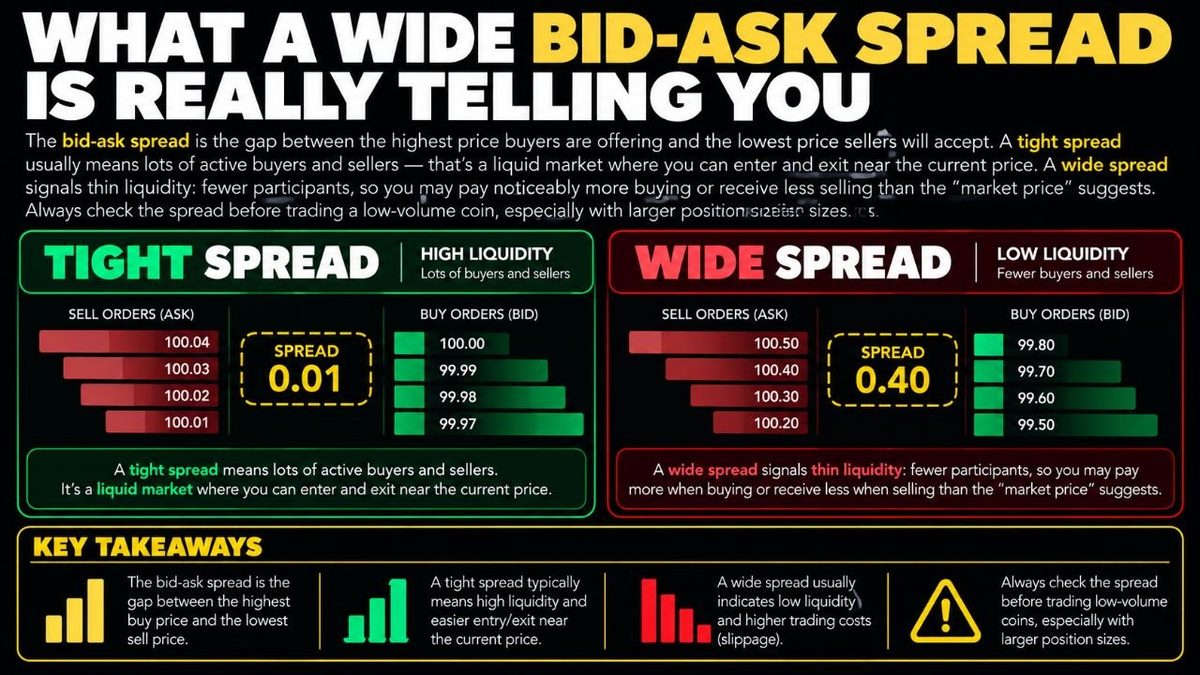
The bid-ask spread is the gap between the highest price buyers are offering and the lowest price sellers will accept. A tight spread usually means lots of active buyers and sellers — that's a liquid market where you can enter and exit near the current price. A wide spread signals thin liquidity: fewer participants, so you may pay noticeably more buying or receive less selling than the "market price" suggests. Always check the spread before trading a low-volume coin, especially with larger position sizes.
What The Spread Actually Measures
Every tradeable market has two prices at any given moment: the bid, which is the highest price a buyer is currently willing to pay, and the ask (sometimes called the offer), which is the lowest price a seller is currently willing to accept. The difference between these two numbers is the spread. If a coin's highest bid is 99 and its lowest ask is 101, the spread is 2, or roughly 2 percent of the price.
This gap exists because buyers and sellers rarely agree on price instantly. Someone has to move first, either the buyer raising their offer or the seller lowering theirs, and until that happens the trade sits unfilled. The size of that gap is a direct, real-time readout of how easily an asset can change hands without anyone having to compromise much on price.
Why Spreads Widen Or Narrow
Spreads are mostly a function of how many people are actively quoting prices on both sides at once. When a market has many participants placing orders close to the current price, competition keeps the bid and ask tightly bunched together, because if one seller asks too high, another will undercut them, and the same happens on the buy side. This is what people mean by a liquid market, one where trading activity is dense enough that entering or exiting rarely moves the price much.
Thin markets work in reverse. If only a handful of participants are willing to trade a coin at any given time, there's no competitive pressure pulling bids and asks together, so the gap can stay wide for long stretches. Spreads also tend to widen during periods of high uncertainty or fast price movement, since market makers and traders become more cautious about quoting tight prices when the "fair value" of an asset is shifting quickly.
Reading The Spread Before You Trade
A tight spread on a widely traded coin generally suggests you can buy or sell close to the price you see quoted, with less slippage between the price you expected and the price you actually get. A wide spread is a warning sign worth taking seriously, particularly on lower-volume coins, because it means the visible "market price" is somewhat theoretical. You might place a market order expecting to pay near the last traded price and instead find yourself paying meaningfully more, or receiving meaningfully less if selling.
This matters more the larger your order size is. A small trade might only interact with the top of the order book, but a larger one can eat through several price levels, effectively paying an even worse average price than the quoted spread suggests, a phenomenon often called slippage.
Common Mistakes And Limitations
A frequent mistake is comparing spread in absolute terms rather than as a percentage of price, which can be misleading across coins of very different price points. Another is assuming a tight spread guarantees safety. Spreads can look tight in normal conditions and then blow out suddenly during volatile moves, news events, or periods of low trading activity, such as certain hours when fewer participants are active.
The spread also doesn't tell you anything about deeper liquidity, meaning how much size sits behind the best bid and ask. A market can show a tight spread with very little volume backing it, which can vanish the moment a real order arrives.
Fitting Spread Into A Broader Approach
The spread works best as one input alongside trading volume, order book depth, and overall market conditions, not as a standalone signal. Many traders use limit orders rather than market orders on wider-spread coins, giving themselves control over the price paid rather than accepting whatever the market offers. None of this removes risk entirely, and no spread reading guarantees a good outcome, but understanding it helps you avoid unpleasant surprises and size positions more sensibly relative to a market's actual liquidity.