
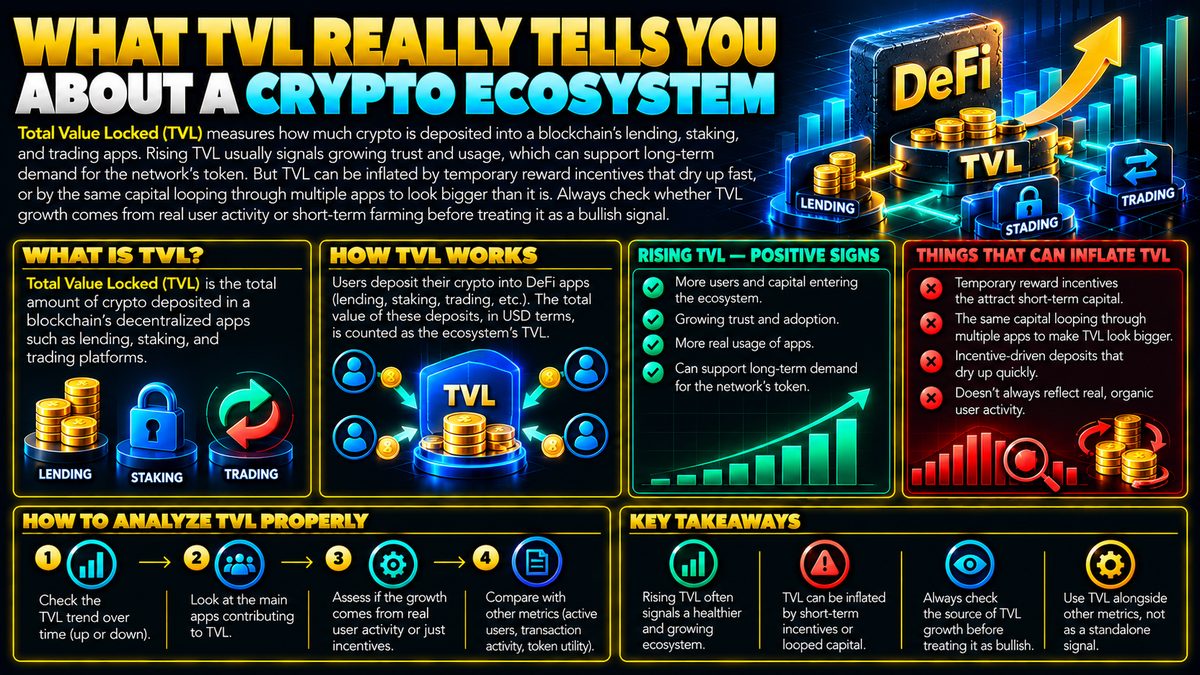
Total Value Locked (TVL) measures how much crypto is deposited into a blockchain's lending, staking, and trading apps. Rising TVL usually signals growing trust and usage, which can support long-term demand for the network's token. But TVL can be inflated by temporary reward incentives that dry up fast, or by the same capital looping through multiple apps to look bigger than it is. Always check whether TVL growth comes from real user activity or short-term farming before treating it as a bullish signal.
What TVL Actually Measures
Total Value Locked, or TVL, is a way of adding up all the crypto assets that users have deposited into a blockchain's decentralized applications, often called dapps. This includes coins sitting in lending pools, tokens staked to earn rewards, and liquidity pairs sitting in trading pools. The idea is simple: if people are willing to park their assets inside an ecosystem's apps, it suggests they trust the platform enough to use it, and that the ecosystem has active demand rather than just a token trading on paper.
TVL is usually expressed in a currency value, like dollars, even though the underlying deposits are crypto assets that fluctuate in price. This matters because TVL can rise or fall simply because the price of the locked assets moved, even if the actual number of coins deposited stayed the same. Separating price effects from genuine deposit growth is one of the first things a careful trader should try to do.
How TVL Forms and Grows
TVL grows when users move assets into lending markets, staking contracts, or liquidity pools, usually because they are earning some kind of yield or reward for doing so. New blockchain ecosystems often try to attract this capital early by offering token incentives, meaning users get extra tokens on top of normal fees or interest just for depositing. This can create a fast, visible spike in TVL that looks like organic growth but is really a response to a temporary subsidy.
Over time, if the underlying apps are genuinely useful, some of that capital tends to stay even after incentives shrink, because real trading volume, borrowing demand, or fee income keeps users engaged. If the apps offered little beyond the reward, capital often exits quickly once the incentive program ends, causing TVL to fall sharply. Watching how TVL behaves after incentives are reduced can tell you more than watching the peak number itself.
Reading TVL Without Being Misled
A rising TVL chart is often treated as a bullish signal, meaning it is read as evidence that a network's token will see more demand over time, since some apps require holding or using the native token to participate. This can be a reasonable observation, but it is not a guarantee of future price behavior, and TVL alone says nothing about whether a token is fairly valued.
One common distortion is called looping, where the same underlying capital is deposited into one app, borrowed against, and then deposited again into another app, repeating several times. Each step adds to the reported TVL total even though no new capital actually entered the ecosystem. This can make TVL numbers look far larger than the real amount of unique capital committed by users.
Common Mistakes and Limitations
A frequent mistake is comparing TVL across ecosystems without checking how it is calculated, since some tracking methods count looped or borrowed capital differently. Another is assuming TVL growth automatically means user growth, when in reality a small number of large depositors, sometimes called whales, can move the number significantly on their own.
TVL also says nothing about security, code quality, or whether deposited funds are actually safe from exploits. A high TVL can attract attackers rather than signal safety.
Using TVL Alongside Other Tools
TVL is most useful when combined with other data, such as the number of active wallet addresses, transaction counts, fee revenue, and how TVL responds when reward incentives change. No single metric, including TVL, should be the sole basis for a trading decision, and any approach should include position sizing and risk management appropriate to the uncertainty involved.