
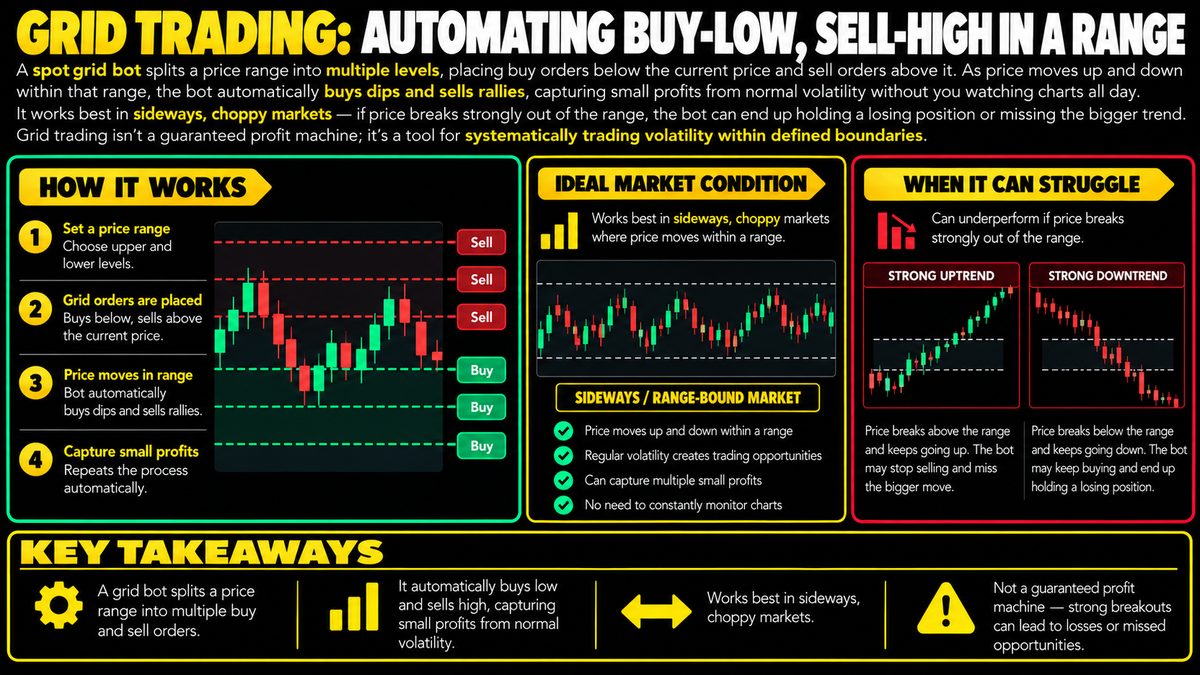
A spot grid bot splits a price range into multiple levels, placing buy orders below the current price and sell orders above it. As price moves up and down within that range, the bot automatically buys dips and sells rallies, capturing small profits from normal volatility without you watching charts all day. It works best in sideways, choppy markets — if price breaks strongly out of the range, the bot can end up holding a losing position or missing the bigger trend. Grid trading isn't a guaranteed profit machine; it's a tool for systematically trading volatility within defined boundaries.
What A Grid Bot Actually Does
A spot grid bot is a piece of software that automates a simple idea: buy low, sell high, repeated many times over a small price range. Instead of you manually watching a chart and placing one trade, you tell the bot a price range, for example between 90 and 110 on a hypothetical coin, and how many levels to divide that range into. The bot then places a ladder of buy orders below the current price and sell orders above it, spaced evenly across that range.
As the price moves down and touches a buy level, the bot buys a small amount. When the price bounces back up and touches a sell level, the bot sells that same amount for a small profit. Each round trip captures only a modest gain, but in a market that oscillates up and down repeatedly without going anywhere in particular, those small gains can add up over many cycles. The appeal is that it removes emotion and constant screen time from a style of trading that depends on reacting quickly to short-term price swings.
How The Grid Is Built
Setting up a grid means choosing three main things: the upper and lower bounds of the range, the number of grid lines within it, and the amount of capital allocated to each order. A tighter range with more lines creates more frequent, smaller trades. A wider range with fewer lines creates less frequent but larger trades. Some bots space grid lines evenly in price terms, others space them evenly in percentage terms, which can matter when the asset is volatile.
The bot also needs starting capital split between the asset and cash, so it has something to sell if price rises and something to buy with if price falls. Fees matter here too, since every filled order incurs a trading cost, and if the grid spacing is too tight, fees can eat into or exceed the small profits from each trade.
Why Range-Bound Markets Suit This Tool
Grid trading is essentially a bet that price will stay within a defined channel for a while, bouncing between support and resistance rather than trending strongly in one direction. In choppy, sideways conditions, this can look like a compact profit machine, since every wiggle in price is used as sold or bought inventory.
The problem is that markets do not always stay sideways. When price breaks decisively above the top of the grid, the bot has already sold off its holdings on the way up and stops participating in further gains, effectively missing the larger move. When price breaks decisively below the bottom of the grid, the bot keeps buying dips that keep getting deeper, ending up holding a position that is worth less than what was paid for it, with no upper boundary to sell into.
Common Mistakes And Limitations
A frequent mistake is setting a grid range based on recent price action without considering that ranges eventually end. Traders sometimes leave a grid running unattended for long stretches, assuming it is passive income, when in reality a strong trend can quietly turn a grid position into a significant unrealized loss. Overly tight grids can also generate so many small trades that fees dominate the outcome even when the strategy is technically working.
Grid bots also do not understand news, fundamentals, or shifts in market structure. They simply follow the rules they were given, so if conditions change, a human still needs to intervene, adjust the range, or shut the bot down.
Fitting Grids Into A Broader Approach
Grid trading works best as one tool among several, not a standalone solution. Combining it with a view on broader trend direction, sensible position sizing, and a plan for what happens if price exits the range can help manage the downside. Like any automated strategy, it removes some emotional decision-making but does not remove risk, and no grid configuration guarantees profit in every market condition.