
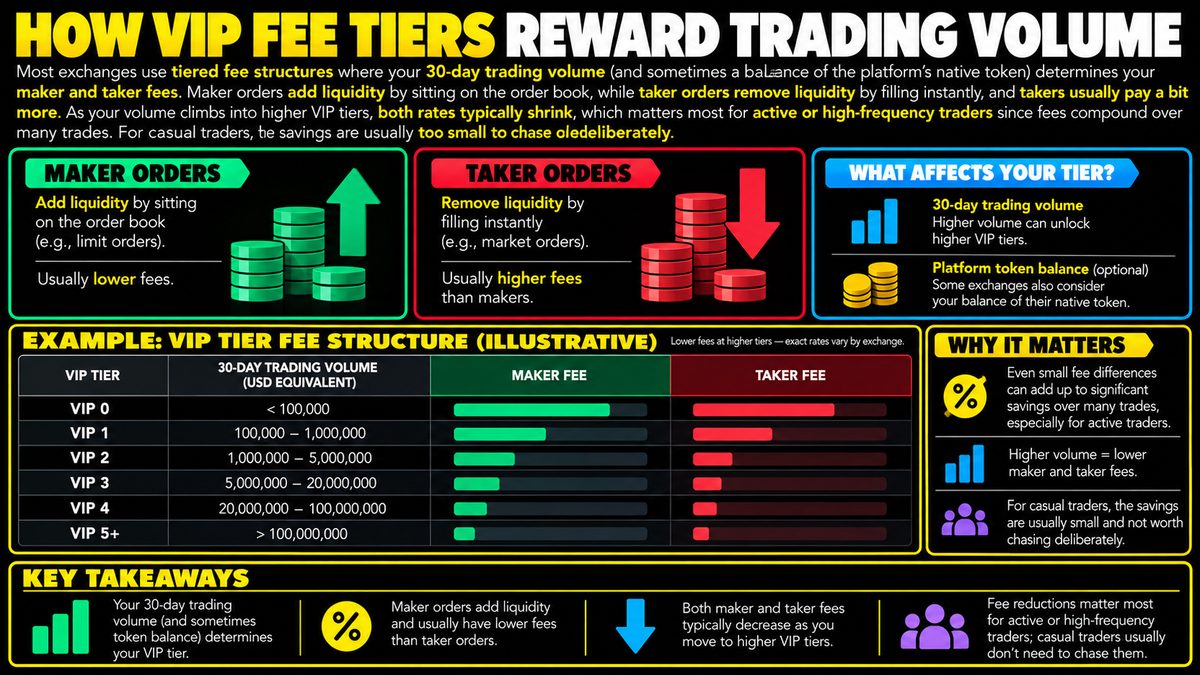
Most exchanges use tiered fee structures where your 30-day trading volume (and sometimes a balance of the platform's native token) determines your maker and taker fees. Maker orders add liquidity by sitting on the order book, while taker orders remove liquidity by filling instantly, and takers usually pay a bit more. As your volume climbs into higher VIP tiers, both rates typically shrink, which matters most for active or high-frequency traders since fees compound over many trades. For casual traders, the savings are usually too small to chase deliberately.
What VIP Fee Tiers Actually Are
Almost every crypto trading platform charges a small fee every time you place a trade, and most structure those fees in tiers rather than a single flat rate. The idea is simple: the more you trade, the less you pay per trade, at least in percentage terms. Your tier is usually recalculated on a rolling basis, often looking at your trading volume over the past 30 days, though some platforms also let you lower your tier by holding a certain amount of their native token in your account.
Think of it like a loyalty program at a store. A shopper who buys a small amount occasionally pays full price, while a shopper who buys in bulk regularly might get a discount. In trading, the discount usually is not automatic just because you have a large account balance sitting idle. It is tied to actual trading activity, executed volume, not the size of your wallet.
Maker Fees Versus Taker Fees
To understand tiers properly, you need to understand the difference between a maker and a taker. A maker order is one that does not execute immediately. Instead, it sits on the order book at a specific price, waiting for someone else to trade against it. Because this kind of order adds depth and options for other traders, it is called adding liquidity.
A taker order does the opposite. It matches immediately against an existing order already sitting on the book, removing that liquidity instantly. Because takers get instant execution and certainty, they typically pay a slightly higher fee than makers. Some tier structures even offer negative maker fees at the highest levels, effectively paying certain large traders a tiny rebate to keep the order book active, though this is not universal and depends entirely on the platform's own rules.
How Tiers Shift as Volume Grows
As a trader's 30-day volume increases, they move up through tier levels, and both maker and taker rates typically shrink at each step. In an entirely hypothetical example, a beginner tier might charge something like 0.10 percent on both maker and taker orders, while a much higher tier might bring taker fees down closer to 0.04 percent and maker fees even lower. These numbers are illustrative only and vary widely between platforms and change over time, so no one should treat any specific figure as representative of what they will actually pay.
The compounding effect matters most for frequent traders. Someone placing dozens or hundreds of trades a day will feel even a small percentage difference multiply significantly over a month, while someone trading once or twice a week will barely notice it.
Why Casual Traders Rarely Benefit
For someone trading small amounts occasionally, the difference between a low tier and a slightly better one is often just a few cents or a small fraction of a dollar per trade. Deliberately increasing trading frequency just to climb a fee tier can end up costing far more in trading losses or accumulated fees than it would ever save. Fee optimization only becomes a meaningful strategy when trading volume is already high for other legitimate reasons.
Fitting Fees into a Broader Trading Plan
Fee tiers are one small piece of a much larger picture that includes position sizing, stop losses, and overall risk tolerance. No fee discount changes the fact that markets can move against a trade at any time, and no tier structure guarantees profitability. Fees should be understood and accounted for, but chasing them should never come before sound risk management or a clear trading plan.