
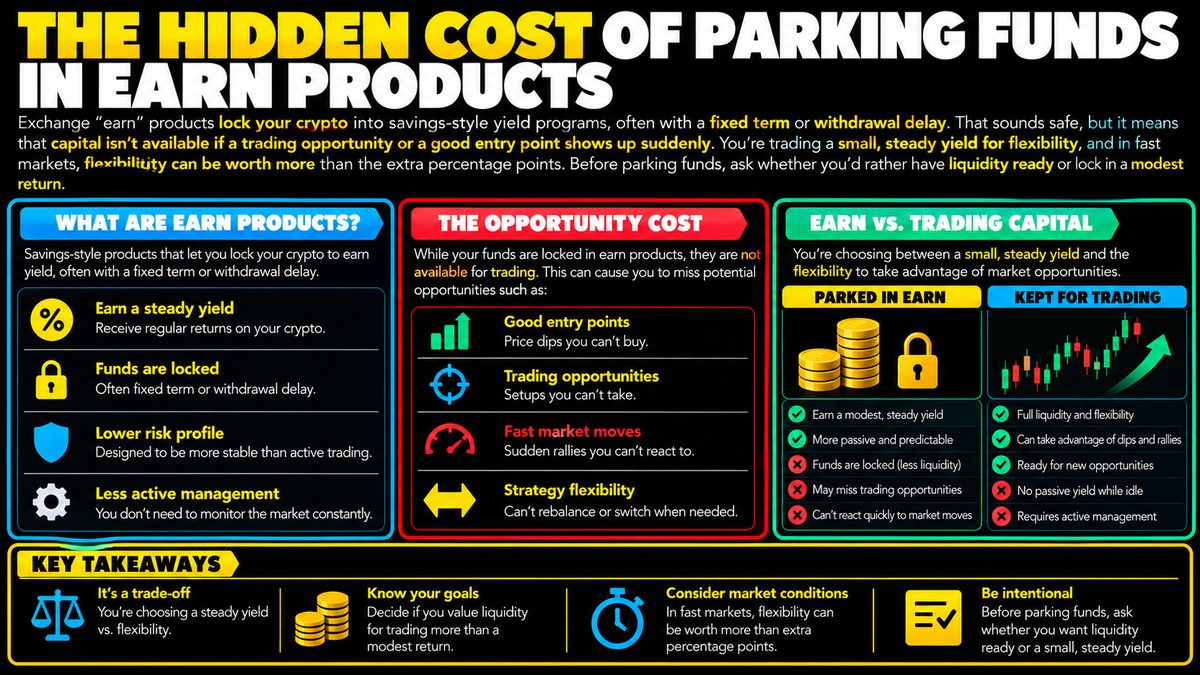
Exchange "earn" products lock your crypto into savings-style yield programs, often with a fixed term or withdrawal delay. That sounds safe, but it means that capital isn't available if a trading opportunity or a good entry point shows up suddenly. You're trading a small, steady yield for flexibility, and in fast markets, flexibility can be worth more than the extra percentage points. Before parking funds, ask whether you'd rather have liquidity ready or lock in a modest return.
What Earn Products Actually Do
When you deposit crypto into an "earn" or "savings" style product, you are usually lending that crypto to a platform, a lending pool, or a staking mechanism in exchange for a yield, which is just a fancy word for interest or a reward rate. Some of these programs let you withdraw anytime, but many require a fixed term, meaning your funds are locked for a set number of days or weeks, or they impose a withdrawal delay so you cannot access your coins the moment you ask for them. In exchange for giving up that flexibility, you are promised a return that is often higher than simply holding the asset in a normal wallet or balance.
This structure is not inherently bad. It can be a reasonable way to earn something on coins you were planning to hold long term anyway. The issue is less about the product itself and more about what you give up to use it, which is the topic worth understanding before you commit funds.
The Real Trade You Are Making
Every locked earn product is really a trade between certainty and optionality. Optionality means having the choice to act when conditions change, such as when a market drops sharply and creates what looks like a good entry point, or when a position you are already holding needs to be adjusted quickly. If your capital is locked, that choice disappears for the duration of the term, no matter how attractive the opportunity looks.
Consider a simplified hypothetical. Imagine you lock 1,000 units of a coin for 30 days to earn a modest yield of a few percent annualized. Halfway through that period, the market drops meaningfully and then recovers, creating a swing that active traders were able to act on. Because your funds were locked, you were not able to participate either on the way down or the way up. The yield you earned might be a fraction of what that single swing represented. This does not mean the swing was guaranteed to happen, only that locking funds removes your ability to respond if it does.
Liquidity Has Its Own Value
Liquidity, meaning how quickly you can convert an asset into spendable or tradable form, is often treated as a passive, boring quality. In calm markets that may be true. In fast-moving markets, liquidity becomes an asset in itself, because it is what allows you to reposition, take profit, cut a loss, or seize a sudden setup. When you lock funds away, you are implicitly betting that no such opportunity or risk will arise during the lock period, which is a bet you may not have consciously made.
Common Mistakes Traders Make
A frequent mistake is locking a large portion of trading capital into an earn product simply because the yield number looks attractive, without weighing it against the trader's own typical activity level. Another is underestimating how withdrawal delays behave during periods of high market stress, when demand to exit can be highest and processing can be slower than expected. A third mistake is treating locked yield as risk-free, when in reality the underlying platform, lending counterparty, or protocol can carry its own risks separate from normal market price risk.
Fitting This Into a Broader Plan
A more balanced approach is to separate capital by purpose before parking any of it. Funds earmarked for long-term holding with no near-term trading intent are more reasonable candidates for locked yield. Funds meant for active trading or opportunistic entries generally benefit from staying liquid. This is not a recommendation to avoid earn products, only a reminder that no yield is free, and the hidden cost is usually flexibility, which only reveals its value at the exact moment you no longer have it.