
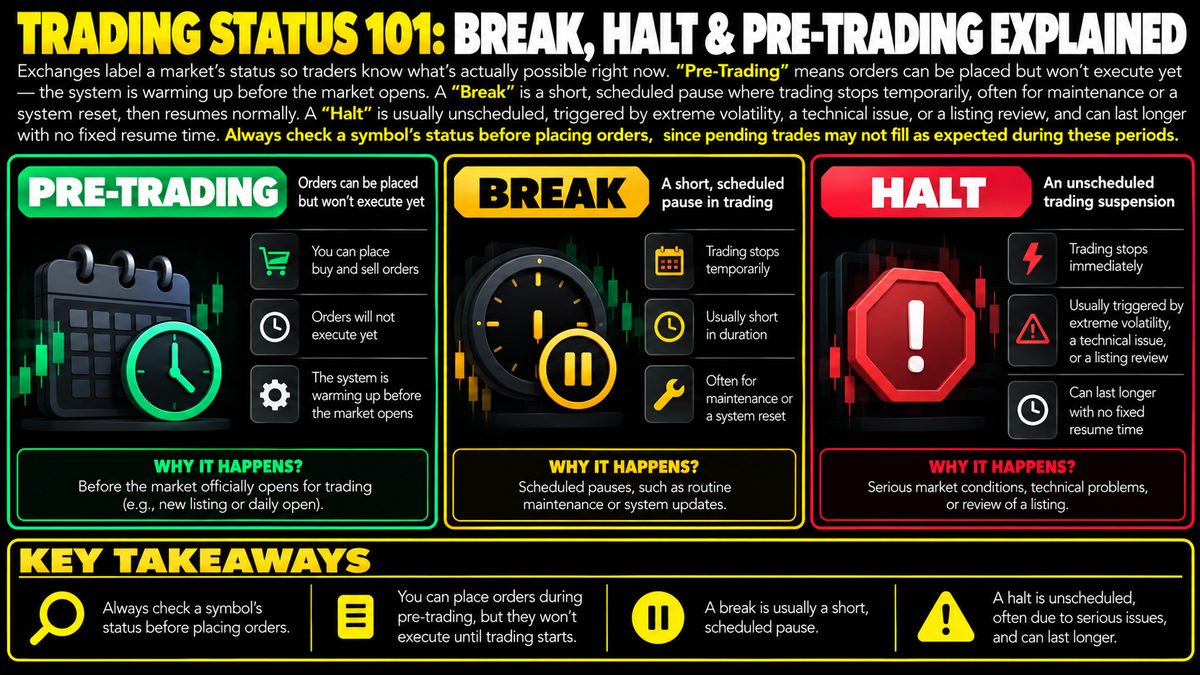
Exchanges label a market's status so traders know what's actually possible right now. "Pre-Trading" means orders can be placed but won't execute yet — the system is warming up before the market opens. A "Break" is a short, scheduled pause where trading stops temporarily, often for maintenance or a system reset, then resumes normally. A "Halt" is usually unscheduled, triggered by extreme volatility, a technical issue, or a listing review, and can last longer with no fixed resume time. Always check a symbol's status before placing orders, since pending trades may not fill as expected during these periods.
Why Market Status Labels Exist
Every exchange needs a way to tell traders exactly what is happening with a given trading pair at any moment. Prices on a screen can look active even when no real trading is occurring, so exchanges attach a status label to each symbol to remove that ambiguity. Understanding these labels matters because placing an order during the wrong status can lead to confusion, delays, or an order sitting unfilled when you expected instant execution.
These statuses are not predictions about where price is heading. They are purely operational signals, similar to a store sign that says open, closed for restocking, or closed until further notice. Learning to read them is a basic risk management skill, not a trading strategy.
Pre-Trading Explained
Pre-Trading is a preparatory phase that happens before a market officially opens for the day or before a new listing goes live. During this window, the order book is often visible and you may be able to submit orders, but those orders will not match or execute yet. Think of it like customers lining up outside a shop before the doors open, they can queue and choose what they want, but the cashier is not yet ringing anyone up.
The purpose is to let the system collect orders, calibrate opening prices, and confirm that everything is functioning correctly before real trading begins. Traders sometimes use this period to position orders in advance, but it is worth remembering that prices displayed during pre-trading can shift once trading actually starts, so what you see is not guaranteed to be what you get.
Understanding a Trading Break
A Break is a short, scheduled pause built into the exchange's normal operating routine. It might occur daily, weekly, or at specific intervals, and its purpose is usually maintenance, a system reset, or a brief settlement process behind the scenes. Because it is scheduled, exchanges typically publish the expected start and end times in advance.
During a Break, new orders generally cannot be placed or executed, and existing open orders may simply wait until trading resumes. Once the Break ends, the market reopens and trading continues as normal. Since the timing is known ahead of time, a Break is usually the least disruptive of these statuses for a trader who checks the schedule beforehand.
What Triggers a Halt
A Halt is different in nature because it is usually unscheduled and reactive rather than planned. Common triggers include extremely sharp price moves that breach a volatility threshold, a technical malfunction affecting the exchange's matching engine, or a review tied to a specific listing, such as a security concern or a compliance question. Because the cause varies, the length of a Halt is unpredictable and there is often no fixed resume time announced upfront.
This uncertainty is the key risk. A Halt can last minutes, hours, or occasionally longer, and prices may gap noticeably once trading resumes compared to where they stood before the pause. Orders placed during a Halt typically will not execute, and traders holding open positions may find themselves unable to adjust or exit until normal trading returns.
Practical Takeaways and Limitations
None of these statuses tell you anything about future price direction, and none guarantee a smooth reopening. A Halt caused by extreme volatility, for example, does not indicate whether the next move will continue in the same direction or reverse sharply. Treat status labels strictly as operational information, not as a signal to act on.
Before placing any order, it is good practice to check the current status of the specific symbol you are trading, since pending orders can behave unexpectedly if the market shifts phase midway. Combining this habit with basic risk controls, such as position sizing and avoiding assumptions about instant execution, helps reduce the chance of unpleasant surprises during these transitional periods.