
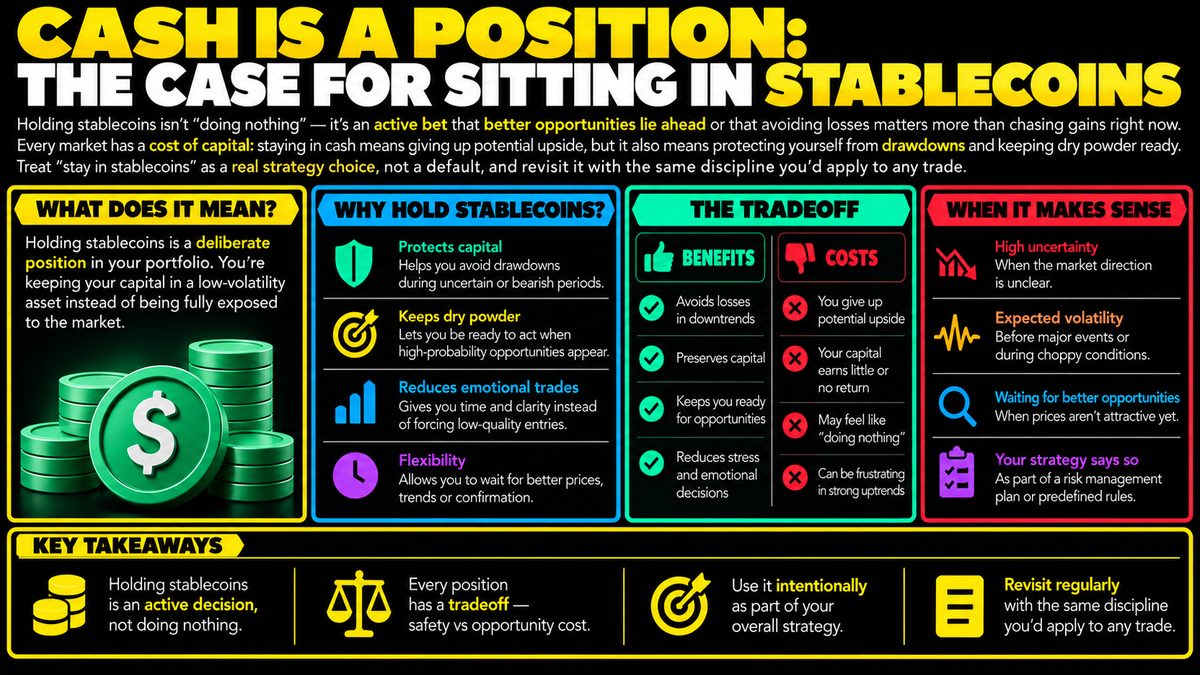
Holding stablecoins isn't "doing nothing" — it's an active bet that better opportunities lie ahead or that avoiding losses matters more than chasing gains right now. Every market has a cost of capital: staying in cash means giving up potential upside, but it also means protecting yourself from drawdowns and keeping dry powder ready. Treat "stay in stablecoins" as a real strategy choice, not a default, and revisit it with the same discipline you'd apply to any trade.
Why Holding Cash Is Still a Decision
When prices are moving and everyone else seems to be trading, sitting in stablecoins can feel like you are doing nothing. In reality, choosing to hold stablecoins is a position, just like holding a coin or a token. A stablecoin is a type of cryptocurrency designed to hold a steady value, usually pegged to a currency like the US dollar. When you convert your holdings into stablecoins, you are making an active choice about risk and timing, even if it does not feel like "trading" in the traditional sense.
Every position has an opportunity cost, meaning the potential gain you give up by not choosing a different option. Holding stablecoins means you avoid the ups and downs of volatile assets, but you also give up any gains those assets might have made. Recognizing this tradeoff is the first step to treating cash as a deliberate strategy rather than a passive default.
The Cost of Capital in Crypto Markets
In traditional finance, the cost of capital often refers to the return you could have earned elsewhere with your money. In crypto, this idea applies just as strongly. If you hold stablecoins during a period where other assets rise sharply, the cost of that decision is the gain you missed. Conversely, if you hold stablecoins during a downturn, the benefit is the loss you avoided.
Neither outcome is guaranteed in advance. Nobody can reliably predict which scenario will play out, which is why holding cash should be treated as a hypothesis you are testing, not a guaranteed safe harbor. Markets can remain volatile, calm, or trend for longer than expected, and cash positions carry their own risks, including missing extended rallies.
Dry Powder and Optionality
One common reason traders hold stablecoins is to keep dry powder, a term for funds kept ready to deploy when an opportunity appears. Having available capital means you are not forced to sell an existing position at an inconvenient time just to take advantage of a new setup. This optionality can be valuable, especially in markets where conditions shift quickly.
However, dry powder only has value if it is eventually used with a plan. Sitting in stablecoins indefinitely without any criteria for when you would deploy that capital is not a strategy, it is simply avoidance. A deliberate cash position should come with some general framework for what conditions might prompt you to act, even if those conditions are broad or based on your own risk tolerance rather than a specific price target.
Common Mistakes When Holding Cash
One frequent mistake is treating a move to stablecoins as an emotional escape rather than a planned decision. Fear-driven exits often happen at the worst possible time and can lock in losses without a clear rationale for reentry. Another mistake is holding cash so long that it becomes the default state, with no periodic reassessment of whether that stance still makes sense given changing conditions.
It is also easy to forget that cash positions carry their own risks, such as inflation eroding purchasing power over time, or the platform holding your stablecoins facing operational issues. No position, including cash, is entirely free of risk.
Making Cash Part of a Broader Plan
Treating a stablecoin allocation as a genuine strategic choice means revisiting it with the same discipline applied to any other position. This can include setting rough criteria for reentry, sizing the cash position deliberately rather than accidentally, and being honest about whether the choice is driven by analysis or by fear.
Ultimately, no framework, pattern, or allocation guarantees a favorable outcome. Combining a thoughtful cash strategy with broader risk management practices, like diversification and position sizing, can help you make more consistent decisions rather than reactive ones.