
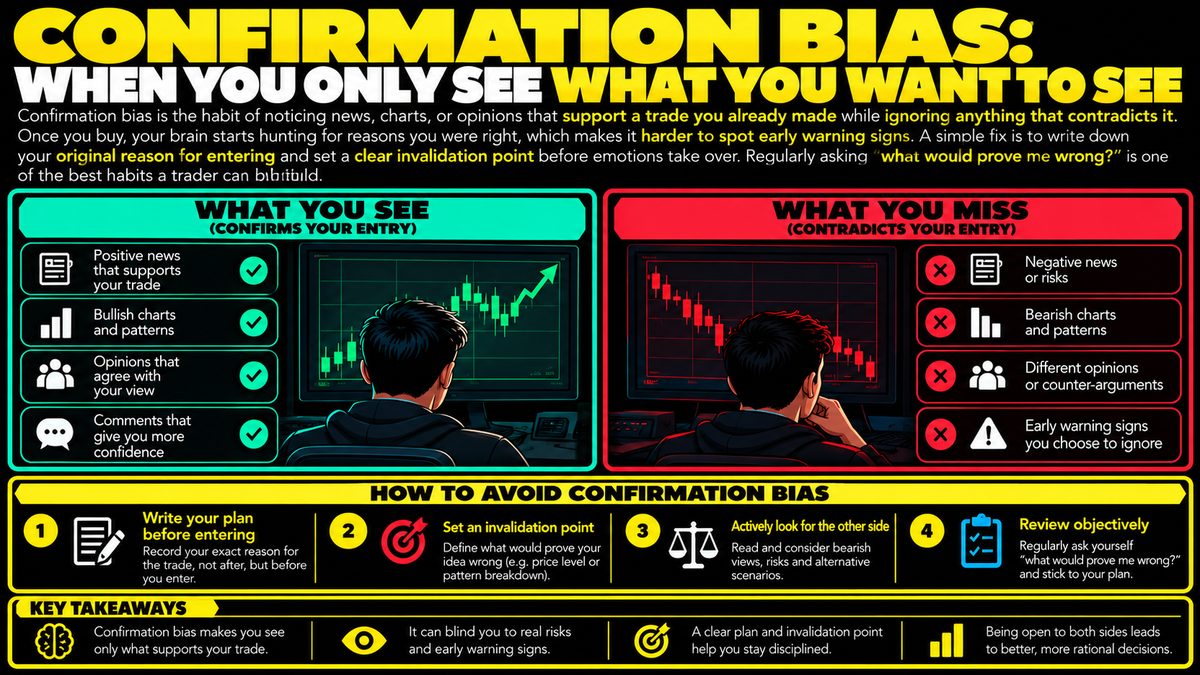
Confirmation bias is the habit of noticing news, charts, or opinions that support a trade you already made while ignoring anything that contradicts it. Once you buy, your brain starts hunting for reasons you were right, which makes it harder to spot early warning signs. A simple fix is to write down your original reason for entering and set a clear invalidation point before emotions take over. Regularly asking "what would prove me wrong?" is one of the best habits a trader can build.
Why Your Brain Does This
Confirmation bias is not a character flaw, it is a built-in shortcut the brain uses to save mental energy. Once you form a belief, such as deciding a coin is about to rise, your mind finds it easier to notice information that agrees with that belief than information that challenges it. This is not unique to trading. People do it with political opinions, product choices, and even relationships. In markets, though, this shortcut becomes expensive because it directly affects money on the line and can quietly erode a trading plan without the trader noticing anything has changed.
How It Shows Up After You Enter a Trade
The moment you open a position, whether long (betting the price will rise) or short (betting it will fall), something shifts psychologically. You are no longer a neutral observer, you are emotionally invested in a particular outcome. Suddenly, bullish tweets feel more convincing, bearish commentary feels like noise, and chart patterns seem to line up perfectly with what you hoped would happen. Meanwhile, warning signs such as weakening volume, a failed breakout, or a shift in broader market sentiment get mentally filed away as unimportant. This selective attention is not intentional deception, it happens automatically, which is exactly what makes it dangerous.
Why This Distorts Decision Making
The core problem is that confirmation bias narrows the range of information you actually process. A trade decision made with a full, balanced view of the evidence is fundamentally different from one where half the evidence was quietly ignored. Over time, this creates a feedback loop, the trader holds a losing position longer than planned, reinterprets bad news as temporary, and adds to the position hoping to be proven right, sometimes called averaging into a loser. None of this happens because the trader is careless, it happens because the mind has stopped treating new information objectively.
Building a Written Anchor Before You Act
One practical defense is writing down the specific reason for entering a trade before it is placed, along with a clear invalidation point, meaning the price level or condition that would prove the original idea wrong. For example, a trader might hypothetically decide that if a coin trading at 100 falls below 90, the original thesis no longer holds regardless of how convincing the news looks in the moment. Having this written in advance matters because it captures your thinking before emotional investment in the outcome existed. Reading it back later provides an objective checkpoint that current emotions cannot rewrite.
Practicing the Habit of Self-Doubt
Periodically asking "what would prove me wrong right now" is a simple but powerful habit because it forces the brain to actively search for disconfirming evidence instead of passively waiting for it. This does not mean second-guessing every trade constantly or abandoning a plan at the first sign of doubt, it means building a routine check, perhaps daily or at each key price level, where you deliberately look for the counterargument. Pairing this with predefined risk management, such as position sizing and stop-loss levels decided before entry, reduces reliance on in-the-moment judgment altogether.
No Tool Removes the Bias Entirely
Confirmation bias cannot be fully eliminated, only managed, and no indicator, checklist, or amount of experience makes a trader immune to it. Even professional analysts and long-time traders fall into this pattern regularly. The goal is not perfection but awareness, recognizing when your thinking has become one-sided and building small structural habits, like written plans and invalidation points, that make it easier to notice bias before it turns into an avoidable loss.