
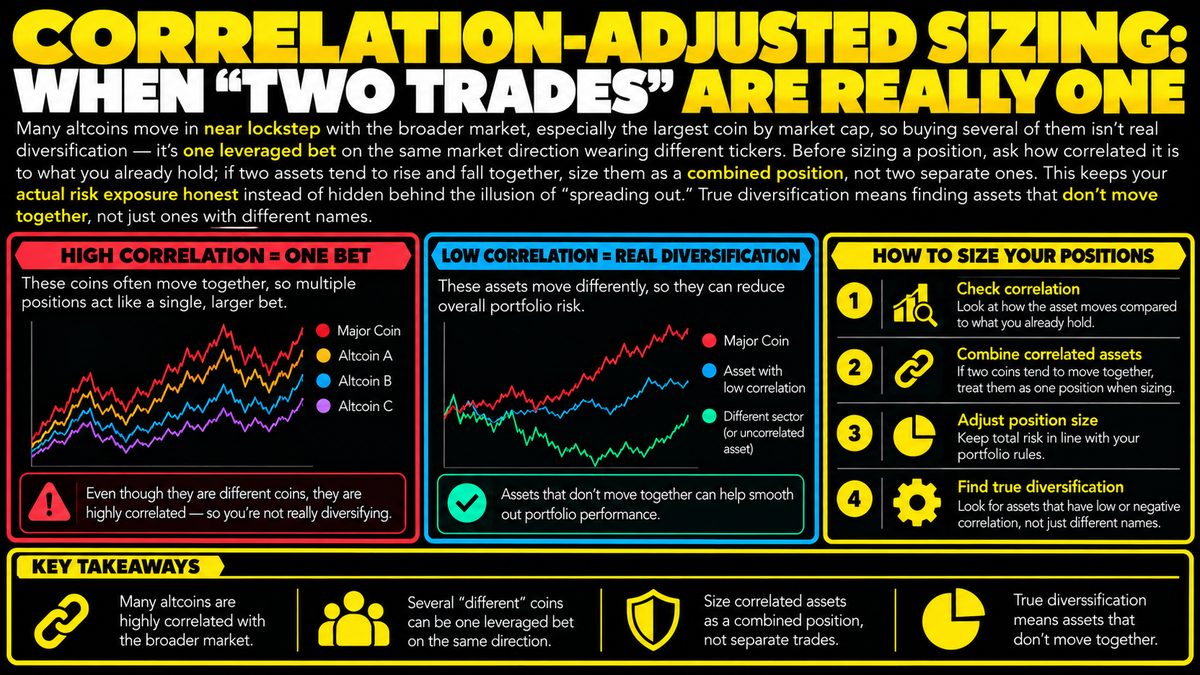
Many altcoins move in near lockstep with the broader market, especially the largest coin by market cap, so buying several of them isn't real diversification — it's one leveraged bet on the same market direction wearing different tickers. Before sizing a position, ask how correlated it is to what you already hold; if two assets tend to rise and fall together, size them as a combined position, not two separate ones. This keeps your actual risk exposure honest instead of hidden behind the illusion of "spreading out." True diversification means finding assets that don't move together, not just ones with different names.
What Correlation Actually Means
Correlation describes how closely two assets move in relation to each other over time. If two coins tend to rise and fall together most of the time, they are said to be highly correlated. If one tends to move independently of the other, or even in the opposite direction, the correlation is low or negative. In crypto markets, many smaller coins, often called altcoins, tend to track the largest coin by market capitalization fairly closely, especially during broad market swings driven by sentiment, liquidity, or macroeconomic news.
This happens because a large share of trading activity across the market is driven by the same underlying forces: overall risk appetite, capital flows in and out of crypto as an asset class, and shared narratives that sweep through many tokens at once. When those forces dominate, individual project fundamentals matter less in the short term, and prices move together.
Why "Spreading Out" Can Be an Illusion
A trader who buys five different altcoins might feel like they have built a diversified portfolio because the tickers are different and the projects have different use cases. But if all five tend to rise and fall together with the broader market, the trader has effectively made one large directional bet, just split across five line items. If that shared direction moves against them, all five positions likely lose at the same time, and the combined drawdown can be larger than expected because the trader underestimated their true exposure.
This is the core problem with confusing variety for diversification. Diversification is supposed to reduce risk by combining assets that do not move in lockstep, so that losses in one area can be offset by stability or gains elsewhere. Simply holding many assets that all move the same way does not achieve that goal, no matter how different their names or stories sound.
Sizing Positions With Correlation in Mind
A more honest approach is to think about position sizing at the portfolio level rather than per asset. Before adding a new position, it helps to ask whether it tends to move with something already held. If the answer is yes, the sensible approach is to treat the new and existing position as parts of one combined exposure, and size that combined exposure according to the risk the trader is willing to take, rather than sizing each position as if it were independent.
For example, imagine a trader willing to risk a certain percentage of their account on a directional bet related to overall market conditions. If they hold one coin already tied to that bet, adding a second highly correlated coin at full size effectively doubles the bet, even though it looks like two separate, smaller trades.
Common Mistakes and Limitations
A common mistake is estimating correlation based on gut feeling rather than observing how assets have actually behaved together over meaningful stretches of time. Correlation is also not fixed. Assets that moved together in one period can decouple later, and assets that seemed independent can suddenly move together during periods of market stress, when almost everything tends to fall at once regardless of prior relationships.
No correlation measurement is a guarantee of future behavior, and it should not be treated as a precise science, especially with a limited history of data.
Fitting This Into a Broader Risk Framework
Correlation-adjusted sizing works best alongside other basic risk practices, such as setting a maximum loss per trade, keeping position sizes reasonable relative to total capital, and periodically reviewing whether a portfolio has quietly become one large bet dressed up as several smaller ones. Thinking this way does not eliminate risk or predict outcomes, but it keeps a trader's sense of their own exposure closer to reality.