
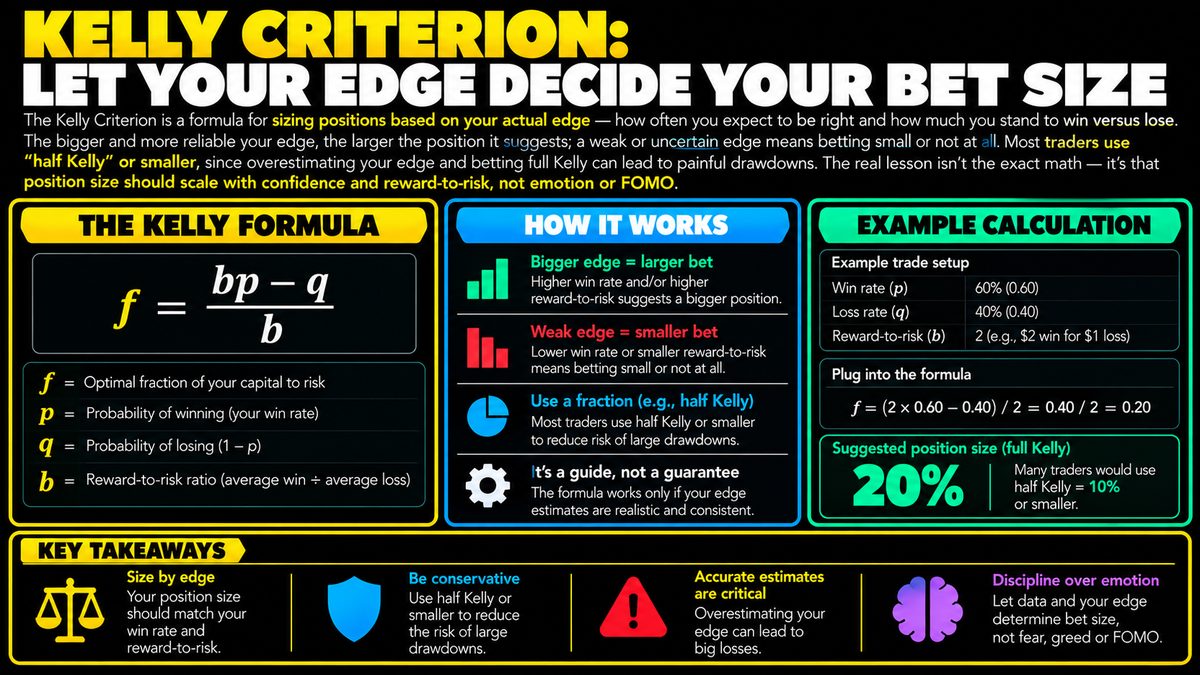
The Kelly Criterion is a formula for sizing positions based on your actual edge — how often you expect to be right and how much you stand to win versus lose. The bigger and more reliable your edge, the larger the position it suggests; a weak or uncertain edge means betting small or not at all. Most traders use "half Kelly" or smaller, since overestimating your edge and betting full Kelly can lead to painful drawdowns. The real lesson isn't the exact math — it's that position size should scale with confidence and reward-to-risk, not emotion or FOMO.
What The Kelly Criterion Actually Is
The Kelly Criterion is a mathematical formula originally developed for gambling and later adopted by investors and traders to answer one narrow question: given a repeatable edge, what fraction of your capital should you risk on each bet to grow your account fastest over the long run without going broke. An edge simply means a situation where your expected outcome is favorable, based on your estimated win rate and the ratio of potential reward to potential loss. The formula takes those two inputs and spits out a suggested percentage of your capital to commit.
It is important to understand this is not a prediction tool. It says nothing about whether a specific trade will win or lose. It only tells you, if your inputs are accurate, how to size positions so that a real statistical edge compounds efficiently instead of being wasted by bets that are too small or destroyed by bets that are too large.
How The Formula Works Conceptually
At its core, Kelly compares two things, how often you expect to be right, and how much you make when right versus how much you lose when wrong. If you expect to win a high percentage of the time, or if your winners tend to be much larger than your losers, the formula suggests a larger position size. If your edge is thin, your win rate is close to fifty-fifty, or your losses tend to be similar in size to your wins, the formula suggests a small position or sometimes no position at all.
A simplified way to picture it, imagine a hypothetical setup where you believe you will be right sixty percent of the time, and your average win is roughly equal to your average loss. Kelly math would suggest committing a modest slice of capital, not all of it, because even a real edge needs room to survive the inevitable losing streaks that occur along the way.
Why Traders Scale It Down
Full Kelly sizing assumes your inputs, win rate and reward to risk ratio, are precisely correct. In real markets, nobody knows their true edge with that kind of precision. Estimates are almost always noisy, and overestimating your edge even slightly can push full Kelly into position sizes that produce brutal drawdowns when reality falls short of expectation.
Because of this, many practitioners use half Kelly or even a quarter of the suggested size. This sacrifices some theoretical growth in exchange for a much smoother equity curve and far less risk of a catastrophic losing streak. The tradeoff is considered worth it by most experienced traders, since overconfidence in one's own edge is one of the most common and expensive mistakes in trading.
Common Mistakes And Limitations
The biggest misuse of Kelly is plugging in a win rate or reward to risk ratio that is simply guessed or based on a tiny, unrepresentative sample of past trades. Garbage inputs produce a garbage position size, no matter how elegant the math looks. Kelly also assumes each bet is independent and that your edge stays stable over time, assumptions that rarely hold perfectly in fast moving, correlated crypto markets where conditions shift quickly.
It is also not a complete risk management system on its own. It does not account for liquidity constraints, sudden volatility spikes, or the emotional difficulty of holding a large position through a drawdown, even a mathematically justified one.
Fitting It Into A Broader Approach
The lasting lesson from Kelly is less about memorizing the formula and more about the mindset behind it, position size should be a function of demonstrated edge and reward to risk, not a function of excitement, fear of missing out, or how confident you feel in the moment. Pairing this idea with stop losses, diversification, and honest record keeping of your actual win rate over time gives the concept practical teeth. No formula, including this one, guarantees profit or protects against loss, and it should be treated as one input among many rather than a mechanical answer.