
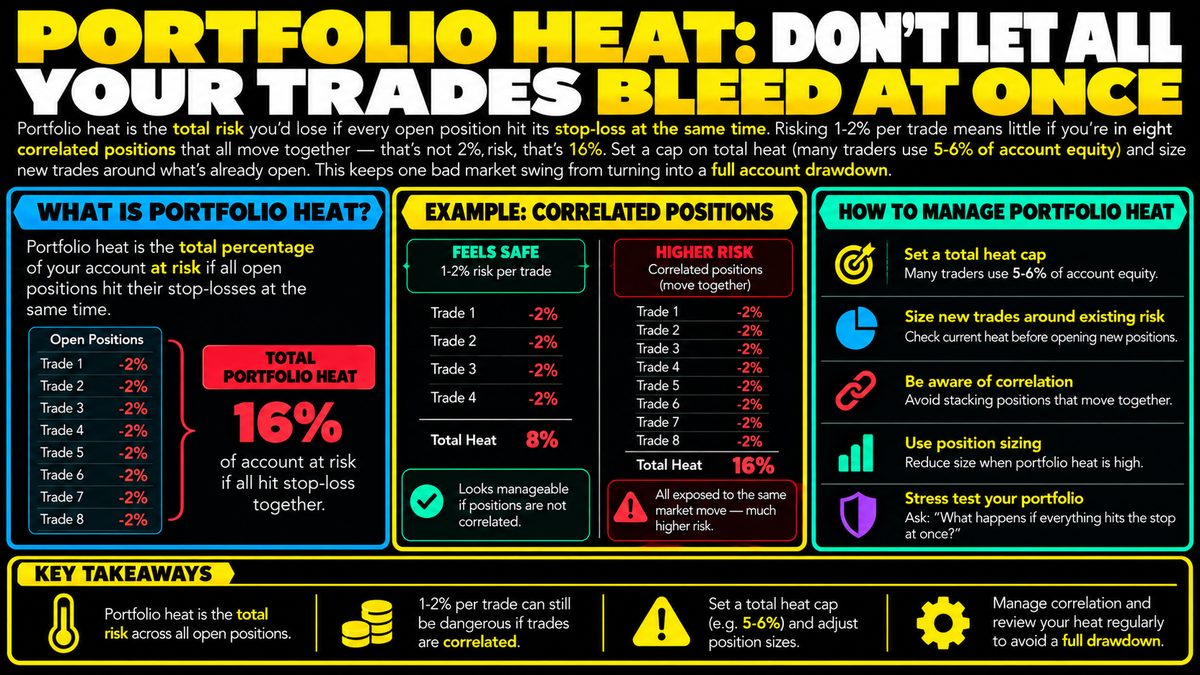
Portfolio heat is the total risk you'd lose if every open position hit its stop-loss at the same time. Risking 1-2% per trade means little if you're in eight correlated positions that all move together — that's not 2% risk, that's 16%. Set a cap on total heat (many traders use 5-6% of account equity) and size new trades around what's already open. This keeps one bad market swing from turning into a full account drawdown.
What Portfolio Heat Actually Measures
Portfolio heat is a simple but often ignored idea: if every single trade you currently have open hit its stop-loss (the price level where you exit to cap a loss) at the same time, how much of your account would disappear? That combined number is your heat. It is different from the risk of any one trade, because it accounts for everything you're exposed to at once, not just the position you happen to be looking at right now.
Most beginner risk rules focus on a single trade, something like "never risk more than one or two percent of your account on one position." That is a reasonable starting point, but it quietly assumes each trade is an isolated event. In reality, traders rarely hold just one position. They hold several, and those positions often move for the same underlying reason.
Why Correlated Trades Multiply Risk
Correlation means two or more things tend to move in the same direction at the same time. In crypto, many coins are correlated because they react to the same broad market sentiment, the same liquidity conditions, or the same news about the sector as a whole. If a trader opens eight separate positions, each risking two percent, and all eight are tied to the same market mood, then a single sharp downturn can trigger all eight stop-losses in the same hour.
That is not two percent of risk, it is closer to sixteen percent, because the loss on one position is not offset by gains elsewhere, it happens alongside seven similar losses. The per-trade rule was followed correctly, yet the account still absorbed a drawdown far larger than the trader ever intended. This is the core danger portfolio heat is meant to catch.
How Traders Set a Heat Cap
A common practice is to set a maximum total heat, often somewhere around five to six percent of account equity, though the right number depends on a trader's own tolerance for drawdown and how volatile the assets are. Before opening a new position, the trader adds up the risk already committed across all open trades and checks whether the new trade would push the total past that cap.
If it would, the choices are usually to skip the new trade, reduce its size, tighten the stop, or close an existing position first. This turns risk management into a portfolio-level decision rather than a trade-by-trade afterthought, and it forces some discipline around how many similar positions get stacked on top of each other.
Common Mistakes and Real Limitations
A frequent mistake is treating every position as independent when sizing risk, ignoring that several trades are effectively the same bet wearing different names. Another is calculating heat only at the moment of entry and never updating it as stops are moved or new trades are added throughout the day.
Portfolio heat is also not a precise science. Correlations between assets shift over time and can break down exactly when they matter most, during sharp market-wide moves. Stops can also gap past their intended level in fast markets, meaning the real loss can exceed the planned heat calculation. It is a risk-reduction tool, not a guarantee against loss.
Fitting Heat Into a Broader Risk Framework
Portfolio heat works best alongside other basic risk habits, such as sensible position sizing, realistic stop placement, and awareness of how many assets in a portfolio actually behave differently from one another. No single measure, indicator, or cap can protect against every scenario, and markets can move in ways that defy prior patterns entirely. Thinking in terms of total exposure, rather than isolated trades, is simply one more way to keep a single bad swing from becoming a full account event.