
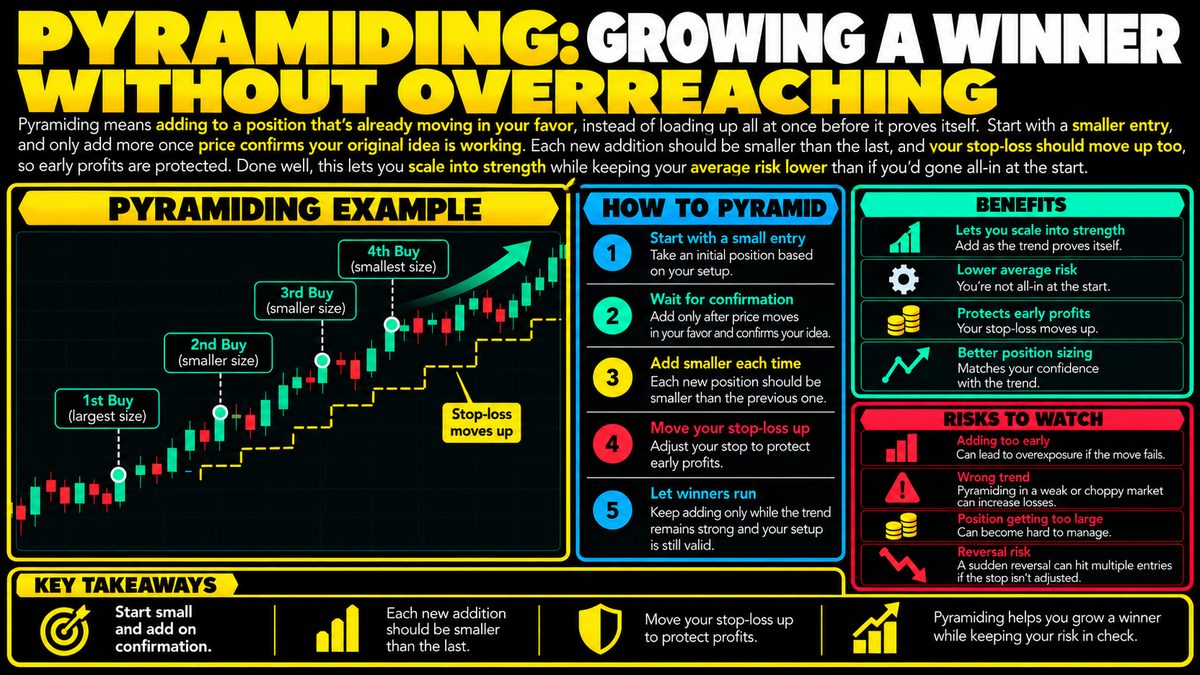
Pyramiding means adding to a position that's already moving in your favor, instead of loading up all at once before it proves itself. Start with a smaller entry, and only add more once price confirms your original idea is working. Each new addition should be smaller than the last, and your stop-loss should move up too, so early profits are protected. Done well, this lets you scale into strength while keeping your average risk lower than if you'd gone all-in at the start.
What Pyramiding Actually Means
Pyramiding is a way of building a position over time rather than committing all your capital in a single trade at once. Instead of deciding upfront "I will buy X amount right now," a trader starts with a smaller test entry. If the market moves in the direction they expected, they add more. If it does not, the initial position was small enough that the damage stays limited.
The name comes from the shape of the position over time: a wide base of smaller, later additions sitting on top of a narrower, earlier entry, or visualized the other way as a pyramid where the first entry is the tip and confirmation builds the base underneath it. Either way, the core idea is the same, size grows only after the market has already agreed with you.
How a Pyramided Position Is Typically Built
A common approach starts with a modest first entry, sized so that even a full stop-out would only be a small, acceptable loss. If price then moves favorably and reaches some kind of confirmation, for example a new higher structure forming, a breakout holding, or a pullback finding support, the trader adds a second entry. This second entry is usually smaller than the first, not larger, because the trader now has unrealized profit on the line and does not want to dilute that cushion with oversized new risk.
If the trend continues, a third addition might follow, smaller still. Each new layer is added only after price confirms the previous layer's thesis, never in anticipation of it. As additions are made, the stop-loss, which is a predetermined price where the trade is exited to cap losses, is typically moved up to lock in some of the paper profit, so a reversal cannot turn a winning trade into a losing one on the whole position.
Why Traders Use This Approach
The appeal of pyramiding is that it tries to solve a real tension in trading, the temptation to go all-in early to capture the maximum move versus the risk that an early full-size bet gets wrong-footed before the trend even develops. By starting small, a trader protects capital while the idea is unproven, then scales into strength once the market has already given some evidence the thesis is correct. In theory this produces a lower average risk than a single large entry made without that confirmation.
Common Mistakes and Limitations
Pyramiding is often misused by traders who add to losing positions instead of winning ones, sometimes called averaging down, which is a fundamentally different and riskier behavior since it increases exposure to a trade that has not been validated. Another common error is adding equal or larger size on each new layer, which can leave the position more exposed at exactly the point when a reversal would be most costly. Traders also sometimes forget to raise their stop-loss as they add, leaving early profits unprotected.
It is also worth remembering that confirmation signals can fail. A breakout can reverse, a new high can be a false one, and no sequence of additions guarantees the trend continues. Pyramiding manages risk, it does not eliminate it, and transaction costs from multiple entries and exits can also add up.
Fitting It Into a Broader Risk Framework
Pyramiding works best as one tool within a larger plan that includes clear position sizing rules, a predefined maximum risk per trade, and a consistent method for identifying confirmation rather than reacting emotionally to price. It pairs naturally with trailing stops and with technical or trend-following tools used to define what counts as confirmation. As with any technique, past patterns of price behavior do not guarantee future outcomes, and this explainer is educational only, not a recommendation to trade in any particular way.