
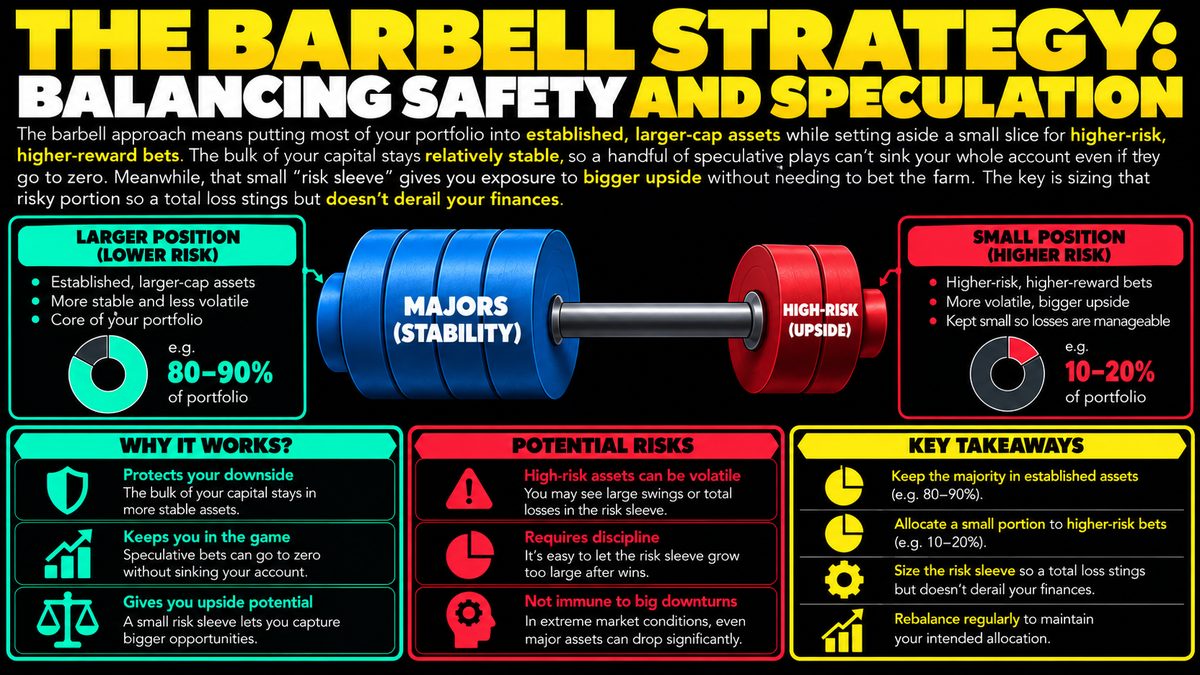
The barbell approach means putting most of your portfolio into established, larger-cap assets while setting aside a small slice for higher-risk, higher-reward bets. The bulk of your capital stays relatively stable, so a handful of speculative plays can't sink your whole account even if they go to zero. Meanwhile, that small "risk sleeve" gives you exposure to bigger upside without needing to bet the farm. The key is sizing that risky portion so a total loss stings but doesn't derail your finances.
What The Barbell Actually Looks Like
Picture a barbell at the gym: heavy weight on each end, almost nothing in the middle. Applied to a portfolio, that means most of your money sits in the "safe" end, established, larger-cap assets that have been around long enough to have deeper markets and more history to evaluate. A small remainder sits in the "risky" end, newer or smaller assets with much higher volatility and a much wider range of possible outcomes. The middle, moderate-risk assets that offer neither real stability nor real upside, is deliberately left thin or skipped. The idea isn't unique to crypto; it borrows from a broader risk-management concept used in traditional investing and even in decision-making generally: avoid the mushy middle, concentrate at the extremes where you understand the risk clearly.
Why Traders Use This Split
The logic is about controlling the damage a bad outcome can do. If your speculative bets are small relative to your whole account, then even a total loss on all of them, say a coin genuinely going to zero, only costs you that fixed slice. Meanwhile the larger, steadier portion of your holdings keeps compounding or at least surviving. This matters because speculative assets in crypto can lose all their value quickly, sometimes for reasons that have nothing to do with the broader market. A barbell structure means you can still participate in that upside potential without a single bad bet threatening your overall financial position.
Sizing The Risk Sleeve
There's no universal number for how big the speculative slice should be, and anyone who gives you an exact percentage is guessing on your behalf. What matters is asking yourself a simple question: if this entire slice went to zero tomorrow, would it change your life, your obligations, or your sleep. If the answer is yes, the slice is too big. Some traders use a small single-digit percentage of total holdings, others go a bit higher depending on their income, timeline, and tolerance for volatility. The sizing should be revisited periodically too, since winning speculative bets can grow that slice far beyond its original weight without you noticing.
Common Mistakes
The most frequent error is letting the risk sleeve creep upward. A speculative position that triples in value can suddenly represent a much larger share of the portfolio than intended, quietly turning a barbell into something far more lopsided and dangerous. Another mistake is treating the "safe" end as risk-free. Larger, established crypto assets are still volatile compared to traditional safe havens, and a barbell in crypto is about relative safety, not guaranteed stability. Some traders also fool themselves by adding too many "middle" assets, moderate-cap coins that carry real risk but offer limited asymmetric upside, defeating the purpose of the structure.
Fitting It Into A Broader Risk Framework
A barbell approach works alongside other basics of risk management, not instead of them. Position sizing, diversification within each end of the barbell, and having a plan for when to trim winners or cut losers all still apply. It also doesn't replace research; putting money into an established asset because it's "the safe end" without understanding it is still a risk decision, just a different kind. No structure, barbell or otherwise, guarantees protection against loss or promises any particular return. It's simply a way of organizing exposure so that your worst-case scenario in the speculative sleeve doesn't become your worst-case scenario overall.