
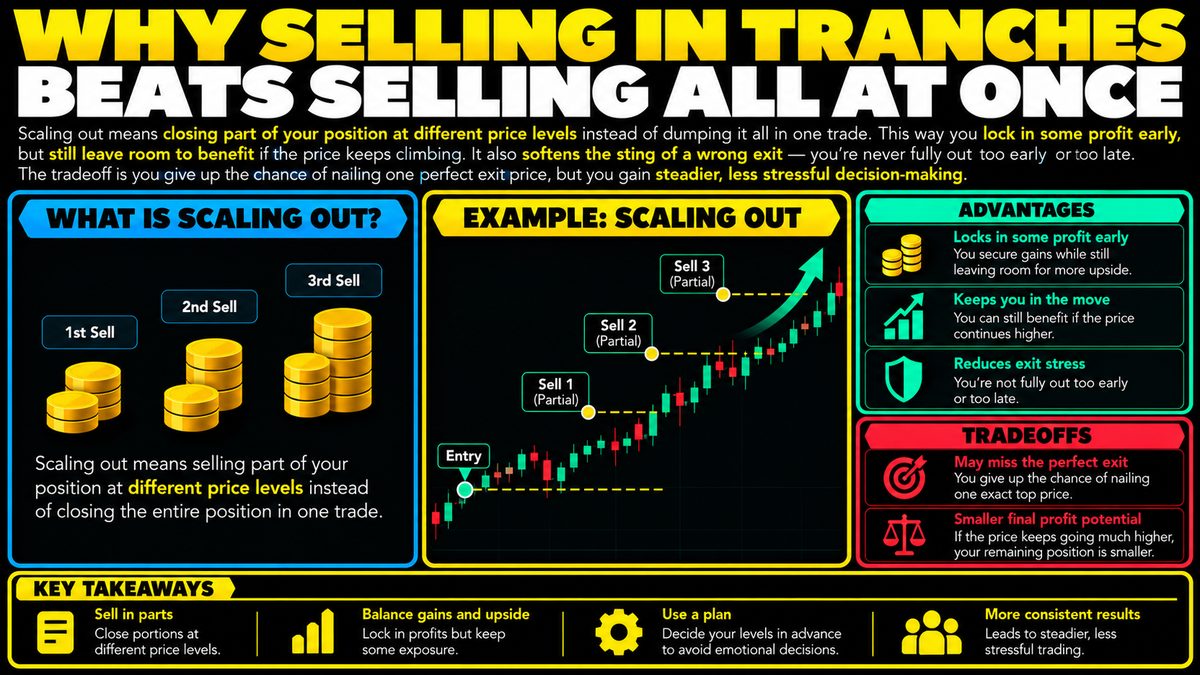
Scaling out means closing part of your position at different price levels instead of dumping it all in one trade. This way you lock in some profit early, but still leave room to benefit if the price keeps climbing. It also softens the sting of a wrong exit — you're never fully out too early or too late. The tradeoff is you give up the chance of nailing one perfect exit price, but you gain steadier, less stressful decision-making.
What Scaling Out Actually Means
Scaling out is the practice of closing a trade in pieces rather than all at once. Instead of deciding on a single exit price and selling your entire position the moment it hits, you sell a portion at one level, another portion at a higher level, and perhaps a final portion even higher or based on some other signal. The result is an average exit price built from several smaller decisions instead of one large, all-or-nothing decision.
Imagine you hold a coin you bought at 100. Rather than setting one target of 150 and selling everything there, you might sell a third at 120, a third at 140, and let the rest ride with no fixed target, perhaps trailing a stop instead. Each slice is a separate, smaller bet, and together they smooth out the outcome compared to guessing one perfect number.
Why Traders Use This Approach
The core appeal is psychological as much as it is technical. Nobody can consistently predict the exact top of a move, and trying to do so often leads to either selling too early out of fear or holding too long out of greed. By splitting the exit into tranches, a trader locks in some realized profit early, which reduces anxiety, while still keeping a portion of the position open in case the price continues higher.
This also softens the impact of being wrong. If the price reverses right after your first sale, you still have profit banked. If it keeps climbing past your first few exits, you still benefit from the remaining position. Selling everything at once means every outcome depends entirely on that single moment being the right one, which is a lot of pressure to put on one decision.
Common Ways to Structure the Tranches
There is no single correct method. Some traders use fixed percentage levels, such as selling a quarter of the position every time the price rises by a set amount. Others tie their exits to technical levels like resistance zones, moving averages, or prior swing highs. Others use time-based rules, trimming a position after a certain number of days regardless of price, simply to reduce risk exposure over time.
Some traders also scale out based on changing conviction. If the original reason for holding the trade weakens, even without a price target being hit, they might reduce the position size as a way of managing uncertainty rather than waiting for a specific number.
The Tradeoffs and Limitations
Scaling out is not free of downsides. By design, you give up the possibility of selling your entire position at the single best price. If the market happens to peak exactly where your last tranche was sitting, a trader who sold everything there in one shot would have done better on paper. Scaling out optimizes for consistency and reduced regret, not for maximizing the theoretical best outcome.
It also requires more active management. Multiple exit levels mean more decisions, more monitoring, and sometimes higher transaction costs depending on fees per trade. In fast-moving or highly volatile conditions, tranches can also fill oddly, leaving a trader with an average price that feels awkward in hindsight.
Fitting It Into a Broader Risk Plan
Scaling out works best as one part of a broader plan that includes position sizing, stop-losses, and a clear understanding of why the trade was entered in the first place. It does not replace analysis; it simply changes how a decision already made gets executed. No exit method, tranche-based or otherwise, guarantees a good outcome, since markets can move against any plan at any time.
Treating scaling out as a tool for managing behavior and emotional consistency, rather than a way to engineer perfect trades, tends to be the more realistic mindset. Combined with sound risk management and honest record-keeping of what worked and what did not, it can make exits feel less like guesswork and more like a repeatable process.