
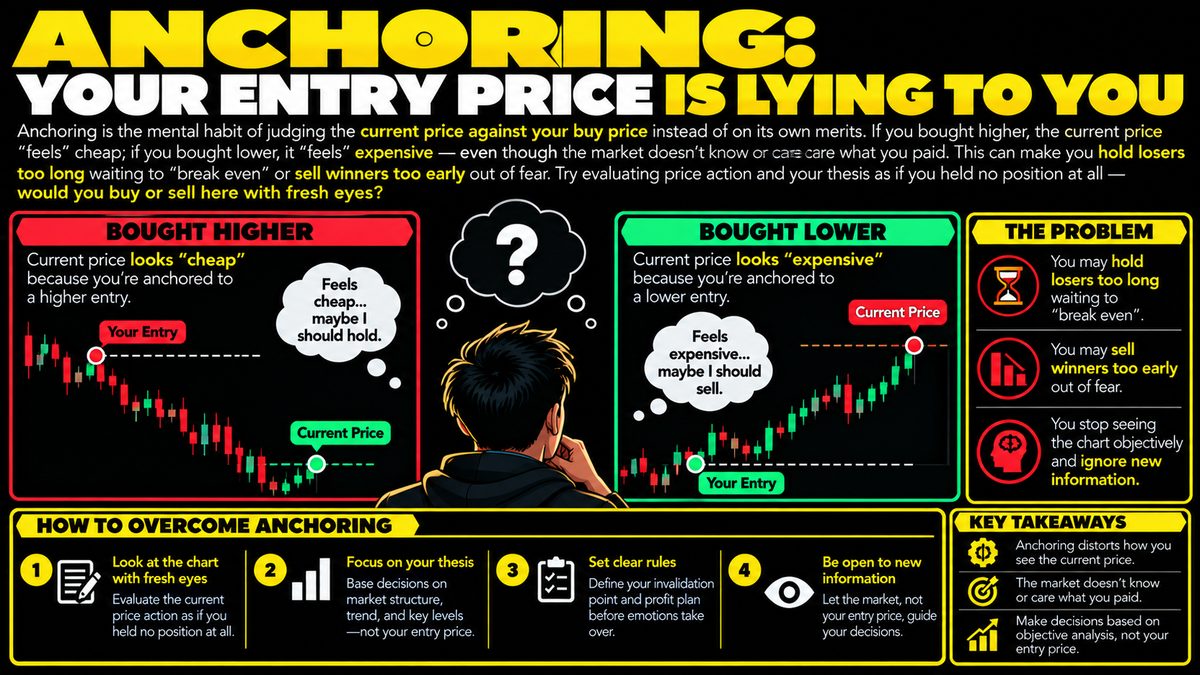
Anchoring is the mental habit of judging the current price against your buy price instead of on its own merits. If you bought higher, the current price "feels" cheap; if you bought lower, it "feels" expensive — even though the market doesn't know or care what you paid. This can make you hold losers too long waiting to "break even" or sell winners too early out of fear. Try evaluating price action and your thesis as if you held no position at all — would you buy or sell here with fresh eyes?
What Anchoring Actually Is
Anchoring is a mental shortcut where your brain latches onto a number it already knows and uses it as a reference point for every judgment after that. In trading, the number that sticks hardest is almost always your entry price, the price you paid when you opened a position. Once that number is in your head, it quietly becomes the yardstick for whether the current price feels good or bad, even though the market has no memory of what you paid and no reason to move in your favor just because you are waiting.
This happens because the human mind is wired to think in terms of gains and losses relative to a reference point, not in absolute terms. A coin trading at 100 is the same coin whether you bought it at 80 or at 120. Objectively nothing about its value has changed based on your purchase price. But psychologically, those two scenarios feel completely different, and that feeling shapes decisions in ways that often work against you.
How It Shows Up In Real Decisions
If you bought a coin at 80 and it is now at 100, the gain can feel like free money, making you reluctant to sell even when your original reasons for buying no longer hold. You might hold on simply because the position feels like a win, not because the setup still makes sense.
Flip it around: if you bought at 120 and the price drops to 100, that same price now feels like a loss, and many traders refuse to sell until they get back to break even. This is one of the most common and costly patterns in trading. People hold losing positions far longer than they should, not because the evidence supports holding, but because selling at a loss confirms a mistake, and the brain wants to avoid that discomfort. Meanwhile the capital stays tied up in a position that may keep deteriorating.
Why This Distorts Your Analysis
The deeper problem is that anchoring replaces analysis with emotion. Instead of asking whether the current price reflects fair value given new information, you end up asking whether it is above or below what you paid. These are two completely different questions, and only one of them has anything to do with the asset's actual prospects.
This also affects winners, not just losers. Fear of giving back paper gains can cause traders to exit strong positions too early, locking in a small profit instead of letting a well-reasoned thesis play out, simply because the current price already feels like a win worth protecting.
A Simple Mental Reset
One practical way to counter anchoring is to imagine you hold no position at all and ask yourself plainly: would I buy this asset right now, at this price, given what I currently know? If the answer is yes, that supports holding or even adding. If the answer is no, that is worth taking seriously, regardless of whether you are currently sitting on a gain or a loss.
This exercise will not feel natural at first, because it goes against the brain's default wiring. It also will not produce certainty. No mental trick removes risk or guarantees a better outcome.
Where This Fits With Risk Management
Anchoring is best handled alongside concrete tools rather than willpower alone. Predetermined exit rules, position sizing decided in advance, and written-down reasons for entering a trade all give you something more objective to check against than your own purchase price. None of this eliminates uncertainty or predicts what price will do next, but it reduces the chance that your entry price quietly becomes the only thing driving your decisions.