
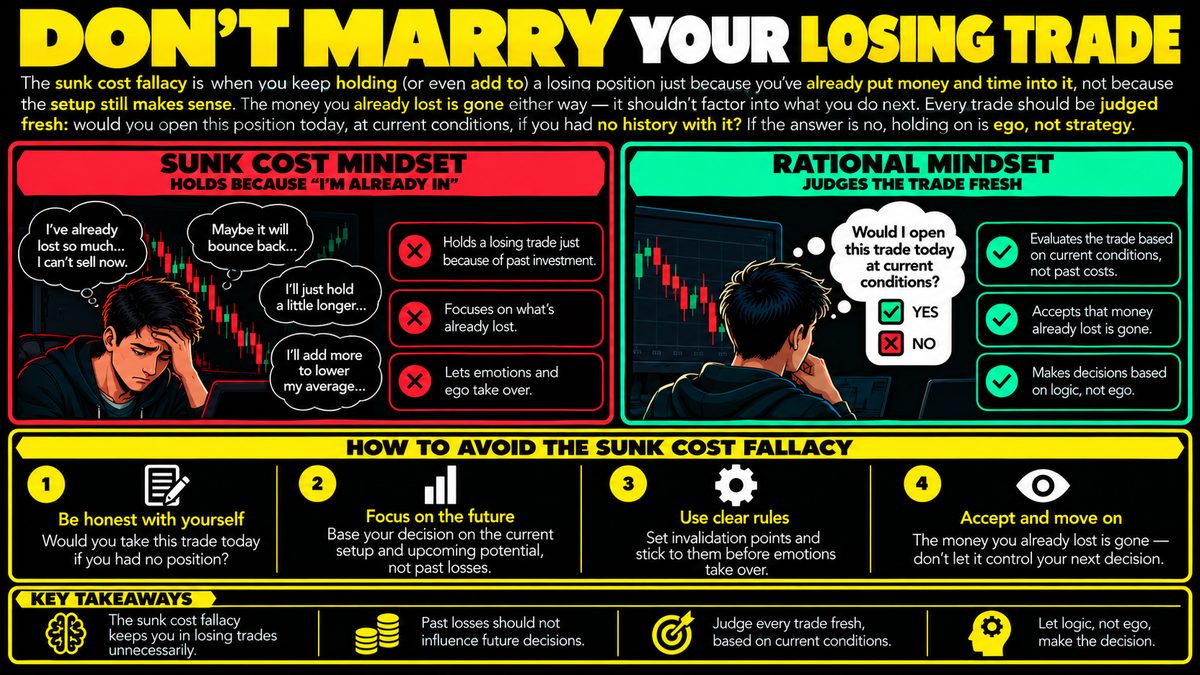
The sunk cost fallacy is when you keep holding (or even add to) a losing position just because you've already put money and time into it, not because the setup still makes sense. The money you already lost is gone either way — it shouldn't factor into what you do next. Every trade should be judged fresh: would you open this position today, at current conditions, if you had no history with it? If the answer is no, holding on is ego, not strategy.
What the Sunk Cost Fallacy Actually Is
The sunk cost fallacy is a thinking error where you let past investment of money, time, or effort influence a decision that should only be based on the present and future. In trading, this shows up when someone holds onto a losing position, or even adds more money to it, simply because they already have so much tied up in it. The logic sounds reasonable in the moment: "I've already lost this much, I can't quit now." But the money already spent is gone regardless of what you do next. It cannot be recovered by holding, and it cannot be protected by adding more. The only thing that matters going forward is whether the trade still makes sense based on current conditions, not based on what you've already put into it.
How It Shows Up in a Trade
Imagine you buy a coin at 100, expecting it to rise. It drops to 80, then 60. At each stage, the original reason you bought may have already stopped being true, but instead of reassessing, you tell yourself you'll hold until it gets back to breakeven, because selling now would "lock in the loss." Some traders go further and buy more at 60 or 40, not because the setup improved, but because it lowers their average cost and makes the eventual breakeven point easier to reach. This is often called averaging down, and while it can sometimes be a deliberate, pre-planned strategy, it becomes dangerous when it's really just an emotional attempt to avoid admitting the first decision isn't working out.
The Fresh Eyes Test
A useful mental exercise is to ask yourself: if I had no position at all right now, and I was looking at this coin fresh, with no history, would I open this trade today at current conditions? If the honest answer is no, then continuing to hold is not a strategy, it is attachment. This test strips away the emotional weight of the loss already taken and forces you to evaluate the asset on its current merits, not on what you wish had happened. It is uncomfortable to do this honestly, because it often means admitting the original trade idea has failed, but that discomfort is far cheaper than the discomfort of a larger loss later.
Why This Bias Is So Powerful
Humans are wired to hate feeling like they wasted something, whether it's money, time, or effort. Admitting a loss can feel like admitting you were wrong, and that feels worse to many people than the actual financial cost of being wrong. Markets do not know or care how much you've invested, emotionally or financially, in a position. Price moves based on supply, demand, news, and the collective behavior of other participants, none of which are influenced by your personal history with the trade. Treating a loss as a reason to hold or add more is essentially letting ego substitute for analysis.
Common Mistakes and Practical Guardrails
One common mistake is confusing a planned, pre-defined averaging strategy with an emotional reaction to a loss. The difference lies in whether the decision was made in advance, with clear conditions, or is being invented in the moment to avoid discomfort. Another mistake is treating "it already dropped a lot" as a signal that it must be close to turning around, which is not something a lower price inherently guarantees. Setting predefined exit points before entering a trade, and deciding in advance what would make you reconsider the setup, can help remove emotion from these decisions later. No single rule guarantees a good outcome, since markets are unpredictable, but separating past losses from future decisions is one of the more reliable habits that can improve decision quality over time.