
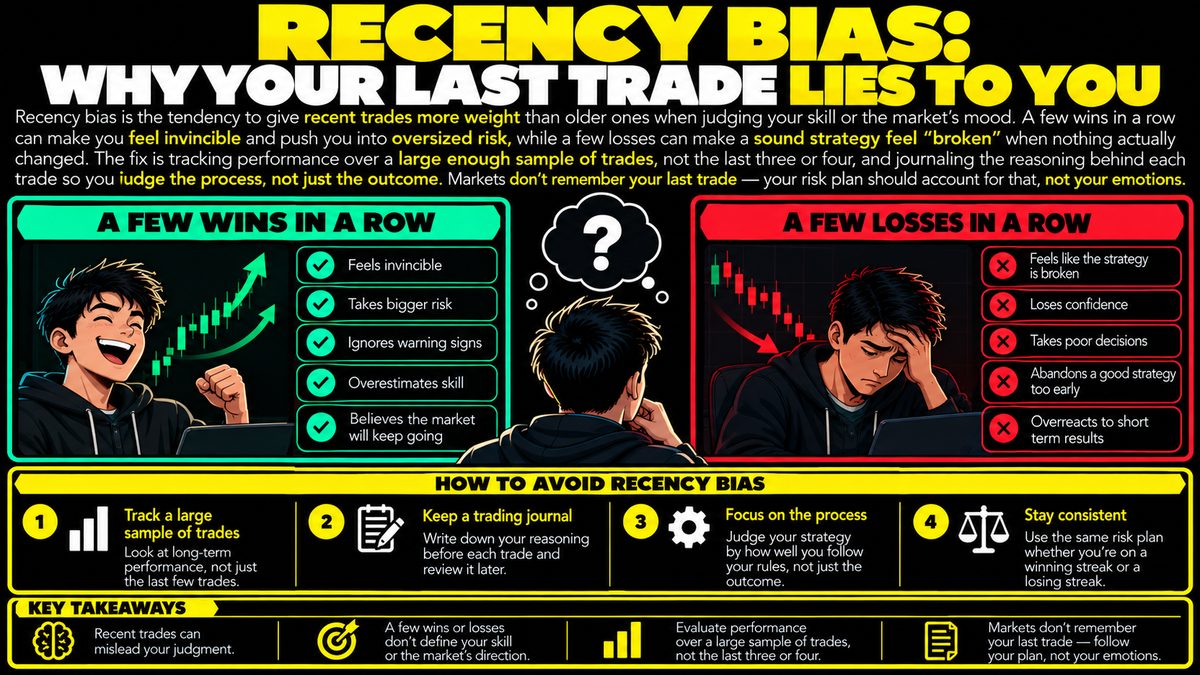
Recency bias is the tendency to give recent trades more weight than older ones when judging your skill or the market's mood. A few wins in a row can make you feel invincible and push you into oversized risk, while a few losses can make a sound strategy feel "broken" when nothing actually changed. The fix is tracking performance over a large enough sample of trades, not the last three or four, and journaling the reasoning behind each trade so you judge the process, not just the outcome. Markets don't remember your last trade — your risk plan should account for that, not your emotions.
What Recency Bias Actually Is
Recency bias is a mental shortcut where the brain treats the most recent events as more important or more representative than older ones, even when there is no logical reason for that weighting. It is not unique to trading. People do the same thing when judging a sports team after one good game or a restaurant after one bad meal. In trading, this shortcut becomes dangerous because markets are full of randomness, and a small number of recent trades can easily be noise rather than a real signal about your skill or the market's direction.
The human brain evolved to notice patterns quickly, often for survival reasons, but financial markets do not reward the same instincts that helped early humans avoid predators. A string of three or four trades is a tiny sample size, meaning it is too small a set of data points to draw a reliable conclusion from. Yet emotionally, those few trades can feel like overwhelming proof that something has changed.
How It Shows Up After Wins
After a few winning trades in a row, many traders start to feel that they have figured something out, that their read on the market is unusually sharp right now. This feeling often leads to increasing position size, meaning the amount of capital risked per trade, loosening stop losses, meaning the predetermined price at which a losing trade is closed to limit damage, or entering trades that do not fit the original strategy at all. The underlying belief is that recent success predicts near-term success, even though market conditions can shift without warning and a prior winning streak offers no guarantee of what comes next.
How It Shows Up After Losses
The mirror image happens after a string of losses. A trader who has followed a tested, rules-based approach for months may suddenly conclude the method is broken after just a handful of red trades. This can trigger abandoning the strategy entirely, chasing a different approach, or revenge trading, which means trying to immediately win back losses with impulsive, oversized trades. In reality, even a strategy with a genuine statistical edge over time will produce losing streaks, because probability does not move in a straight line.
Why a Larger Sample Changes the Picture
Judging a strategy fairly requires looking at a meaningful number of trades, often dozens or more, rather than the last handful. A useful habit is separating the outcome of a trade from the quality of the decision that led to it. A well-reasoned trade can still lose, and a poorly reasoned trade can still win by chance. Keeping a trading journal that records the reasoning, the setup, and the risk parameters before the outcome is known helps a trader later review whether the process was sound, independent of how any single trade turned out.
Fitting This Into a Risk Plan
A risk management plan exists precisely to remove emotional decision-making from moments when recency bias is strongest. Predefined position sizing, maximum loss limits, and rules for when to pause trading after a drawdown all act as guardrails that do not care how the last few trades felt. Combining this structure with regular, honest review of a large trade sample is far more informative than reacting to the most recent result. No journaling habit, risk rule, or pattern recognition method can guarantee future outcomes, since markets remain uncertain, but reducing the emotional weight given to recent trades is a realistic way to make decisions more consistently.