
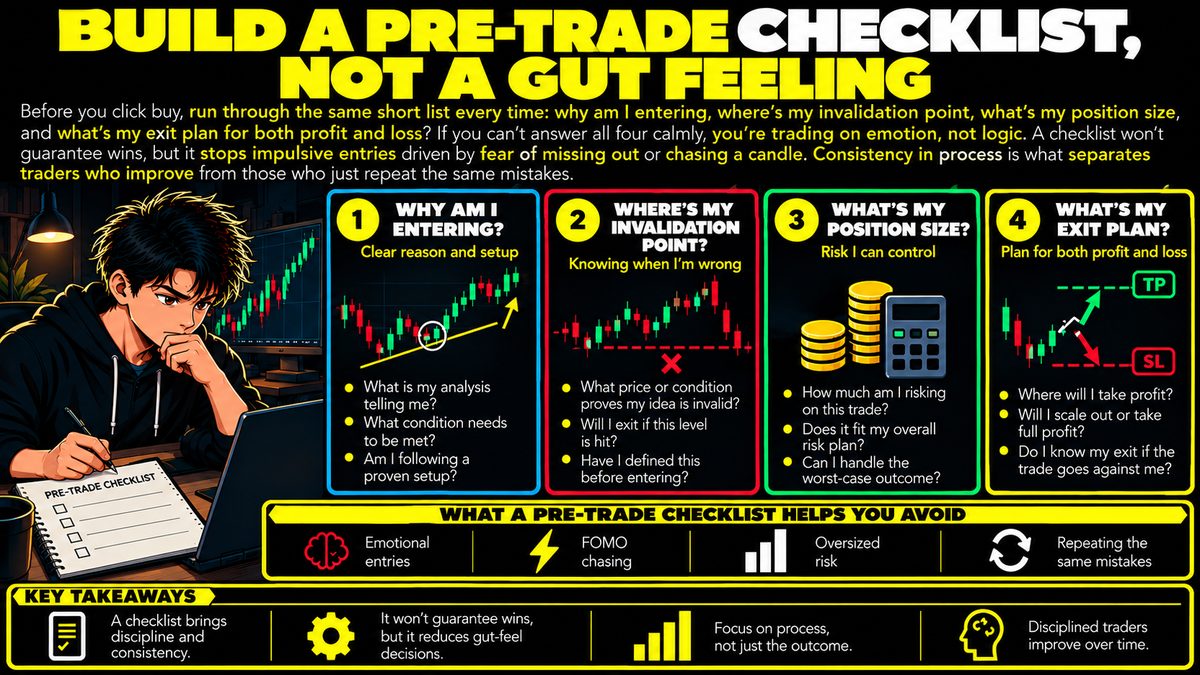
Before you click buy, run through the same short list every time: why am I entering, where's my invalidation point, what's my position size, and what's my exit plan for both profit and loss? If you can't answer all four calmly, you're trading on emotion, not logic. A checklist won't guarantee wins, but it stops impulsive entries driven by fear of missing out or chasing a candle. Consistency in process is what separates traders who improve from those who just repeat the same mistakes.
Why a Checklist Beats a Feeling
Trading decisions made in the moment are often shaped by adrenaline, not analysis. When a coin moves quickly, the brain registers it the same way it registers any sudden opportunity or threat, which pushes people toward fast, reactive choices. A checklist slows that process down. It forces you to answer the same questions every time, regardless of how exciting or scary the market looks, so your entries come from a repeatable process rather than a mood.
This matters because consistency is what allows you to actually learn from your trading history. If every trade is entered for a different, vague reason, you can never tell afterward whether your approach is working or whether you just got lucky or unlucky. A checklist turns trading into something you can review and improve, rather than a string of disconnected gambles.
The Four Questions
The first question is why you are entering at all. This should be a specific, observable reason, such as a particular chart pattern, a signal from an indicator you use, or a level the price has reacted to before, not simply a hunch that it is going up.
The second question is where your invalidation point is. Invalidation means the price level or condition that proves your original reason for entering was wrong. If the market reaches that point, the trade idea has failed, regardless of how you feel about it.
The third question is position size, meaning how much of your capital you are putting at risk relative to your total account. The fourth is your exit plan on both sides, meaning you decide in advance roughly where you would take profit and where you would cut losses, before emotions have a chance to shift your judgment later.
What Happens Without One
Without a checklist, traders commonly fall into chasing a candle, meaning buying after a sharp move purely because it already happened and looks exciting, with no plan for what comes next. This is closely related to fear of missing out, where the discomfort of watching a move without being part of it overrides any structured reasoning.
Another common failure is moving the goalposts mid-trade, such as widening a stop loss after the price already breached it, simply because admitting the original idea was wrong feels uncomfortable. A written invalidation point decided in advance makes this harder to rationalize, because you are comparing the market to a rule you set calmly rather than to a feeling you have right now.
Limitations of a Checklist
A checklist does not predict the market and does not turn a weak idea into a good one. If your reason for entering is poorly thought out, answering the four questions quickly will not fix that; it simply exposes the weak reasoning sooner, which is still valuable but not a guarantee of profit.
It also will not remove emotion from trading entirely. You can still feel fear or greed while following a checklist. Its purpose is to give you a stable reference point to return to when those feelings arise, not to eliminate them.
Fitting It Into a Larger Process
A pre-trade checklist works best alongside broader risk management habits, such as capping how much of your account you are willing to lose on any single trade, and alongside other analysis tools you already use, such as chart patterns or technical indicators. The checklist is not a replacement for those tools; it is the discipline layer that ensures you actually use them consistently instead of abandoning them under pressure.
Over time, reviewing completed trades against the checklist lets you see patterns in your own behavior, not just the market's. That self-awareness, built trade by trade, is often what separates traders who steadily refine their process from those who repeat the same avoidable mistakes indefinitely.