
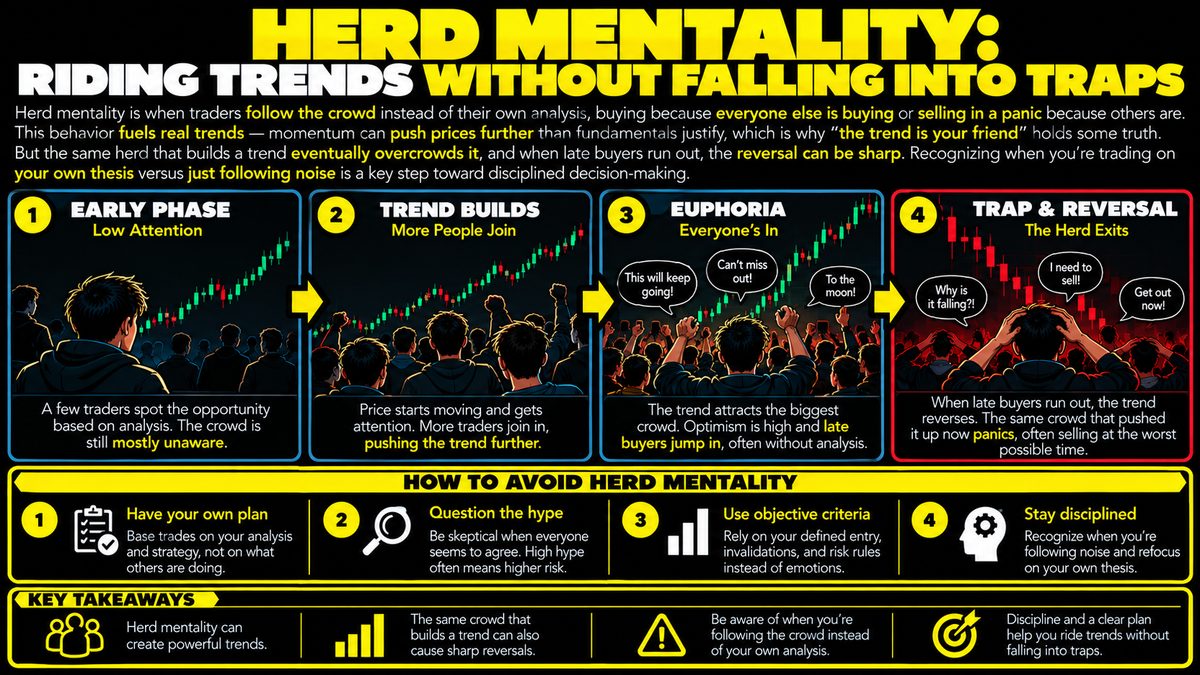
Herd mentality is when traders follow the crowd instead of their own analysis, buying because everyone else is buying or selling in a panic because others are. This behavior fuels real trends — momentum can push prices further than fundamentals justify, which is why "the trend is your friend" holds some truth. But the same herd that builds a trend eventually overcrowds it, and when late buyers run out, the reversal can be sharp. Recognizing when you're trading on your own thesis versus just following noise is a key step toward disciplined decision-making.
Why the Crowd Moves Markets
Markets are made of people, and people are social creatures. When prices start moving in one direction, it is natural to assume that other traders know something you do not. This feeling is amplified in crypto, where information spreads fast through social media, group chats, and news feeds. As more people buy because others are buying, demand itself becomes the story, pulling in even more buyers who fear missing out. This self-reinforcing cycle is herd mentality in action, and it is one of the most powerful forces behind short-term price trends.
How Trends Are Built on Momentum
A trend does not need a perfect fundamental reason to keep going. Once enough traders believe a move is real, their collective buying or selling can push price further than any underlying data would suggest alone. This is why the old trading saying "the trend is your friend" holds some truth. Riding an established trend, with the crowd rather than against it, has historically been an easier path than trying to predict a reversal before it starts. Imagine a coin trading at 100 that climbs to 120 simply because steady buying attracts more buyers. The move is real in the sense that it happened, even if it is driven more by psychology than by new information.
When the Herd Becomes a Trap
The same crowd behavior that builds a trend eventually works against it. As a move extends, later participants tend to buy with less analysis and more emotion, often near the end of the trend rather than the beginning. Once most of the people who wanted to buy have already bought, there is no new demand left to push price higher, and even a small wave of selling can trigger a fast reversal. This is sometimes described as the trend running out of new buyers. The sharpest drops often happen precisely when confidence is highest, because that is when the most late entrants are holding positions with little room left to be patient.
Telling Your Thesis from Noise
A practical habit is to pause and ask whether you can explain, in your own words, why you are considering a trade without mentioning what other people are doing. If the honest answer is "because everyone else is buying" or "because it is trending," that is a signal you may be following noise rather than analysis. This does not mean herd-driven trades are always wrong, but it means you should recognize the trade for what it is and size your risk accordingly, rather than convincing yourself it is based on deeper research than it actually is.
Using Trend Tools Without Losing Yourself
Indicators like moving averages, trendlines, and volume can help confirm that a trend has real participation rather than relying on gut feeling alone, but no tool can tell you in advance when the crowd will turn. Combining trend-following with clear risk management, such as deciding in advance how much you are willing to lose on a trade, matters more than trying to time the exact top or bottom. No pattern, indicator, or crowd signal guarantees an outcome, and herd behavior can reverse without warning.
Building Independent Judgment Over Time
The goal is not to ignore the crowd entirely, since trends are a real and recurring feature of markets, but to stay aware of when you are reasoning independently versus simply reacting to others. Keeping a trading journal, reviewing past decisions, and noticing patterns in your own emotional triggers can help separate genuine analysis from borrowed conviction. Over time, this awareness is what allows a trader to ride trends deliberately instead of being swept along by them.