
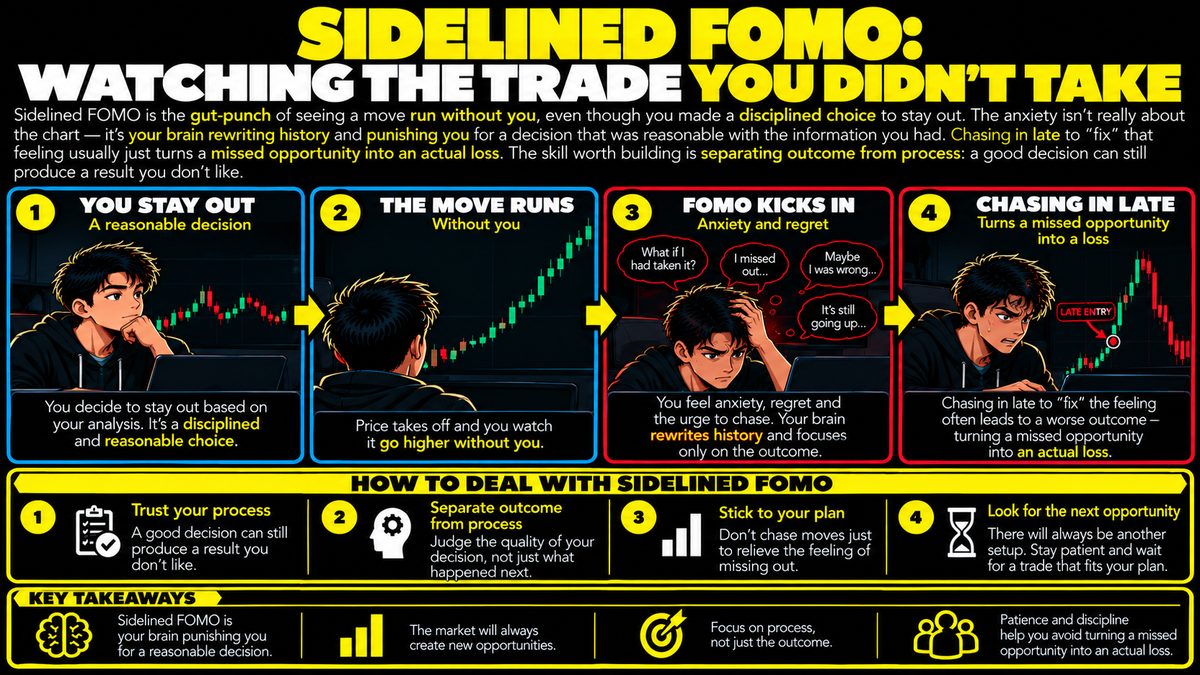
Sidelined FOMO is the gut-punch of seeing a move run without you, even though you made a disciplined choice to stay out. The anxiety isn't really about the chart — it's your brain rewriting history and punishing you for a decision that was reasonable with the information you had. Chasing in late to "fix" that feeling usually just turns a missed opportunity into an actual loss. The skill worth building is separating outcome from process: a good decision can still produce a result you don't like.
What Sidelined FOMO Really Is
Sidelined FOMO is the uncomfortable feeling that shows up when a market moves the way you expected, but you are not in the trade. You watched the setup, decided the risk did not justify entering, and then the price went on to do exactly what you thought it might. The discomfort is not really about missing money. It is the mental sting of watching your own forecast turn out correct while your decision to stay out feels, in hindsight, wrong.
This is different from regular FOMO, which usually drives people into a trade they were never planning to take. Sidelined FOMO happens after a disciplined choice, which makes it sneakier. It can quietly convince a careful trader that their process failed them, when in fact their process worked exactly as intended by keeping them out of a trade that did not meet their criteria at the time.
Why Your Brain Rewrites the Story
Once a price move has already happened, your brain processes it very differently than it did in the moment of deciding. This is called hindsight bias, the tendency to see past events as having been more predictable than they actually were. Looking backward, the move looks obvious. In the moment, it was one of many possible outcomes, and you had no reliable way to know which one would occur.
Hindsight bias turns a reasonable decision into something that feels like a mistake, purely because of how things turned out. It ignores the fact that at the time you decided to stay sidelined, the information available did not clearly favor entering. Judging a decision by its outcome alone, rather than by the quality of the reasoning behind it, is one of the most common traps in trading psychology.
How This Feeling Changes Behavior
The real danger of sidelined FOMO is not the discomfort itself but what traders do to relieve it. A common reaction is chasing, meaning entering a trade late, after much of the move has already happened, just to feel involved again. Chasing often means buying into a price that has already extended, with a weaker risk-to-reward setup than the original opportunity offered.
This is how a missed opportunity can turn into an actual financial loss. The original decision to stay out cost nothing. The emotional reaction to that decision, acted on impulsively, can cost real capital. Recognizing this pattern is often the first step toward breaking it, since the urge to chase usually has more to do with easing anxiety than with any new, objective reason to enter.
Judging the Decision, Not the Result
A core skill in trading is learning to separate process from outcome. A good decision is one that was reasonable given the information, risk tolerance, and strategy you had at the time, regardless of what the market did afterward. A good process can still produce a disappointing result, and a poor process can occasionally produce a lucky win. Over many trades, process quality tends to matter far more than any single outcome.
Reviewing your own trade journal, including the trades you chose not to take and why, can help reinforce this. It becomes easier to see that staying out was consistent with your rules, even on the occasions when the market moved favorably without you.
Keeping It in Perspective
No indicator, pattern, or rule set can predict markets with certainty, and missing a move is simply part of trading, not evidence of a flawed strategy. Managing sidelined FOMO is less about eliminating the feeling and more about not letting it override a tested plan. Combining clear entry and exit rules with sound risk management gives you a steadier reference point than emotion alone, especially in moments when hindsight makes the past look deceptively obvious.