
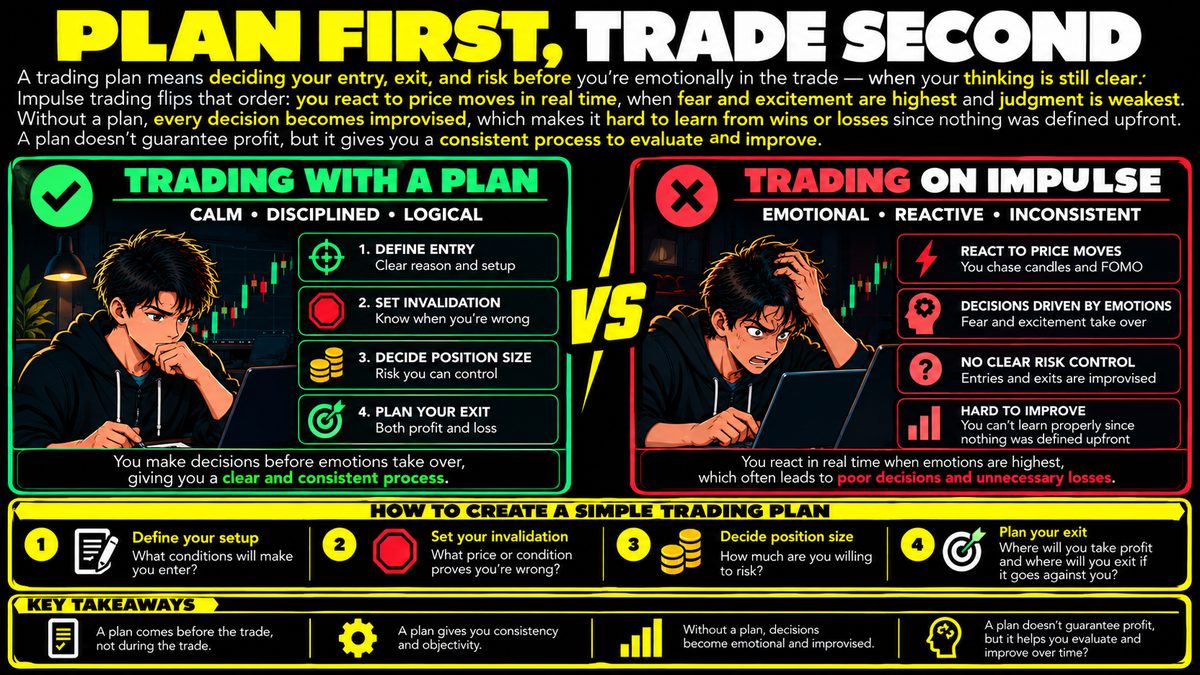
A trading plan means deciding your entry, exit, and risk before you're emotionally in the trade — when your thinking is still clear. Impulse trading flips that order: you react to price moves in real time, when fear and excitement are highest and judgment is weakest. Without a plan, every decision becomes improvised, which makes it hard to learn from wins or losses since nothing was defined upfront. A plan doesn't guarantee profit, but it gives you a consistent process to evaluate and improve.
What a Trading Plan Actually Is
A trading plan is simply a written set of decisions made before you open a position. It answers a few basic questions in advance: why you are entering, at what price, how much you are risking, where you will exit if the trade goes wrong, and where you will exit if it goes right. None of this requires special software or complex math. It can be a few lines in a notes app. The point is not the format but the fact that the decisions exist before money is on the line, while you can think clearly about probabilities instead of outcomes you are currently living through.
How Impulse Trading Creeps In
Impulse trading happens when price movement itself becomes the trigger for action. A coin jumps ten percent and you buy because it feels like it is "going somewhere." It drops and you sell because watching the number fall is uncomfortable. In both cases, the decision is being made by the chart in real time, not by anything you reasoned out beforehand. This matters because the moments when price is moving fast are exactly the moments when fear of missing out or fear of loss are strongest, and those emotions narrow your thinking. Under that kind of pressure, people tend to shorten their time horizon, ignore risk, and justify decisions after the fact rather than before.
Why Planning Ahead Changes the Outcome
When entry, exit, and risk are defined in advance, a trade becomes something you can evaluate on its own terms. Imagine deciding beforehand that you will risk a small, fixed amount, exit if the price falls to a certain level, and take profit at another level if it rises. Whether the trade wins or loses, you can look back and ask whether the plan itself was reasonable, separate from the emotional experience of watching it unfold. Without that structure, every trade is improvised, and improvised decisions are hard to learn from because there was no original intention to compare the outcome against. Over time, undefined trading tends to produce a pattern where small gains are taken too early out of nervousness and small losses are allowed to grow out of hope, which is the opposite of what most durable approaches aim for.
Common Mistakes Even With a Plan
Having a plan does not remove the temptation to abandon it. A common mistake is moving a stop loss further away once price approaches it, effectively rewriting the rules mid-trade because the original outcome is no longer comfortable. Another is treating a plan as rigid wisdom instead of a hypothesis, holding onto a position long after the original reason for entering has clearly stopped applying. Plans also fail when they are too vague, such as "sell when it feels like enough," which is not really a defined exit at all. A workable plan needs specific, observable conditions, not feelings.
Where This Fits With Risk Management
A trading plan is not a prediction tool and it does not improve your odds of picking the right direction. Its value is procedural. It fits alongside other risk management habits like limiting how much of your capital is exposed to any single trade, accounting for the possibility that any individual trade can lose regardless of how good the reasoning was, and keeping records so patterns in your own behavior become visible over time. No plan, indicator, or pattern guarantees a profitable outcome, and claims that suggest otherwise should be treated with skepticism. What a plan offers instead is a consistent process, one that lets you separate the quality of your decision-making from the randomness of any single result, and improve the former over time.