
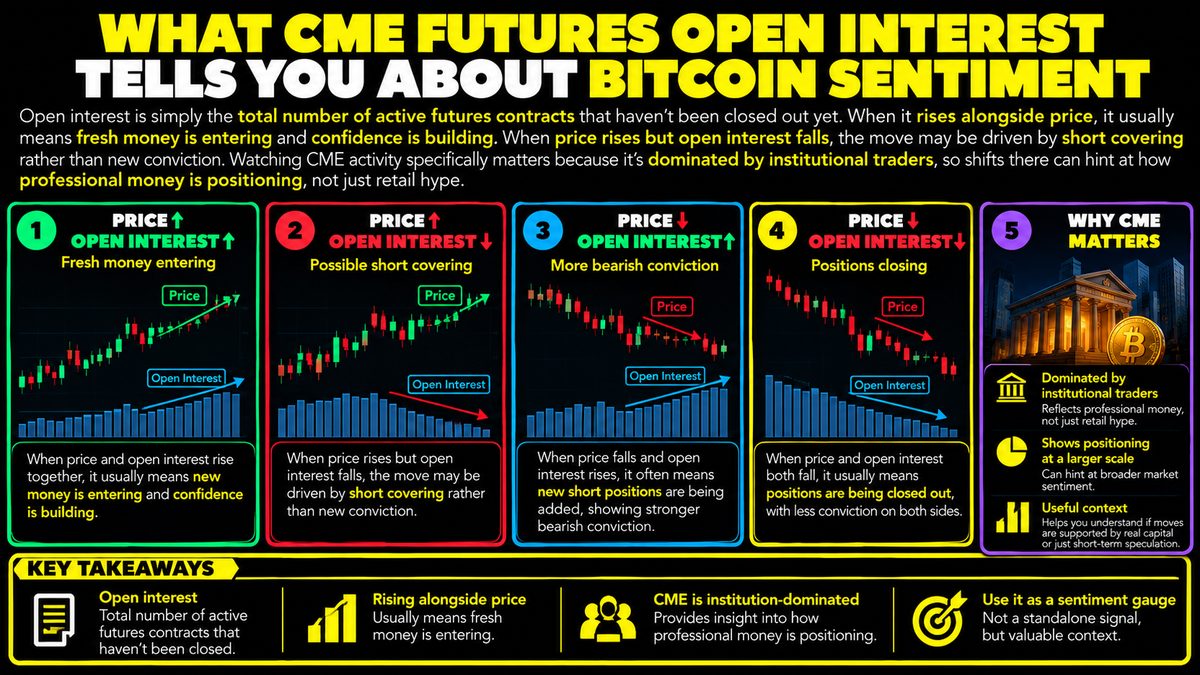
Open interest is simply the total number of active futures contracts that haven't been closed out yet. When it rises alongside price, it usually means fresh money is entering and confidence is building. When price rises but open interest falls, the move may be driven by short covering rather than new conviction. Watching CME activity specifically matters because it's dominated by institutional traders, so shifts there can hint at how professional money is positioning, not just retail hype.
What Open Interest Actually Measures
Open interest is a running total of how many futures contracts are currently open, meaning they haven't yet been closed, settled, or offset by an opposite trade. A futures contract is simply an agreement to buy or sell an asset at a set price on a future date, used here to speculate on or hedge against Bitcoin's price without owning the coin itself. Every time a new contract is created, open interest goes up by one. Every time an existing contract is closed out, it goes down by one. It is different from trading volume, which just counts how many contracts changed hands in a day regardless of whether positions were opened or closed.
Because open interest tracks the stock of active bets rather than the flow of trades, it works as a rough gauge of how much capital and conviction is sitting behind the current price level. A market with low open interest can move sharply on relatively little money, while a market with high open interest usually needs more volume to shift meaningfully, since more participants have to be convinced to act.
Why CME Specifically
CME is a regulated derivatives exchange historically used mostly by institutions, funds, and professional trading desks, as opposed to many crypto-native futures venues that attract a larger share of retail traders. This doesn't make CME activity automatically more correct, but it does give a different lens. Changes in CME open interest can hint at how larger, often more risk-managed participants are positioning, which some traders find useful to compare against sentiment on retail-heavy platforms.
Reading Price and Open Interest Together
The basic logic is that price and open interest can confirm or contradict each other. If price rises and open interest rises too, it generally suggests new money is entering with fresh long positions, which is often read as building conviction behind the move. If price rises while open interest falls, it may mean traders who had bet against the market are being forced to buy back their positions to exit, a process called short covering, rather than genuinely new buying interest appearing.
The reverse also applies. Falling price alongside rising open interest can suggest fresh short positions are being added, while falling price with falling open interest may just reflect existing longs exiting rather than aggressive new selling. None of these readings are rules, only common interpretations that can fail depending on context.
Common Mistakes and Limitations
A frequent error is treating open interest changes as a standalone signal rather than one input among many. Open interest doesn't tell you who is long or short, only that a position exists, so it cannot reveal sentiment direction on its own, it has to be paired with price action. It also says nothing about leverage levels, trader experience, or intent, meaning the same open interest figure can represent very different risk profiles at different times.
Another limitation is that open interest data can lag or be reported with delay, and interpreting short-term spikes without context can lead to overreacting to noise rather than genuine shifts in positioning.
Fitting It Into a Broader Approach
Open interest is best treated as background context rather than a trigger for action. Traders who use it typically combine it with price trends, volume, funding rates on perpetual contracts, and broader market structure before forming any view. Because no single data point, including open interest, can reliably predict future price movement, risk management practices like position sizing and predefined risk limits remain essential regardless of what any indicator suggests. This guide is educational only and not financial advice.