
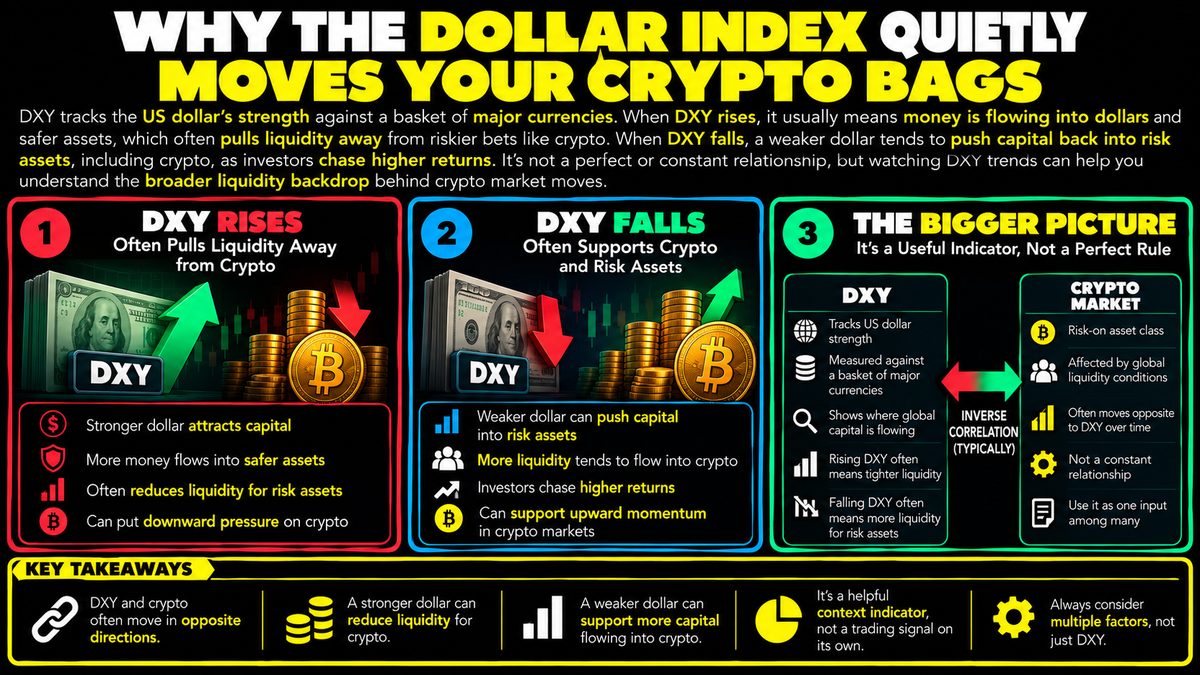
DXY tracks the US dollar's strength against a basket of major currencies. When DXY rises, it usually means money is flowing into dollars and safer assets, which often pulls liquidity away from riskier bets like crypto. When DXY falls, a weaker dollar tends to push capital back into risk assets, including crypto, as investors chase higher returns. It's not a perfect or constant relationship, but watching DXY trends can help you understand the broader liquidity backdrop behind crypto market moves.
What the Dollar Index Actually Measures
The Dollar Index, often shortened to DXY, is a number that tracks how strong the US dollar is compared to a basket of other major currencies, such as the euro, the yen, and the British pound. It does not measure the dollar's value in some absolute sense, only its strength relative to that basket. When DXY climbs, it means the dollar is gaining ground against those currencies. When it falls, the dollar is losing ground. Traders across many markets, not just crypto, watch it as a quick snapshot of global demand for dollars.
Why Dollar Strength Matters for Risk Assets
The dollar is the base currency for most global trade, debt, and savings. When demand for dollars rises, often because investors want safety or because borrowing costs in dollars are increasing, money tends to flow out of riskier, more speculative assets and into cash or dollar-denominated instruments. Crypto, being one of the more volatile and speculative corners of the market, is often grouped with other risk assets like growth stocks. So when DXY rises, it can coincide with reduced appetite for risk, and crypto sometimes sees selling pressure or reduced buying interest. When DXY falls, the opposite dynamic can play out, with cheaper dollar financing and lower safety demand encouraging capital to chase higher returns in riskier places, crypto included.
How Traders Commonly Use DXY
Rather than trading DXY directly, most crypto traders treat it as background context, a way of gauging the broader liquidity environment. For example, imagine a trader notices DXY has been climbing steadily for several weeks while a coin they hold has been drifting lower without any coin-specific news. They might interpret this as part of a wider risk-off mood rather than something unique to that asset. Conversely, if DXY starts trending downward, some traders see it as a tailwind that could support risk assets generally, without predicting any specific price outcome. Some also watch for sharp reversals in DXY, since sudden shifts in dollar strength can sometimes line up with sudden shifts in crypto sentiment, though the timing is never exact or guaranteed.
Common Mistakes and Limitations
A frequent mistake is treating the DXY-crypto relationship as a fixed rule, like a lever that always moves crypto in the opposite direction. In reality, the correlation is loose and changes over time. There are stretches where crypto and the dollar move together, stretches where they move oppositely, and stretches where crypto seems to ignore DXY entirely and trade on its own news, such as regulatory headlines or network events. Relying on DXY alone to time entries or exits ignores all the other forces acting on crypto prices, including sentiment, liquidity specific to crypto markets, and supply and demand within individual coins. No index or indicator, including DXY, can reliably predict future price moves.
Fitting DXY Into a Broader Toolkit
DXY works best as one input among several, not a standalone signal. Combining it with other macro indicators, such as interest rate expectations or broader stock market trends, along with crypto-specific analysis like on-chain activity or trading volume, gives a fuller picture than watching any single metric in isolation. Because the relationship between DXY and crypto can weaken or even flip over different periods, it is worth treating it as a loose backdrop rather than a trading trigger. As with any approach to markets, sound risk management, such as not overexposing a portfolio to a single assumption about macro conditions, matters more than trying to perfectly read any one indicator.