
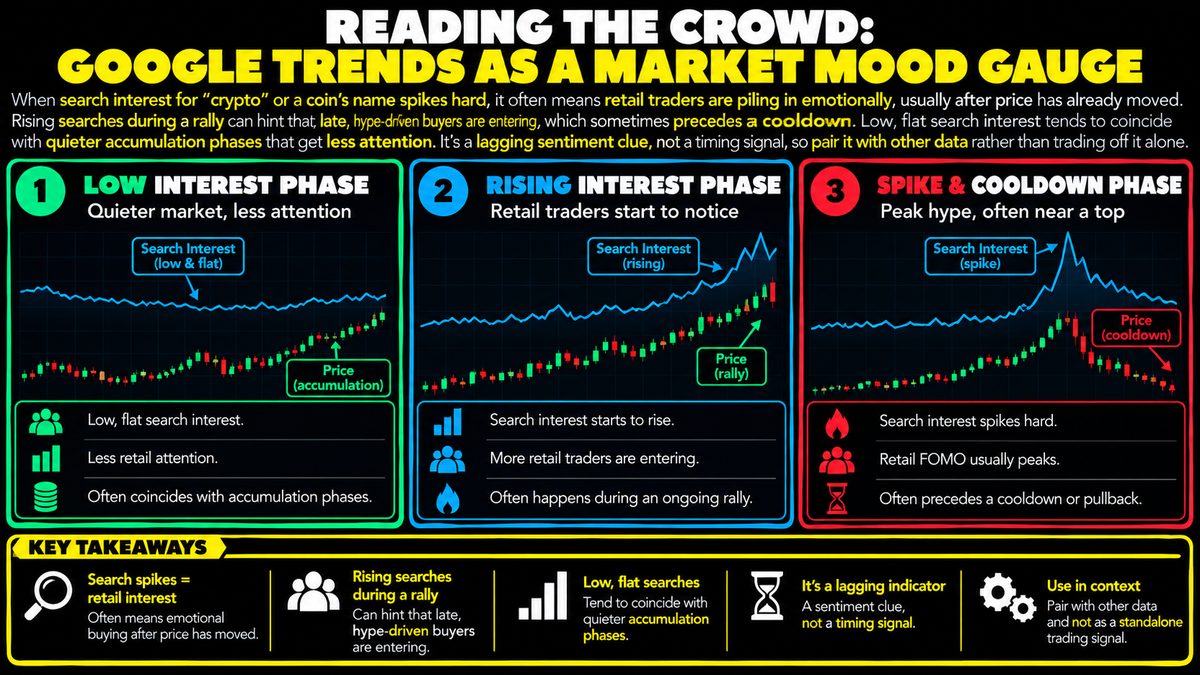
When search interest for "crypto" or a coin's name spikes hard, it often means retail traders are piling in emotionally, usually after price has already moved. Rising searches during a rally can hint that late, hype-driven buyers are entering, which sometimes precedes a cooldown. Low, flat search interest tends to coincide with quieter accumulation phases that get less attention. It's a lagging sentiment clue, not a timing signal, so pair it with other data rather than trading off it alone.
What Search Interest Actually Measures
Search trend data tracks how often people type a given word or phrase into a search engine relative to its own history. It does not measure how many people bought something, how much money moved, or what anyone's opinion was. It simply shows curiosity, or need for information, rising and falling over time. When applied to crypto, a spike in searches for "crypto" or a specific coin's name generally means more people are becoming aware of it or wondering what is happening with it, often because they already heard about a price move somewhere else.
This distinction matters because search data is a secondhand signal. It reflects attention, not conviction, and attention can come from completely different sources: news coverage, social media chatter, a friend's comment, or simple boredom. Treating it as a direct measure of buying or selling pressure is a common misunderstanding worth avoiding from the start.
How the Pattern Typically Forms
In most cycles, price moves first. A coin rallies, someone notices, and only after that does search interest start climbing as newcomers try to learn what it is or whether it is still worth looking at. This is why search spikes are usually described as a lagging indicator, something that confirms a move has already been happening rather than something that predicts one is about to start.
During quiet periods, search volume tends to stay low and flat. Fewer people are curious because there is less visible price action to talk about. Ironically, these quieter stretches are sometimes when more patient, less emotional positioning happens, simply because there is less noise and less urgency in the crowd.
How Traders Commonly Use It
Some traders watch for a sharp jump in search interest during an ongoing rally as a rough proxy for late, hype-driven participation entering the market. The idea is that when a trend has already attracted a wave of newcomers searching the basics, much of the easy enthusiasm may already be spent, which can sometimes precede a slowdown or pullback. Others use persistently low search interest as a loose cue that a market segment is being ignored, which does not mean it is attractive, only that it is quiet.
None of this is used as a standalone trigger. It usually gets layered alongside price charts, volume data, or broader market sentiment readings to see whether multiple signals are pointing in a similar direction.
Common Mistakes and Limitations
A frequent error is treating a search spike as a precise top or bottom signal. It is not. Search data is noisy, delayed, and shaped by factors having nothing to do with trading, like unrelated news stories reusing the same word. It also cannot distinguish between someone searching because they want to learn, warn others, or criticize, versus someone searching because they are excited to buy.
Regional and language differences, changes in how people search over time, and the fact that major moves can happen with very little search attention at all are further limitations. A coin can be heavily traded by experienced participants without ever trending in search engines.
Fitting It Into a Broader Approach
Search trend data works best as one small piece of context rather than a decision-making tool on its own. Pairing it with price action, risk management rules such as position sizing and predefined exit points, and a clear understanding that no indicator guarantees an outcome is far more reliable than reacting to a single spike in curiosity. Markets are shaped by far more than how many people typed a word into a search bar that week.