
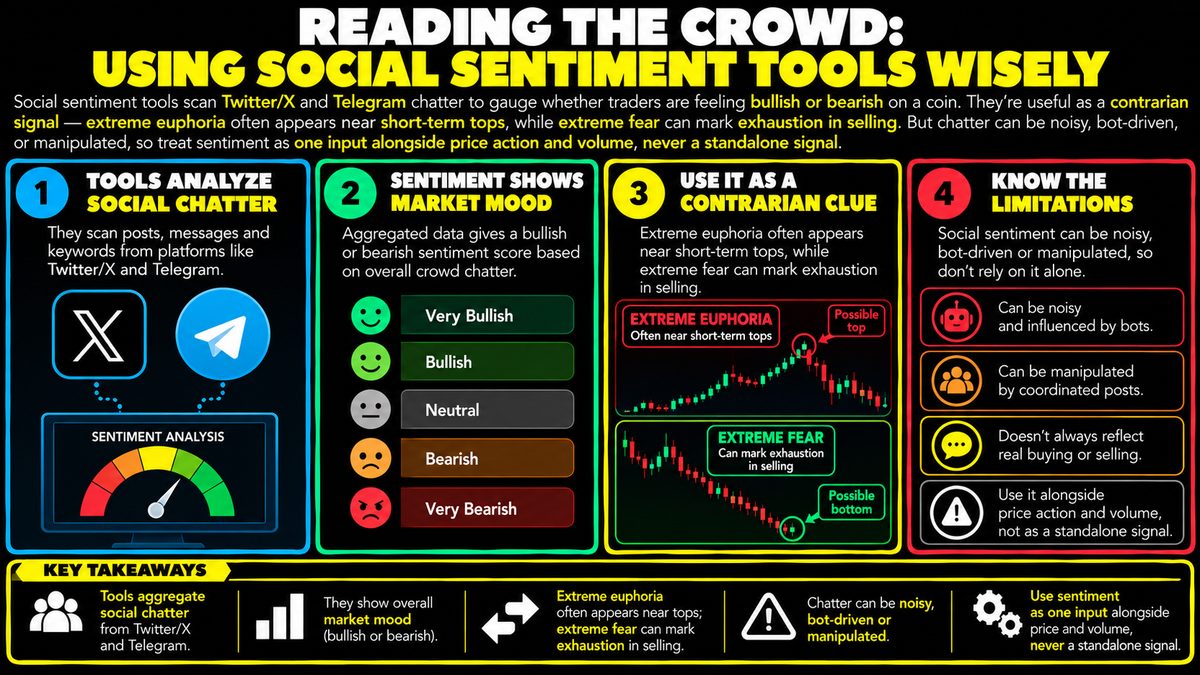
Social sentiment tools scan Twitter/X and Telegram chatter to gauge whether traders are feeling bullish or bearish on a coin. They're useful as a contrarian signal — extreme euphoria often appears near short-term tops, while extreme fear can mark exhaustion in selling. But chatter can be noisy, bot-driven, or manipulated, so treat sentiment as one input alongside price action and volume, never a standalone signal.
What Sentiment Tools Actually Measure
Social sentiment tools work by scanning large volumes of public posts on platforms like Twitter/X or Telegram and running them through language-processing software that tries to classify each post as bullish (expecting prices to rise), bearish (expecting prices to fall), or neutral. The results are usually compressed into a single score or a simple gauge, something like a dial that swings between "extreme fear" and "extreme greed," or a percentage of posts that sound optimistic versus pessimistic about a given coin.
It is important to understand that these tools are not reading minds or verifying trading positions. They are reading words. A person can type something bullish while actually planning to sell, or post sarcastically, and the software may still count it as a bullish signal. The output is a rough approximation of mood, not a precise measurement of what the crowd is actually doing with their money.
Why Extremes Matter More Than the Middle
Most of the time, sentiment readings sit somewhere in a moderate range and are not especially useful on their own. The signal traders pay more attention to is when sentiment reaches an extreme. Imagine a coin where nearly every post mentions huge upside and almost nobody expresses doubt. Historically, in markets generally, periods of near-universal optimism have often coincided with a market that has already absorbed most of the buying it is going to get, leaving fewer new buyers to push prices further. The same logic works in reverse: when sentiment is overwhelmingly negative and despair is widespread, it can suggest that most people who wanted to sell already have, which sometimes precedes a pause or bounce.
This is why sentiment is often described as a contrarian tool, meaning it is sometimes used to lean against the prevailing mood rather than with it. But "sometimes" is the key word. Extreme optimism can also appear in the middle of a strong uptrend that continues for a long time afterward, and extreme fear can persist through a prolonged decline. There is no fixed threshold where a reading guarantees a turning point.
The Noise Problem
Social platforms are full of automated accounts, coordinated posting campaigns, and paid promotion, especially around smaller or lesser-known coins. A sudden spike in bullish chatter might reflect genuine excitement, or it might reflect a small group of accounts posting repeatedly to create an impression of momentum. Sentiment tools generally cannot fully distinguish organic enthusiasm from manufactured hype, which means a reading can be misleading exactly when it looks most dramatic.
Language itself adds further noise. Sarcasm, memes, and inside jokes common in crypto communities are easy for software to misclassify. A post mocking a coin's price could be tagged as bullish simply because it contains optimistic-sounding words.
Using Sentiment Alongside Other Tools
Because of these weaknesses, sentiment readings are generally more useful as a secondary confirmation rather than a primary trigger. Traders who use them often look for sentiment extremes to line up with something happening in price action, such as a stalling rally on falling volume, or a sharp decline that shows signs of slowing down. Volume, in particular, offers a check on sentiment: if euphoric chatter is not accompanied by strong buying volume, the optimism may be shallower than it appears.
Common Mistakes and Limits
A frequent mistake is treating a single extreme reading as a standalone signal to act on immediately, without considering the broader trend or other confirming evidence. Another is ignoring how thin the data can be for smaller coins, where a handful of accounts can swing the score. Sentiment tools are best treated as one input among several, filtered through sound risk management, and never as a guarantee of what will happen next.