
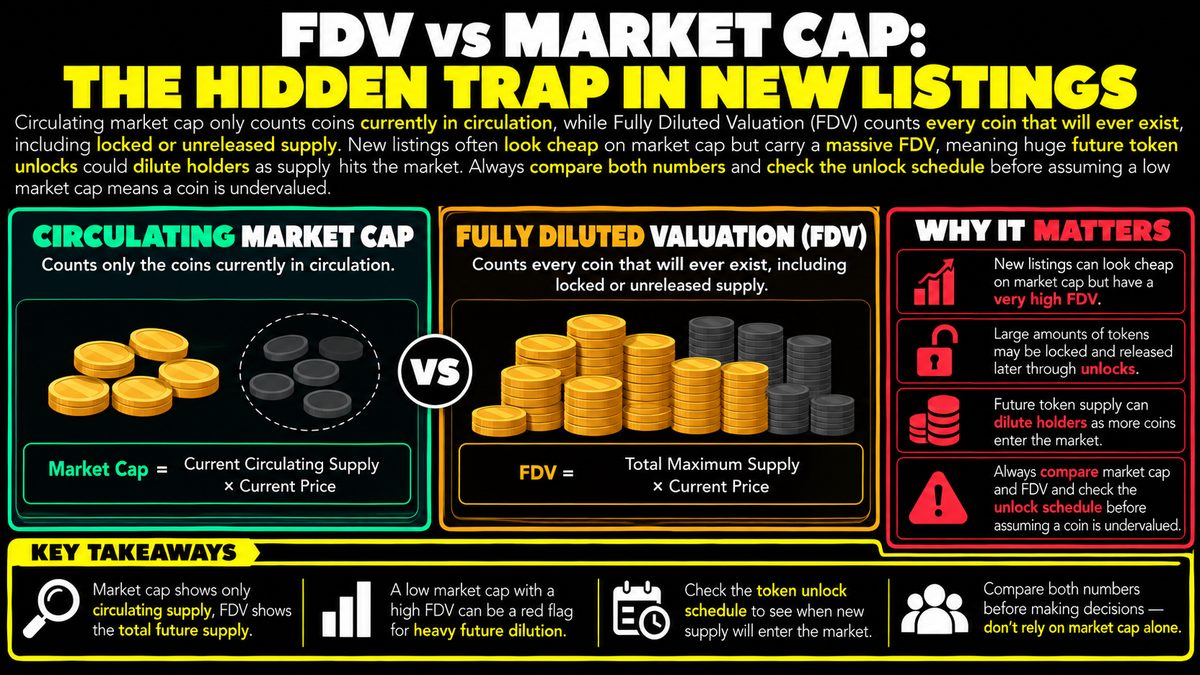
Circulating market cap only counts coins currently in circulation, while Fully Diluted Valuation (FDV) counts every coin that will ever exist, including locked or unreleased supply. New listings often look cheap on market cap but carry a massive FDV, meaning huge future token unlocks could dilute holders as supply hits the market. Always compare both numbers and check the unlock schedule before assuming a low market cap means a coin is undervalued.
What Market Cap Actually Measures
Market capitalization, usually shortened to market cap, is calculated by multiplying a coin's current price by its circulating supply, meaning the number of coins that are already out and tradable right now. If a hypothetical coin trades at 1 and has 10 million coins circulating, its market cap is 10 million. This number is useful because it reflects the value of what is actually available to buy and sell today, similar to how a company's stock market value reflects shares currently trading, not shares that might be issued later.
The key limitation is right there in the definition: circulating supply ignores anything not yet released. Many crypto projects reserve large portions of their total token supply for the team, early investors, treasury funds, or future rewards. Those tokens exist on paper, often locked by smart contracts or vesting agreements, but are not counted in market cap because they are not yet circulating.
What Fully Diluted Valuation Adds
Fully Diluted Valuation, or FDV, takes the current price and multiplies it by the maximum total supply that will ever exist, including every locked, reserved, or unminted coin. Using the same hypothetical coin priced at 1, if its eventual total supply will be 100 million coins instead of 10 million, the FDV would be 100 million, ten times higher than the market cap.
FDV essentially answers the question, what would this coin be worth today if every single token that will ever exist were already circulating and priced the same. It is a forward-looking, theoretical figure rather than a snapshot of present value.
Why New Listings Are Especially Risky Here
Newly listed tokens frequently show a tiny circulating supply compared to their total planned supply. This can make the market cap look small and tempting, almost as if the coin is undervalued or has room to grow. But if the FDV is dramatically larger than the market cap, it often means a huge wave of additional tokens is scheduled to enter circulation over time, through vesting unlocks for team members, investors, or ecosystem incentives.
When those locked tokens unlock and holders become free to sell, the increased supply can place downward pressure on price, a process often called dilution. The coin was never undervalued in a simple sense, it was simply early in its supply release schedule.
Reading the Unlock Schedule
Serious researchers look beyond the two headline numbers and check a project's token unlock schedule, which outlines when and how much supply gets released, often found in a project's documentation or tokenomics page. A schedule with large unlocks concentrated in the near future carries different risk than one with unlocks spread gradually over many years.
It also matters who receives the unlocked tokens. Unlocks going mainly to long-term ecosystem grants behave differently than unlocks going to early investors who bought at a much lower price and may be motivated to sell quickly once they can.
Common Mistakes and How This Fits Your Risk Management
A common mistake is comparing only market caps across different coins without checking FDV, which can make a high-FDV coin look artificially cheaper than a coin with a similar or smaller true future supply. Another mistake is assuming a large gap between market cap and FDV automatically means a price crash is coming, when in reality the impact depends on unlock timing, demand growth, and how the tokens get distributed.
Neither market cap nor FDV is a guarantee of anything, and no single metric predicts future price. Treat them as context, not conclusions. Combining this supply analysis with other research, position sizing, and a clear understanding of your own risk tolerance is a more balanced approach than relying on any one number before forming a view.