
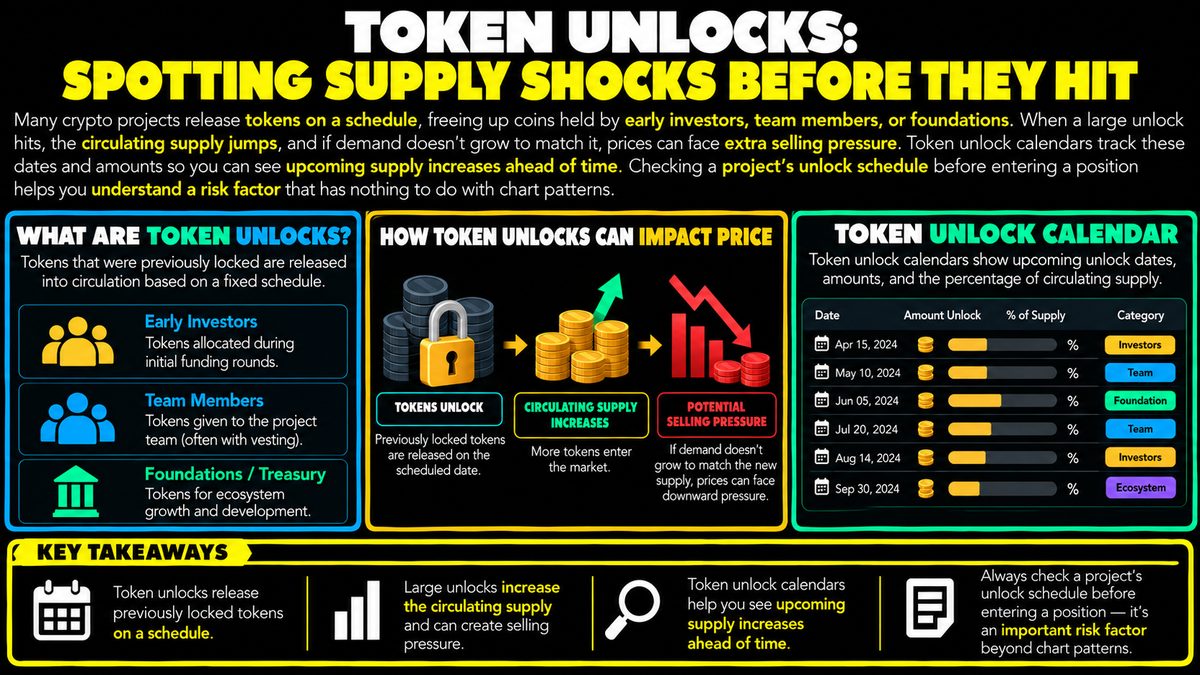
Many crypto projects release tokens on a schedule, freeing up coins held by early investors, team members, or foundations. When a large unlock hits, the circulating supply jumps, and if demand doesn't grow to match it, prices can face extra selling pressure. Token unlock calendars track these dates and amounts so you can see upcoming supply increases ahead of time. Checking a project's unlock schedule before entering a position helps you understand a risk factor that has nothing to do with chart patterns.
What a token unlock actually is
When a crypto project launches, not every coin that will ever exist is usually available to trade right away. A large portion is often locked up and promised to specific groups, such as the founding team, early private investors, or a foundation that manages the project's treasury. These coins are released later according to a predetermined schedule, a process generally called vesting. A token unlock is simply the moment when a batch of those previously locked coins becomes available to move, sell, or transfer.
Circulating supply is the number of coins actually available in the market at a given time, as opposed to total supply, which includes coins that exist but aren't yet freely tradable. An unlock increases circulating supply instantly, even if none of the newly freed coins are sold immediately. Whether that matters depends heavily on how large the unlock is relative to the existing circulating supply, and on who is receiving the coins.
Why unlocks can create selling pressure
The basic economic idea is straightforward. If the number of coins available to trade jumps and buyer demand does not increase by a similar amount, there are simply more coins competing for the same pool of buyers, which can push prices down. This is often called a supply shock. It's a mechanical, structural pressure rather than something driven by news or sentiment, which makes it different from most other price drivers.
It's worth emphasizing that an unlock does not guarantee a price drop. Early investors or team members may choose to hold their newly unlocked coins rather than sell, especially if they believe in the project's long-term direction. Demand from new buyers can also rise around the same period for unrelated reasons, absorbing the extra supply. The unlock creates a condition where selling pressure could increase, not a certainty that it will.
Using unlock calendars as a research tool
Several independent websites and data trackers compile unlock schedules for various projects, listing upcoming dates, the size of each unlock in coins and in percentage of circulating supply, and which group of holders receives them. Checking this kind of calendar before entering a position lets a trader see a known, scheduled risk factor in advance, rather than being surprised by a sudden supply increase.
A useful habit is comparing the unlock size to average daily trading volume, not just to total supply. A large unlock relative to a thinly traded token with low daily volume carries more potential impact than the same percentage unlock on a heavily traded token, because the market has less natural capacity to absorb new sellers.
Common mistakes and limitations
A frequent mistake is assuming every unlock leads to a predictable price decline and trying to time trades purely around the calendar date. Markets often react in advance, with prices drifting down in the days or weeks before an unlock as traders anticipate it, meaning the actual unlock date itself may show little additional movement. Relying only on the calendar date without considering this anticipation effect can lead to poorly timed decisions.
Another limitation is that unlock data only shows scheduled supply changes, not what recipients will actually do with their coins. There is no way to know for certain whether a team or investor will sell immediately, sell gradually, or hold.
Fitting unlocks into a broader approach
Token unlock schedules work best as one input among several, alongside trading volume, broader market conditions, and a trader's own risk tolerance. No calendar, chart pattern, or indicator can guarantee an outcome, and treating unlock data as a certainty rather than a probability is itself a risk. Using position sizing and predefined risk limits remains important regardless of what any single data point suggests.